Japan is moving closer to testing hypersonic missiles on Australian soil, the latest sign that Tokyo and Canberra, both increasingly worried about a conflict over Taiwan, are building what a leading US think tank describes as an alliance in all but name.
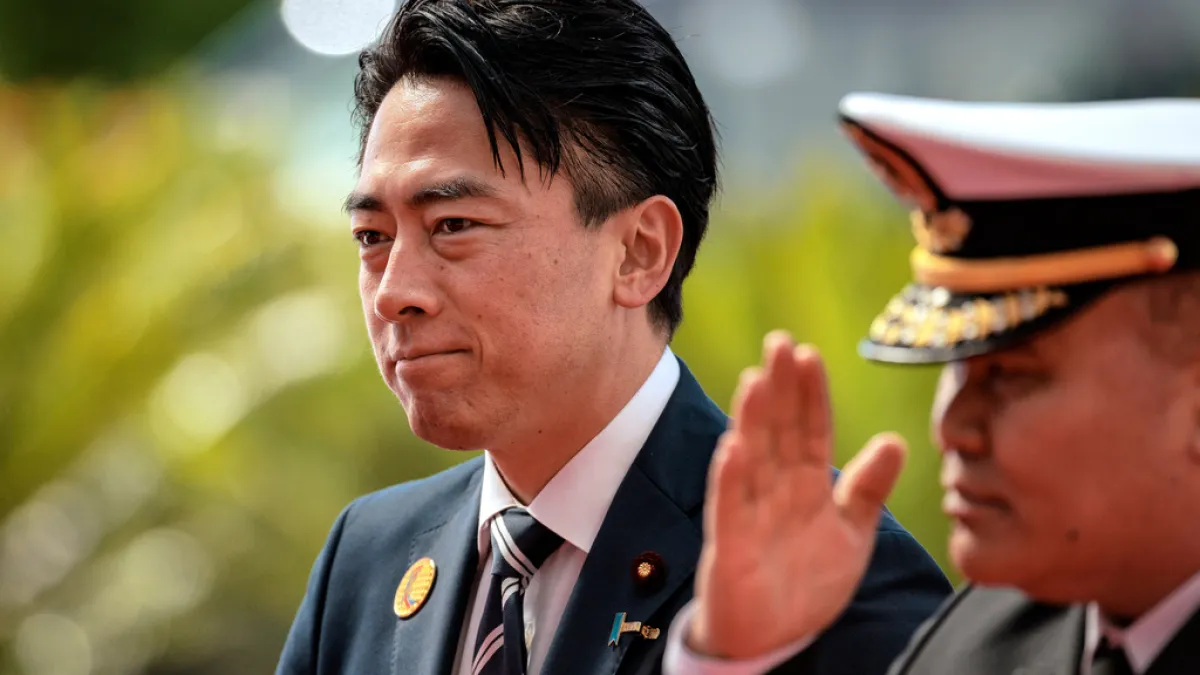
Japanese Defense Minister Shinjiro Koizumi and Richard Marles, Australia's deputy prime minister and defense minister, confirmed during talks in Cebu, Philippines, on October 29, 2026, that Japan sent a survey team to Australia in September to assess local military ranges for hypersonic missile tests. The two sides agreed to keep coordinating toward live tests of Japanese long-range weapons in Australia.
The meeting came a day after the Hudson Institute published "Australia and Japan: Formalizing an Informal Alliance," a report by senior fellow James J. Przystup. After more than 20 years of defense cooperation, he writes, the relationship is "functionally an alliance in everything but" a formal mutual defense pledge like NATO's Article 5.
China's Reach Pulls Two Distant Partners Together
Thousands of kilometers separate Japan and Australia, but their security interests have converged as China's navy and air force operate farther from home.
Australia's wake-up call came from the South Pacific. In 2022, China signed a security agreement with the Solomon Islands that opened the way for Chinese security personnel to deploy there and for Chinese warships to make port calls. In February 2025, Chinese navy vessels announced live-fire drills off Australia's east coast, forcing some commercial flights to reroute.
For Japan, the pressure is closer to home. During China's large-scale military drills around Taiwan in August 2022, several ballistic missiles landed in waters Japan claims as its exclusive economic zone. Later that year, Japan's National Security Strategy labeled China its greatest strategic challenge ever, while its National Defense Strategy called for building, under the Special Strategic Partnership with Australia, the closest cooperation Japan has with any country after the United States.
Przystup also points to Washington. US demands that allies carry more of the defense burden, together with the Trump administration's transactional approach to foreign policy, have pushed Tokyo and Canberra to work directly with each other and rely less on one-way American military support. Both remain US treaty allies, and their bilateral links now let America's two main Indo-Pacific partners coordinate without routing everything through Washington.
Tokyo Fears For Its Islands, Canberra For Its Sea Lanes
The two countries watch the Taiwan Strait for different reasons. Japan faces the risk that fighting around Taiwan could spill directly onto its territory, particularly its southwestern islands, the Nansei chain that stretches toward Taiwan. Australia's concern is that a wider war would upend the regional balance of power and choke the shipping lanes its trade depends on.
Australia's 2024 National Defence Strategy states plainly that the risk of a crisis or conflict in the Taiwan Strait is rising, alongside other potential flashpoints in the South China Sea, the East China Sea, and on the China-India border. Both governments now treat preventing any change to the status quo by force as part of their security policy.
That shared concern has been written into a series of agreements. In October 2022, the two countries updated their Joint Declaration on Security Cooperation, pledging to consult on contingencies that affect their sovereignty or regional security interests and to consider measures in response.
In December 2025, Koizumi and Marles launched the Framework for Strategic Defense Coordination (FSDC), placing defense policy, intelligence, bilateral and multilateral military activities, defense industry and technology, and capabilities including space, cybersecurity, and integrated air and missile defense under a single mechanism led by the two defense ministers. Their joint statement called peace and stability across the Taiwan Strait essential to regional and international security and prosperity, opposed any unilateral change to the status quo by force or coercion, and urged a peaceful resolution of cross-strait issues through dialogue.
From Missile Data Sharing To Hypersonic Test Ranges
Cooperation has moved well beyond routine military exchanges and now reaches intelligence systems, long-range weapons, troop deployments, and naval hardware.
- Missile warning and data sharing: According to the Japanese Defense Ministry's readout of a Japan-US defense ministers' meeting released on May 30, 2026, the two countries welcomed an agreement among Japan, the US, and Australia on information sharing for a networked air and missile defense architecture. Its future operation was named TRISHIP, short for Trilateral Air/Surface/Missile Information Sharing in the Indo-Pacific, and it will let the three countries exchange data on air, surface, and missile threats.
- Hypersonic missile tests: In August 2026, Japan and Australia agreed to work toward Japanese use of Australian military test ranges for next-generation long-range precision strike weapons, including hypersonic missiles. Australia's vast ranges can support Japan's development of standoff strike capability, the ability to hit targets from beyond the reach of enemy air defenses.
- F-35 training: From July to August 2026, Japan sent F-35 fighters and other air assets to Australia for the trilateral Exercise Southern Cross and the multinational Exercise Pitch Black. Marles said on August 18 that the Japanese F-35s had spent nearly two months around Darwin, strengthening coordination between the two air forces.
- Frigate deal: Australia has chosen Japan's upgraded Mogami-class frigate and plans to buy 11, with the first due in 2029. Hudson notes that Mitsubishi Heavy Industries will build the first three in Japan and the remaining eight will be built at Henderson in Western Australia. The two countries will also build maintenance and support capacity, giving Japan's defense industry a long-term role in Australia's naval buildup.
Japan is also moving missile units closer to Taiwan. During its record Keen Sword drills with the US, missiles were positioned 110 kilometers from the island.
Hudson Urges Joint War Planning And A Path To Five Eyes
As cooperation deepens, Przystup argues that the next step is concrete scenario planning: working out each side's capabilities, division of responsibilities, and force deployments in different crises, and doing the same in trilateral planning with the US.
He also calls on Japan to build a stronger system for protecting classified intelligence, which would open the door to eventual membership in Five Eyes, the intelligence-sharing network of the US, the United Kingdom, Australia, Canada, and New Zealand.
Taiwan Contingency Timeline
For the full story of the Japan-China standoff since Prime Minister Sanae Takaichi's remarks in parliament in November 2025, see our continuously updated timeline.
(Related:
What Is a 'Taiwan Contingency'? A Timeline of the Japan-China Standoff Over Takaichi's Remarks
|
Latest
)