Chinese companies, universities, and other domestic organizations must now withhold value-added tax (VAT) when they pay individuals for professional work, under rules that took effect on November 1. The change hands the job of collecting the tax to the payer, closing a gap that let much of the income earned by China's freelancers, consultants, and independent designers go unreported.
The rules, issued by the Ministry of Finance and the State Taxation Administration as Announcement No. 28 of 2026, cover seven kinds of services that individuals provide to organizations in China: research and development, software, design, consulting, radio, film, and television production, cultural services, and education. When an organization pays for any of them, it becomes the legal withholding agent and must deduct VAT and related surcharges before the money reaches the worker.
Who Is Covered And How Much Is Withheld
Under the old arrangement, individuals who earned this kind of income were expected to declare and pay VAT themselves. That self-reporting model also applied during a transition period from January 1 to October 31, 2026. In practice, many freelancers either had invoices issued on their behalf or did not file at all, leaving tax authorities with a blind spot.
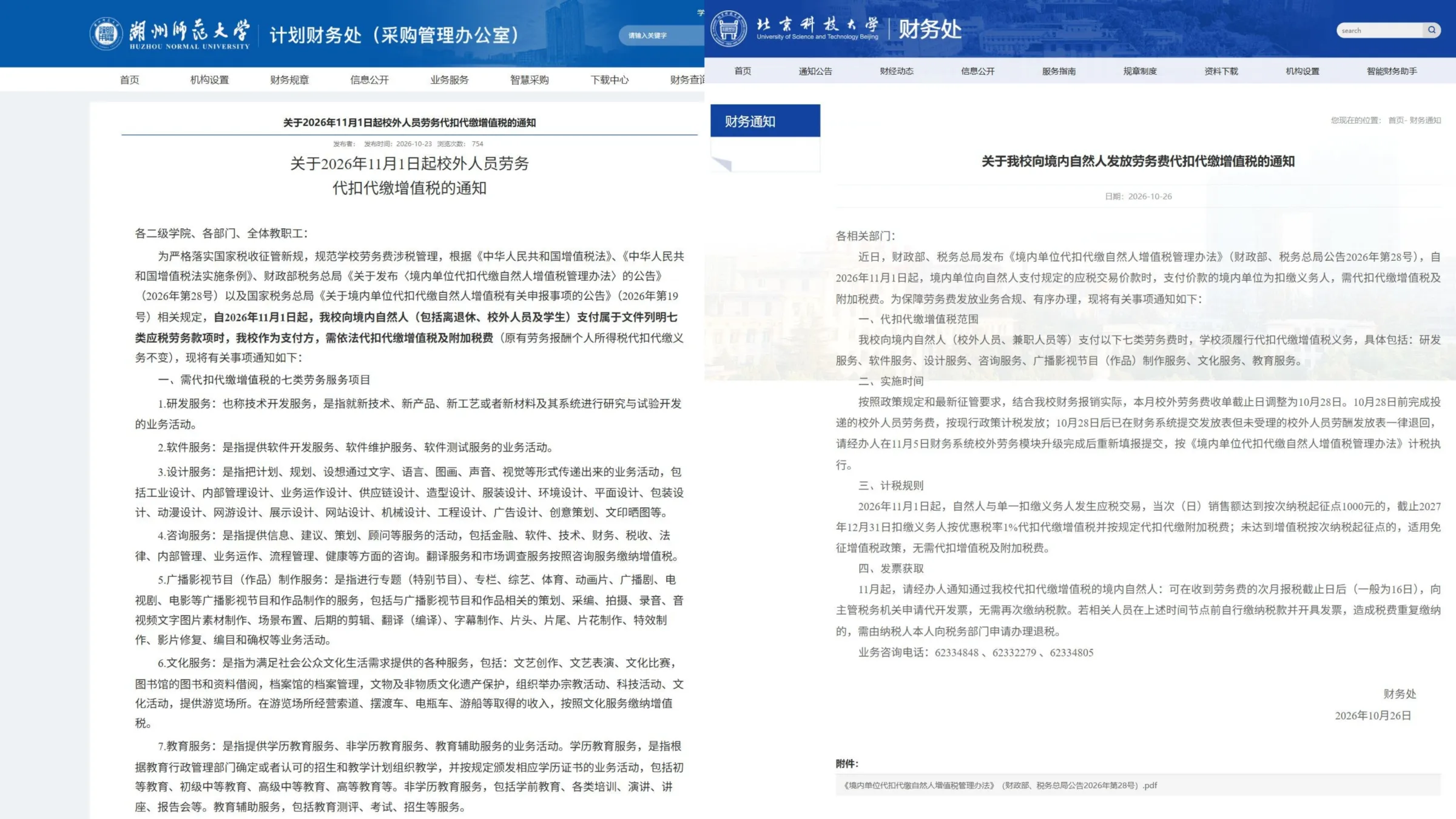
The new system sets a threshold of 1,000 yuan (about US$140) per transaction, or per day, with any single withholding agent. Payments at or above that level are taxed at a preferential rate of 1%, plus surcharges. According to a notice from the University of Science and Technology Beijing, the 1% rate applies until December 31, 2027. Payments below the threshold are exempt from VAT, but organizations must still report them in full.
Gig workers on internet platforms are excluded if the platform already files taxes on their behalf. China's tax authority has said the system rests on the implementing regulations of the country's VAT Law and that specific filing rules will govern the withholding process.
Universities Rewire Their Payment Systems
Institutions inside China's state system have moved first. Universities, design institutes, and consulting agencies have upgraded their finance systems and rewritten the procedures they use to pay outside lecturers, consultants, and other contract workers.
Huzhou Normal University in Zhejiang province told departments that the rules apply to payments to retirees, outside personnel, and students alike. The University of Science and Technology Beijing moved its deadline for submitting outside service fees under the old rules to October 28, and said any claims not processed by then would be returned and must be refiled after its payment system was upgraded on November 5.
For individuals, the effect is immediate: the amount that lands in their accounts is smaller. For the organizations paying them, compliance costs rise, and so does their legal responsibility if the tax is not collected.
China Shifts From Taxing Companies To Taxing Transactions
For decades, China's regulators concentrated on companies, factories, property developers, and financial institutions, along with the payroll of salaried employees. The harder group to track sits between the two: people who earn money as individuals rather than as businesses or employees, from contract workers and independent consultants to photographers, lecturers, and online content creators.
The rise of digital platforms, gig work, and personal brands has made that group far larger. Today a phone, a professional skill, and an online account can add up to a complete business. Bringing those earnings into the VAT withholding system can be read as the tax system's institutional answer to a more individualized economy, moving oversight away from self-declaration and toward collection at the source, with the paying organization doing the work.
Party Discipline Drive Extends To The Tax Office
The rules arrived days after the Communist Party's Central Committee met in Beijing from October 26 to 29 for its Fifth Plenum. The meeting adopted a decision on "persistently advancing full and rigorous Party self-governance," which calls for governing the Party through rules and institutions, strengthening the Party and state oversight system, and integrating Party discipline more deeply into economic and social governance.
China's tax system has long promoted the idea of linking strict governance of the Party with strict administration of taxes. Seen in that light, the withholding rules are a concrete case of more precise and institutionalized collection: an obligation that once depended on individuals' own diligence becomes a legal duty of the organizations that pay them. That reinforces the Party's "cannot be corrupt" safeguards, institutional controls meant to make graft difficult, and shrinks the gray zone in which income went untaxed.
Delivery Riders Double As The State's Eyes
The rules also reflect how quickly China's freelance workforce has grown. Not long ago, people without a so-called stable job risked ridicule from neighbors, relatives, and friends. Freelancing became more fashionable after three years of COVID-19 restrictions, although most people still take the conventional path into state-owned enterprises, whether run by local governments or by Beijing.
On recent reporting trips in China, Storm Media found that many prefecture-level and even county-level cities have opened "Party-mass service centers for new employment groups," aimed at large workforces such as food delivery riders. In some busy commercial districts, riders now act as a kind of "yellow plainclothes" force, a reference to the yellow jackets many riders wear and to the "red armband" volunteers who patrol Beijing's neighborhoods. While delivering meals, they report public order problems and unusual activity to local subdistrict offices, the lowest level of urban government.
From content creators and independent consultants to livestream sellers and outsourced tech workers, more people now take part in the market on the strength of their own skills rather than through a traditional employer. That shift created a particular problem for the state: the freer the work, the harder it was to see where the income came from. Under the new rules, working without a company or a fixed employer no longer means staying off the tax authority's radar. As long as the payer is an organization covered by the system, each transaction is likely to leave a fuller tax record.
New Provincial Chiefs Face A Shrinking Land Revenue Base
The rollout coincides with a wave of leadership changes in China's provinces around the plenum. Anhui, Henan, Shanxi, and Xinjiang have held provincial Party congresses, and the top Party and government posts have changed hands in Hunan, Yunnan, Fujian, Qinghai, Hebei, and Jiangxi, with several officials born after 1965 or 1970 taking office. The reshuffle is widely seen as laying the groundwork for personnel decisions at the Party's 21st National Congress in 2027 while tightening Beijing's political control over the provinces.
In an atmosphere of strict discipline, newly appointed local leaders tend to carry out central policies with extra zeal. Tax collection, which can be measured and used in performance reviews, is an easy way for them to show results. The speed with which universities, research institutes, and state-owned enterprises adjusted their payment procedures suggests that policies are now moving from central documents to grassroots enforcement faster than before.
Fiscal pressure adds urgency. After a prolonged property downturn, strained land finance, and slowing growth, local governments can no longer rely on selling land use rights to fund their budgets. New provincial chiefs are judged not only on GDP but also on debt, jobs, social stability, and fiscal sustainability.
That leaves an open question for Beijing. With land sales unlikely to return to their old role, the new economy of freelancers, platform work, and countless individual transactions may be asked to become a clearer, steadier, and more manageable tax base. Whether it can carry that weight remains to be seen.
(Related:
Beijing Watch | China Moves To Track Down Gig Workers Without Social Insurance, Raising Fears For Small Businesses
|
Latest
)