The opposition Kuomintang (KMT) candidate for mayor of Taichung, Chiang Chi-chen, leads his ruling party rival by 10.2 percentage points, according to a poll released on November 2, 2026, with 26 days to go before voters cast their ballots in the 2026 Taiwan local elections.
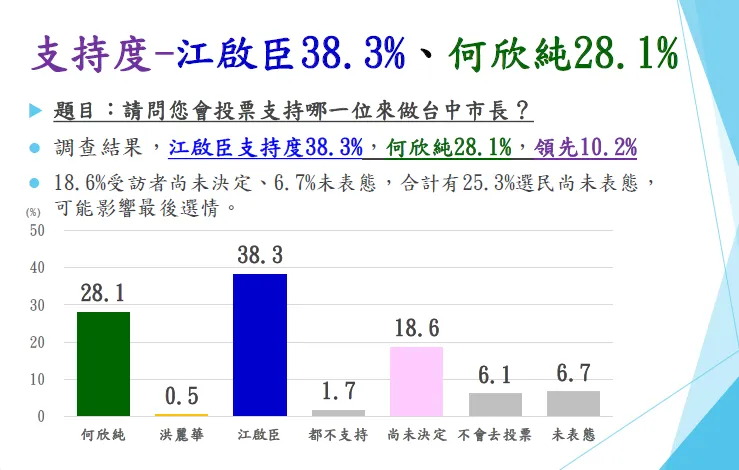
The survey, carried out by the Fo Guang University Poll Center and commissioned by the KMT caucus in the Taichung City Council, put Chiang at 38.3% and Ho Hsin-chun of the ruling Democratic Progressive Party (DPP) at 28.1%. Both candidates are sitting legislators, and Chiang, also known as Johnny Chiang, is a former KMT chairman.
Taichung, Taiwan's second-largest city by population, is governed by KMT Mayor Lu Shiow-yen, who cannot run again after serving two terms. That makes the open seat one of the most closely watched contests of the November 28 elections, in which voters across Taiwan will choose mayors, county magistrates, and local councilors.
Chiang Outpolls Ho On Every Indicator Tested
Beyond voting intention, the poll tested five other indicators, and Chiang came out ahead on every one of them by a double-digit margin.
Asked who was most likely to win, 46.9% of respondents named Chiang and 21.3% named Ho, a gap of more than two to one. On who could best govern the city, Chiang led 38.4% to 24.1%. On who could best steer Taichung's development over the next 10 years or longer, he led 41.7% to 25.5%.
The widest gap came on personal image. Some 45.1% of respondents said they had the most favorable impression of Chiang, compared with 26.9% for Ho, a difference of 18.2 points. When asked to name a candidate without any prompting, 46.4% mentioned Chiang first and 26.9% named Ho, giving Chiang overall unprompted name recognition of 71.0%.
Voters Over 50 And Inland Districts Power Chiang's Lead
Chiang led among both men and women, by 40.3% to 30.2% among male respondents and 36.4% to 26.1% among female respondents. He was also ahead at every education level. His support passed the halfway mark among voters in their 50s and 60s, at 52.7% and 51.2% respectively.
His strongest geographic showing came in Taichung's 8th legislative district, which covers Fengyuan, Shigang, Dongshi, Xinshe, and Heping in the city's inland northeast. There, 56.7% of respondents backed him. He drew 44.9% in the 1st district and 45.4% in the 2nd, both along Taichung's coastal belt, and also outpolled Ho in the 3rd and 4th districts.
Taken together, the breakdown suggests Chiang's base stretches from the foothill towns known locally as the "mountain city" area and the coastal townships to the fast-growing urban districts of Xitun and Nantun.
A Quarter Of Taichung Voters Remain Undecided
The race is far from settled. Some 18.6% of respondents said they had not yet decided and another 6.7% declined to state a preference, a combined 25.3% that outweighs Chiang's current lead. A further 6.1% said they would not vote, 1.7% backed neither candidate, and a minor candidate drew 0.5%.
The survey was also commissioned by the KMT's own council caucus, and other recent polls of the race have produced a wide range of results.
Rival Polls Put The Gap Between 2 And 13 Points
A TVBS Poll Center survey conducted from September 7 to 11, also commissioned by the KMT caucus, put Chiang at 45.1% and Ho at 32.5%, a 12.6-point lead. A poll released on October 12 by the Taichung chapter of the Friends of Lai Ching-te Association, a civic group that supports the DPP, painted a much tighter picture: conducted by Evidence-Based Polling on October 5 and 6, it showed Chiang at 34.3% and Ho at 32.4%, with 32.2% undecided.
Separately, an artificial intelligence voter simulation by TPOC, a Taiwanese research center, released on October 21, gave Chiang 46.2% and Ho 35.5% after undecided virtual voters were pressed on their leanings. That exercise modeled AI-generated voters rather than surveying real residents.
How The Fo Guang University Poll Was Conducted
The Fo Guang University Poll Center interviewed residents registered in Taichung who were aged 20 or older and eligible to vote, using computer-assisted telephone interviewing from October 29 to 31, 2026. It completed 1,003 interviews.
The pollster used stratified random sampling, drawing numbers systematically from telephone directories and randomizing the last two digits. Results were weighted by gender, age, education, and administrative district. The margin of error is plus or minus 3.1 percentage points at a 95% confidence level.