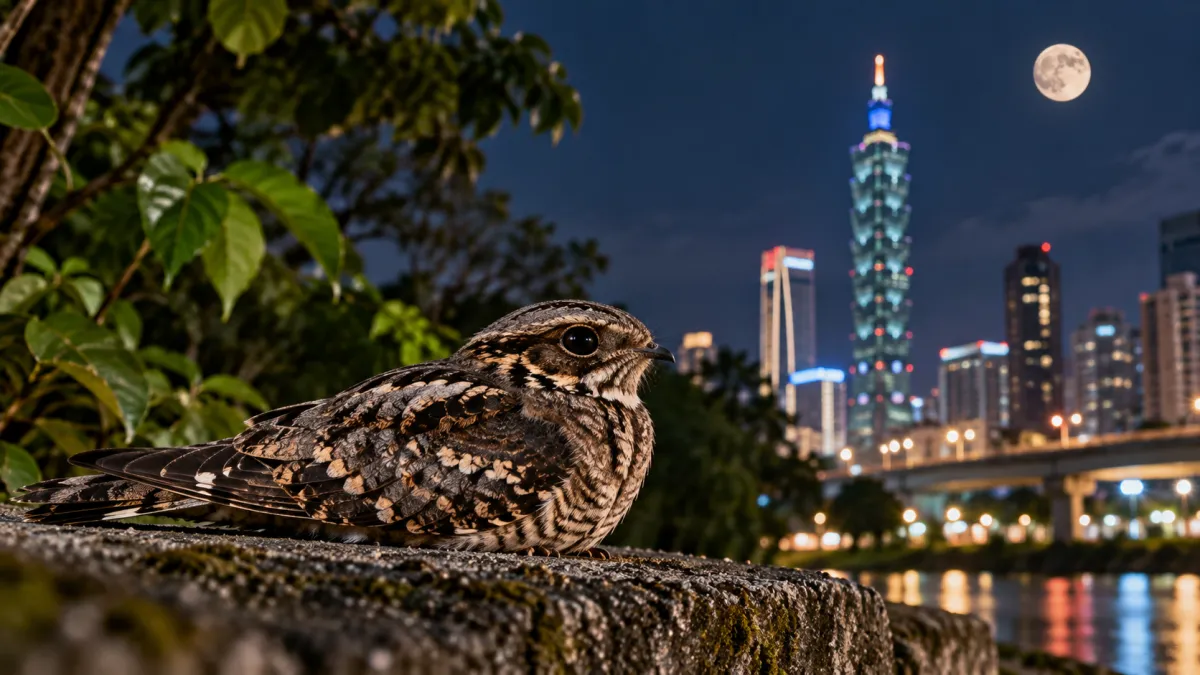
Every spring and summer, residents in many Taiwanese neighborhoods are kept awake by a sharp, repeated bird call that sounds like "jwee, jwee," sometimes continuing late into the night. The culprit is the savanna nightjar, long known locally as the "Taiwan nightjar."
The bird is not only loud at night. Its breeding habits are just as surprising. Unlike most birds, the nightjar does not build a nest at all. It lays its eggs directly on gravel, asphalt and even the concrete rooftops of apartment buildings. With no twigs and no soft lining, how does it protect its eggs and raise its young?
Why The Nightjar Never Builds A Nest
Most people picture birds carrying twigs and grass to build a nest before laying eggs. The savanna nightjar does things very differently. According to the Taiwan Encyclopedia of Life, citing The Avifauna of Taiwan, the savanna nightjar belongs to the nightjar family and is about 25 cm long. Despite its Chinese name, which includes the word for "hawk," it is not a bird of prey.
The species naturally lives on the gravel beds of the middle and lower reaches of rivers, on bare stony ground and in open areas with little traffic, where it lays and incubates its eggs directly on the ground. In other words, nightjars did not stop building nests when they moved into cities. They never built nests in the first place. What has changed is where they lay their eggs, from natural riverbeds to man made structures, not how they breed.
A savanna nightjar usually lays two eggs per clutch. The shells are pale pinkish with rust colored spots, and the birds can incubate them directly on gravel, asphalt or concrete.
How Eggs Without A Nest Escape Predators
If the eggs sit in the open, are they not easy pickings for predators? The answer lies in the nightjar's near perfect camouflage. Taiwan's National Museum of Natural Science says the bird's plumage is mostly grayish brown, covered in a dense pattern of light and dark markings. When it crouches on gravel, soil or flat rock, its feathers blend into the background.
Its legs are short and it is a poor walker, so it often rests on the ground during the day. When threatened, a nightjar does not necessarily fly off right away. It relies first on camouflage and takes off only when danger is very close. This helps adult birds and chicks avoid detection, although eggs and young on the ground can still fall prey to other animals.
Mothers Shelter Their Chicks Under Their Wings
Even without a nest, savanna nightjars still incubate their eggs and feed their young. According to the Taiwan Encyclopedia of Life, the female mainly incubates the eggs and cares for the chicks, while the male helps bring food. The chicks can move about soon after hatching and are good at hiding, unlike many birds whose newborns must stay in the nest waiting to be fed.
The Wildlife Rescue Station of the Ministry of Agriculture's Biodiversity Research Institute says that while resting during the day, mother nightjars cover their chicks with their wings and hide with them in rooftop corners. If someone approaches suddenly, the mother may fly off in alarm, leaving the camouflaged chick crouched in place. That explains why some residents find a motionless baby nightjar on their roof with no parent in sight. Although the chicks can move soon after hatching, they still depend on their parents for food and care.
From Riverbeds To City Rooftops
Savanna nightjars originally lived mainly on gravel riverbeds and open land, but records of them breeding on urban rooftops in Taiwan began to appear in the 2000s. Today, concrete roofs are among their breeding sites. The Taichung City Government's Agriculture Bureau says changes to riverbeds and terrain and the loss of original habitat may explain why nightjars have increasingly appeared in cities. Flat urban rooftops share some features with the bare gravel ground they used to nest on.
Laying eggs on a roof is not necessarily more dangerous than on a riverbed. Writing in the National Taiwan University alumni magazine, NTU researcher Tseng Hui-yun cited a study by the Taichung Wildlife Conservation Society that found nightjars breeding on building rooftops actually had higher breeding success than those on riverbeds, where dogs often attack. Still, urban rooftops have their own risks. Young birds that have just learned to fly can fall into drainpipes or be attacked by cats.
Why Nightjars Call All Night
More than its hidden breeding habits, what residents notice most is the nightjar's loud call. The Taichung Agriculture Bureau says male nightjars call repeatedly during courtship and breeding to attract females and mark their territory, which is why so many residents hear the "jwee, jwee" call at night.
The Taiwan Encyclopedia of Life notes that males repeat a single "jwee" note, with calling peaking in the hour after sunset and the hour before sunrise. Some individuals can call nonstop for as long as 45 minutes. Breeding is seasonal. The Avifauna of Taiwan puts the breeding season at roughly February to July, while the Taichung Agriculture Bureau lists January to September as the courtship and breeding period.
A Nighttime Insect Hunter
Despite the "hawk" in its Chinese name, the savanna nightjar does not hunt with talons. It catches insects in the air. According to the National Museum of Natural Science, it feeds mainly on flying insects such as moths, beetles and grasshoppers and their relatives. It is active at dusk, at night and at dawn, catching flying insects in its open mouth. Late at night, when insects are less active, it may wait at a fixed spot and dart out when prey appears. Nightjars also hunt around city lights, where insects drawn to the glow gather.
What To Do If Nightjars Nest On Your Roof
If you find nightjar eggs or chicks on your roof, the most important thing is not to assume they have been abandoned just because there is no nest. Do not pick them up, move them or destroy them.
The Biodiversity Research Institute's Wildlife Rescue Station notes that nightjar chicks often hide in place using camouflage. Not seeing a parent for a while does not mean the chick has been abandoned. If it looks healthy with no obvious injury or illness, leave it alone so the parents can return. The station also warns against taking healthy chicks home to raise, as they may injure their wings or damage their feathers in captivity and lose the ability to fly, making release impossible.
For residents bothered by the calls year after year, the Taichung Agriculture Bureau suggests clearing weeds, accumulated soil and clutter from rooftops before the breeding season begins, and adjusting the roof environment to make it less attractive to nightjars. Once eggs or chicks are present, residents should not try to drive the birds away in ways that could disrupt breeding, and should contact local wildlife conservation or rescue agencies if needed.
So the next time you hear "jwee, jwee" in the night, remember that this loud bird is not just looking for a mate in the city. It may also be raising its young in some unremarkable flat corner nearby.
Sources: National Museum of Natural Science; Taiwan Encyclopedia of Life; The Avifauna of Taiwan; Taiwan Cultural Memory Bank; Wildlife Rescue Station, Biodiversity Research Institute, Ministry of Agriculture; Taichung City Government Agriculture Bureau; Tseng Hui-yun, NTU Alumni Bimonthly, No. 149; Forestry and Nature Conservation Agency. (Related: Taiwan's Macaques Can Eat Over 300 Wild Plants, So Why Do They Snatch Hikers' Snacks? | Latest )