China's Defense Ministry has confirmed that its coast guard tailed Japanese coast guard ships that took shelter from a typhoon in the Taiwan Strait, and accused Tokyo of using the storm as cover for "political provocation."
The incident involved eight Japan Coast Guard patrol ships and five China Coast Guard vessels. Taiwan's Coast Guard Administration (CGA) had earlier accused Beijing of trying to use the typhoon to create the false impression that it has jurisdiction over the strait.
Japanese Ships Openly Signaled They Were Avoiding A Typhoon
According to Taiwan's CGA, the eight Japanese patrol ships began sailing along the median line of the Taiwan Strait at 6 a.m. on October 22 as powerful Typhoon Champi approached. They headed to waters southwest of Qimei Island in Penghu County, outside Taiwan's 24 nautical mile contiguous zone, to ride out the storm. Five Chinese coast guard ships followed them. The CGA said it tracked the vessels throughout using joint intelligence, surveillance and reconnaissance.
Taiwan's Central News Agency identified the Japanese ships as the helicopter carrying patrol ships Reimei, Yashima and Ryukyu and the large patrol ships Taketomi, Kabira, Matsushima, Irabu and Osumi, Focus Taiwan reported. The Chinese ships included two 5,000 ton class Daishan vessels. The Japanese ships broadcast "AVOID TYPHOON" on their automatic identification systems, which transmit a ship's identity and position, making clear the purpose of their voyage.
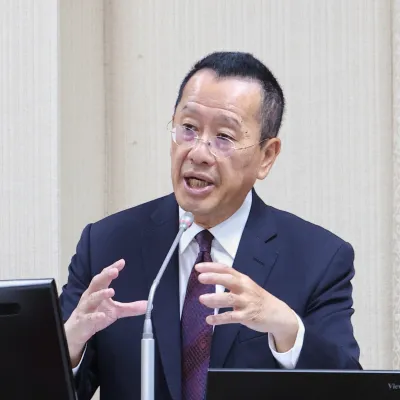
"For JCG ships stationed in Okinawa Prefecture, going to the Taiwan Strait is the best route for sheltering from typhoons," said Hsieh Ching-chin, deputy director general of Taiwan's CGA.
Beijing Confirms The Surveillance And Accuses Japan
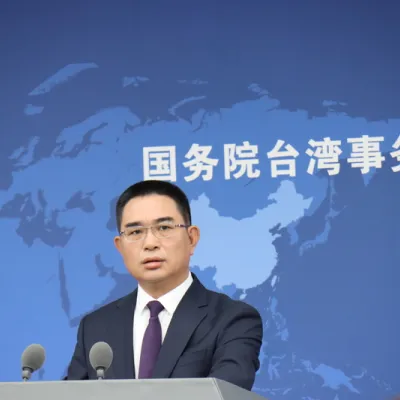
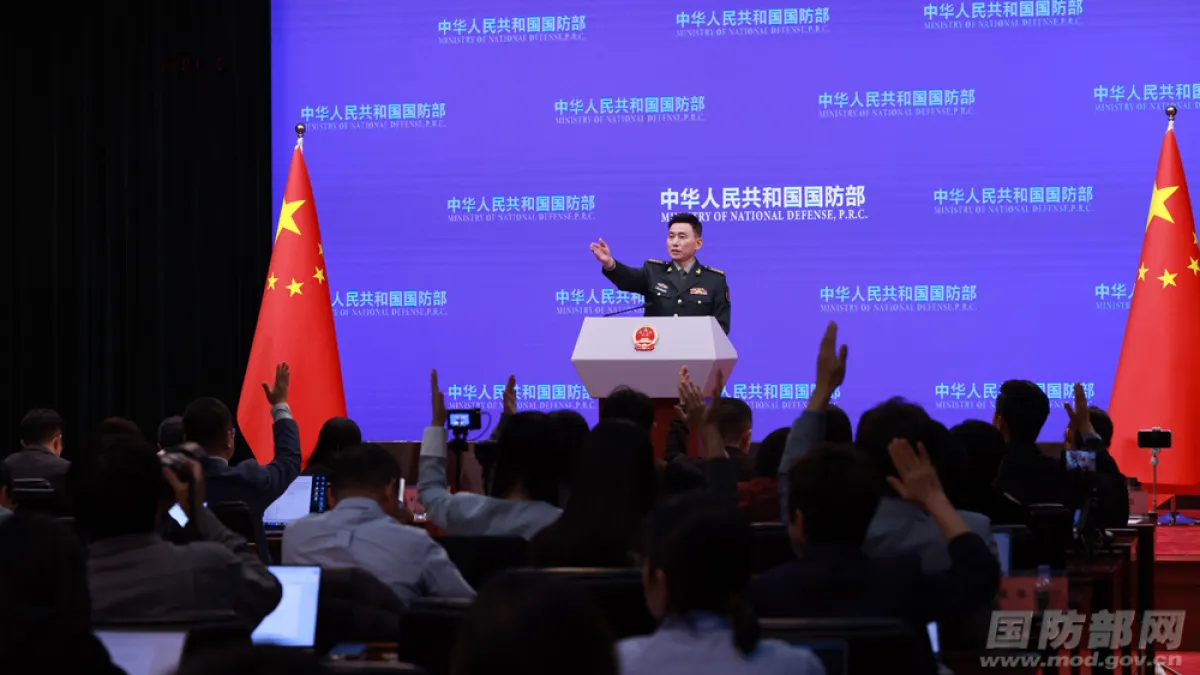
At a regular press conference in Beijing on October 29, a reporter from the Hong Kong based China Review News Agency asked about the shadowing and Taiwan's accusation that China was trying to turn the strait into its "internal waters." According to the transcript released by China's Defense Ministry, spokesperson Zhang Xiaogang said the China Coast Guard had carried out "full escort and surveillance" of the Japanese ships and handled the matter in accordance with the law.
Zhang then restated Beijing's sovereignty claim over Taiwan, saying China has sovereignty, sovereign rights and jurisdiction over the Taiwan Strait.
He accused Japan of using typhoon shelter as an excuse for political provocation that harms China's sovereignty, and demanded that Tokyo stop provoking on the Taiwan issue and undermining regional peace and stability. However, he offered no specific evidence that the Japanese ships had any other political or military purpose, and did not explain what handling the matter "in accordance with the law" involved.
It is not the first such dispute. In July, Japan Coast Guard ships also sheltered in the Taiwan Strait from Typhoon Bavi. China lodged a diplomatic protest, and Tokyo rejected it, according to reports at the time.
Taiwan Says Sheltering Ships Is A Humanitarian Duty
Before Zhang spoke, Taiwan's CGA said on October 23 that the Japanese ships came to shelter in a way that respected Taiwan's law enforcement authority, and that Taiwan supported them in the spirit of humanitarianism and mutual assistance at sea. Citing the United Nations Convention on the Law of the Sea and other international law, it said ships enjoy freedom of navigation in the Taiwan Strait outside territorial waters, and that sheltering from a storm is consistent with humanitarian and international legal principles.
The CGA accused the China Coast Guard of exploiting a natural disaster to tail and monitor foreign government ships, in an attempt to create the illusion of jurisdiction and "internal waters" status for the strait, meaning treating it as waters China can control as its own. While Taiwan offered help at sea to the same Japanese ships, Beijing used surveillance and public statements to assert jurisdiction, turning a storm shelter into a dispute over navigation rights in the Taiwan Strait.
The episode is the latest flashpoint in a broader standoff between Beijing and Tokyo that began after Japanese Prime Minister Sanae Takaichi suggested in November 2025 that a Taiwan contingency could justify Japan's military involvement. See our full timeline of the Japan China standoff over a "Taiwan contingency".