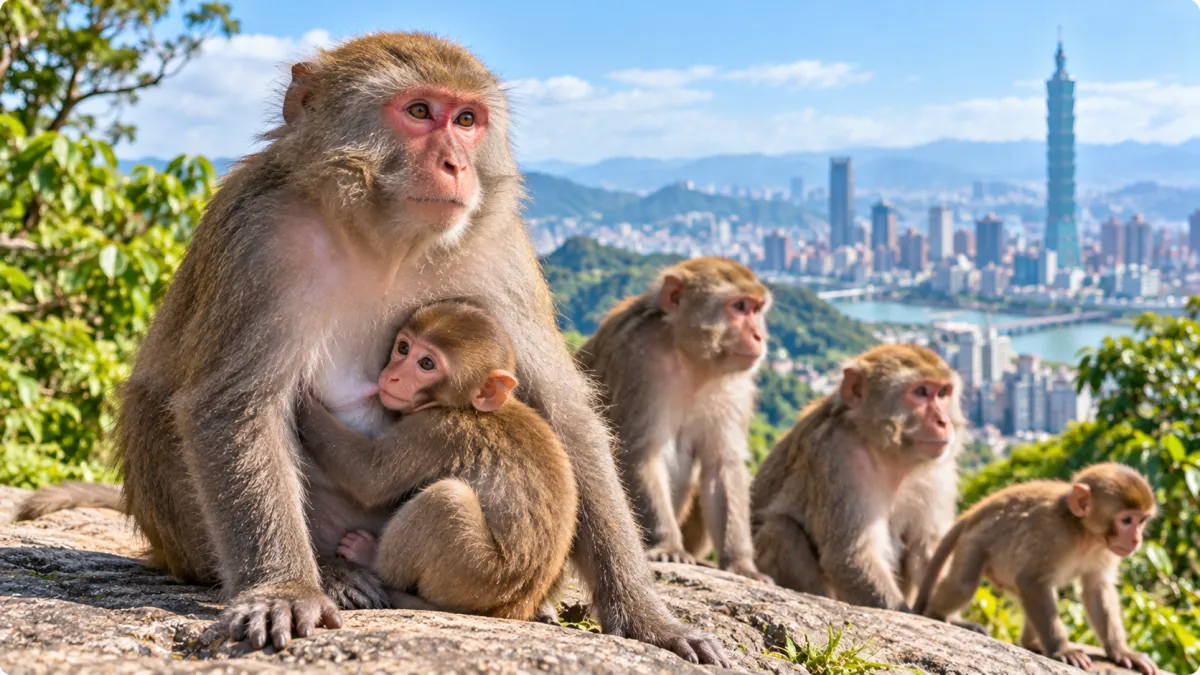
Anyone who has hiked in Taiwan's mountains has probably met a Formosan rock macaque. Some of these monkeys will walk right up to visitors holding food and grab it, leaving the impression that they are greedy or that there is nothing to eat in the forest.
In fact, the opposite is true. According to Taiwan's National Park Service, researchers have recorded the island's only native monkey eating more than 300 kinds of plants, from fruit and young leaves to bark. It also catches insects, frogs and lizards and eats bird eggs. So why do some macaques still go after hikers' snacks? The answer, experts say, lies in years of feeding by people.
What Formosan Macaques Eat In The Wild
Bananas may be the first food people associate with monkeys, but the wild diet of the Formosan macaque is far more varied. The National Park Service describes the species as an omnivore that eats mainly plants and especially likes fruit. Besides ripe fruit, it also eats seeds, flowers, leaves, buds, stems, bark and roots.
Yangmingshan National Park, on the edge of Taipei, lists paper mulberry, banyan, Bischofia, Mallotus, kudzu, Trema and wild persimmon among the plants its macaques eat. For the monkeys, the forest is a huge pantry where fruit, fresh leaves and tender shoots can all become a meal.
The figure of more than 300 plants comes from records gathered over many years of research across different habitats. No single macaque eats all of them.
Frogs, Lizards And Caterpillars Are On The Menu Too
The macaque's diet also includes plenty of animal food. According to the National Park Service, the monkeys hunt insects, spiders, frogs and lizards and eat bird eggs.
Researchers Su Hsiu-hui and Teng Yen-ling of National Pingtung University of Science and Technology have written that macaques at Fushan Botanical Garden in northeastern Taiwan catch caterpillars, stick insects, katydids and even Swinhoe's tree lizards, using their nimble hands to find prey hidden among branches and leaves.
The monkeys even have their own technique for eating caterpillars. Su wrote that when macaques in Fushan find caterpillars covered in stinging hairs, they first rub them on a branch or between their palms before putting them in their mouths.
Formosan macaques have another surprising habit: eating soil. The National Park Service says researchers have seen the monkeys eat dirt, probably to take in minerals.
How Their Diet Changes With The Seasons
What macaques eat also changes through the year. In a 1993 master's thesis at National Taiwan University, Su studied macaques in Renze, Yilan County, through field observation and analysis of their droppings. She found that the monkeys there ate mainly fruit in summer and relied more on stems and leaves in winter, with insects and other animal food more important in summer.
In Renze, summer fruit from fig trees, Trema, Turpinia and large leaved Machilus fed the monkeys. When fruit became scarce in winter, they ate more stems and leaves of climbing vines. In spring, the stems, leaves, buds and flowers of paper mulberry provided food.
Macaques in different places also follow different seasonal menus. A 2021 to 2022 study for Taroko National Park found that macaques in the Tianxiang area ate more fruit in summer and winter, but more leaves in spring and autumn. The monkeys adjust what they look for each day based on what local plants are growing and fruiting.
Why Some Macaques Snatch Food From Visitors
A key reason some macaques approach people for food is human feeding. When monkeys repeatedly get food from visitors, they can learn to link people with food and gradually make a habit of seeking out crowds.
Taroko National Park has found that some macaques in Tianxiang are drawn by human food and often show up outside convenience stores, at pavilions and in parking lots where visitors gather. When someone walks by with food, a monkey may come closer or simply grab it.
The park's research notes that natural habitats around Tianxiang still provide enough food for the macaques, but some troops are lured into visitor areas by human food. It links the problem to people feeding the monkeys in the past, the opening of convenience stores and continued feeding by visitors.
Why Feeding Harms Macaques And The Forest
Formosan macaques also do an important job in the forest: spreading seeds. Yangmingshan National Park says the monkeys spit out some seeds as they eat fruit, while others pass through their digestive system. As troops move through the forest, the seeds are carried to new places, and for some plants, passing through a macaque can even improve germination.
But when macaques come to depend on human food, they may spend less time foraging naturally, weakening their role in seed dispersal. Monkeys that wait by roadsides to be fed also face a higher risk of being hit by cars. And as they lose their wariness of people, incidents of food snatching, scratches and bites become more likely.
Authorities have started to crack down. Feeding wildlife is banned in Yangmingshan National Park, where violators can be fined NT$3,000 (about US$95). In August, the park said it would ticket a visitor who was caught throwing bananas to macaques after a monkey moved a park camera and captured his license plate, Newtalk reported. In the southern city of Kaohsiung, where macaques are common on Shoushan, a local ordinance allows fines of NT$5,000 to NT$10,000, and the city fined a man NT$5,000 this year for feeding a troop of macaques, Nextapple reported.
What To Do If You Meet A Macaque
Taroko National Park advises hikers who encounter Formosan macaques to:
- Keep food in an opaque backpack or a sealed container.
- Avoid walking past monkeys while holding food or carrying plastic bags with food inside.
- Never feed, touch or provoke the monkeys.
- Stay at least 5 meters away.
- Stay calm if a macaque approaches, and do not tug at or fight over food.
So the next time you meet a macaque in the mountains, put your snacks away. The monkeys already have a rich natural menu in the forest, and they do not need visitors to feed them.
Sources: National Park Service; Yangmingshan National Park; Taroko National Park, Formosan Macaque Population Distribution and Management Plan (2021 to 2022); Su Hsiu-hui, Food Habits of Formosan Macaques in Renze, Yilan (1993); articles by Su Hsiu-hui and Teng Yen-ling on the science portal Scitech Vista. (Related: When Typhoon Seas Stop The Ferries, Drones Fly Emergency Medicine To Taiwan's Xiaoliuqiu Island | Latest )