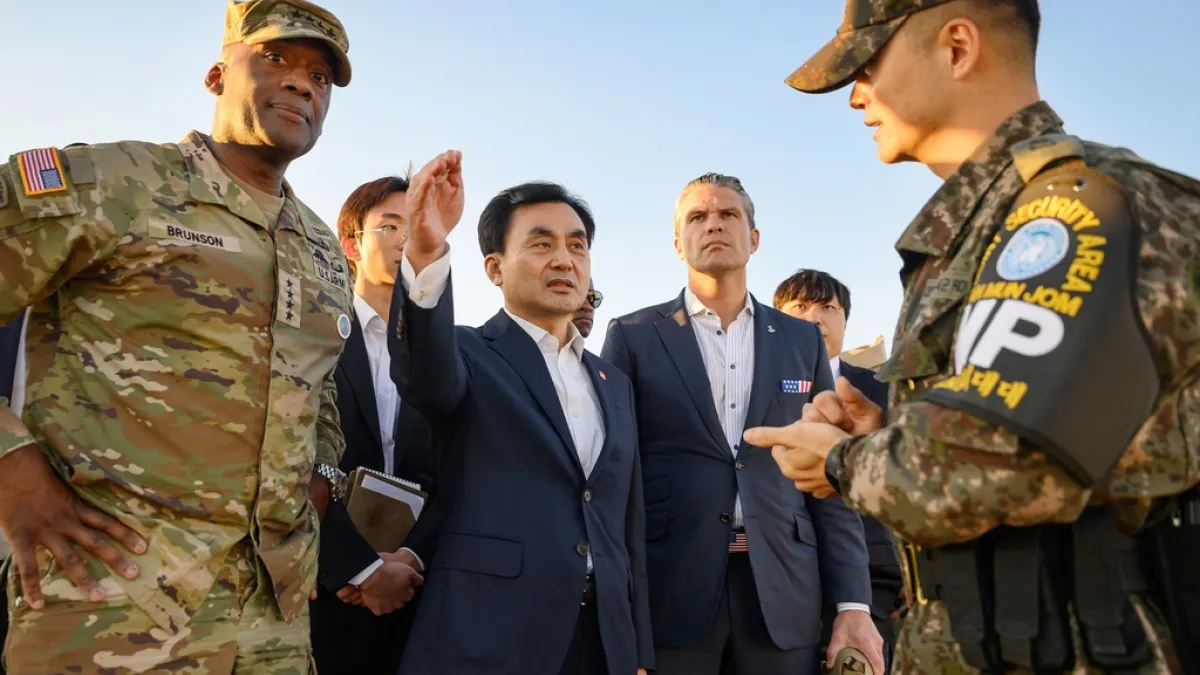
South Korea's defense minister has openly questioned the reliability of the US military, pointing to Washington's struggles in its war with Iran, as the two allies clash over when Seoul should take back wartime command of its own troops.
"We are watching how the United States is dealing with Iran. In a war with North Korea, could we trust a US military like that? We couldn't, could we?" Defense Minister Kang Shin-chul (姜信哲) said on October 26 during the National Assembly's annual audit of government agencies. The JoongAng Ilbo said it was the first time a sitting South Korean defense minister had publicly cast doubt on the dependability of US forces.
What Kang Said At The Parliamentary Audit
Kang was responding to Sung Il-jong (成一鍾), a lawmaker from the opposition People Power Party, who argued that Seoul was moving too hastily to take over wartime operational control, known as OPCON. Kang said it was "a great exaggeration" to claim that South Korea's survival would be at risk once command was transferred. The transfer should proceed once trust is assured, he said, with South Korean generals who know the country's situation in command and US forces in support. Asked about recent reports of friction over intelligence sharing, he said intelligence sharing and military exchanges were going well.
Wartime OPCON refers to command over South Korean forces in the event of war. It currently rests with the commander of the Combined Forces Command, who is also the commander of US Forces Korea. According to the Hankyoreh, the two countries have pursued a conditions based transfer since 2015, under the government of then President Park Geun-hye. The agreed conditions are that South Korea has the military capabilities to lead combined defense, that the alliance can respond to North Korea's nuclear and missile threats, and that the security environment on the Korean Peninsula and in the region is suitable for a stable transfer. Verification proceeds in three stages, initial operational capability, full operational capability and full mission capability, and the process is currently stuck at the second stage.
Kang is not alone in voicing doubts. Song Young-gil (宋永吉), a lawmaker from the ruling Democratic Party who serves as a special adviser to the president on peace diplomacy, said at an October 19 audit of Army headquarters that "US intelligence assets and judgment are by no means all knowing," and argued that in the Iran war, "the United States was led by Netanyahu and Mossad's intelligence and made the wrong call." According to the JoongAng Ilbo, he also called the US military's mistaken bombing of a girls' school in Iran in February "a stupid criminal act" and said that "the view that South Korea would collapse without US forces underestimates the Republic of Korea." When Army Chief of Staff Kim Gyu-ha (金圭河) began to reply that US capabilities were needed, Song cut him off: "How many mistakes has the United States made?"
Why The Two Allies Are Clashing Over Transfer Conditions
The latest tension followed remarks by General Xavier Brunson, commander of US Forces Korea, at an Indo-Pacific forum in Washington on October 14. "None of us can say things haven't changed. Just pick up a newspaper and you'll see things have changed. North Korea fired missiles again this week," he said, according to the Hankyoreh. "Conditions have changed, we have changed our plans, and that creates new standards that we have to abide by." He had earlier warned, in a discussion at the Center for Strategic and International Studies, that transferring wartime command before command capabilities are adequate could weaken defenses.
Seoul pushed back quickly. On October 15, Kang told a parliamentary audit that Brunson "was speaking at the military level, but we are also worried about the overall impact, and we have clearly conveyed our views," effectively confirming that South Korea had lodged a protest. Asked the same day whether Washington was adding new conditions, a Defense Ministry spokesperson, stressing that he was offering a personal view, said: "If the goalposts keep moving, the transfer of wartime command will never be possible." He added that the allies have mutually agreed conditions, that the South Korean military has worked for 20 years to meet them, and that the ministry's official position is to consult closely under the agreed conditions based transition plan.
A JoongAng Ilbo editorial on October 15 identified the procedural sticking point. The US has downgraded some items it rated "sufficient" last year to "insufficient" this year, arguing that battlefield conditions change and items should be reassessed annually. Washington is particularly concerned about surveillance and reconnaissance assets and command and control systems, the paper said, and wants South Korea to upgrade its data links and communications security so they can connect with Maven, the AI targeting analysis system the US has used in combat. A future Combined Forces Command led by a South Korean four star general would need the same capabilities. These are issues that could normally be resolved in working level talks, the paper argued, and the real problem may be a crack in mutual trust.
The Hankyoreh quoted a former security official as saying South Korea had in fact already met the conditions agreed in 2015 and that the United States kept adding new ones, fueling long standing frustration inside the Defense Ministry over "moving goalposts." A former professor at the Korea National Defense University went further at a forum hosted by the paper on October 15: "General Brunson isn't moving the goalposts. He wants to tear them down altogether."
The Shaky Ranking Behind Seoul's Confidence
One source of President Lee Jae-myung's (李在明) confidence in reclaiming wartime command is the claim that South Korea has the world's fifth strongest conventional military. According to the Chosun Ilbo on October 22, Lee has repeatedly cited the ranking since taking office last year, in policy speeches to the National Assembly and at cabinet meetings. At an April cabinet meeting, he told then Defense Minister Ahn Gyu-back (安圭伯), "Even without US forces, South Korea's military is fifth in the world, isn't it? This is an official announcement from a US private analysis firm. Why should we think it would be hard to defend ourselves without foreign troops?" The Democratic Party cited the same ranking in September as proof that South Korea's capacity for self reliant defense had been fully demonstrated.
But the Chosun Ilbo noted that the ranking comes from Global Firepower (GFP), a private website that says its data are provided for "entertainment and historical value as well as general reference purposes" and carries a disclaimer that its accuracy is only as good as its sources. Since 2006, GFP has compared the military strength of 145 countries and territories. This year it ranked South Korea behind the United States, Russia, China and India, and because it effectively ignores nuclear weapons, ahead of France, Britain and Israel. Its index combines more than 60 indicators covering manpower, finances, logistics and geography, but it does not disclose its weightings or methods and does not account for alliances such as the US South Korea alliance or NATO's collective defense.
The paper cited the investigative group Bellingcat as saying it is wrong to describe GFP as an independent research body, calling it a "farm site." Dakota Wood of the Heritage Foundation said that "scholars would rate GFP's credibility lower than Wikipedia." Michael Kofman, a Russia expert at the Carnegie Endowment for International Peace, said that "no one takes the GFP index seriously," because "there is no identifiable assessment methodology, and measuring military power that way is nearly impossible to begin with." Robert Peters, director of the Heritage Foundation's national security center, said such rankings are mostly designed "to drive traffic rather than to provide solid analysis." An anonymous Korean Peninsula expert told the paper that basing a decision on wartime command on an opaque website's ranking "would be dangerous."
Gaps In South Korea's Own Surveillance Capabilities
The Chosun Ilbo also reported that the South Korean navy's only two ocean surveillance ships, the 2,800 ton Sinsegi (AGS 1) and the 3,500 ton Singiwon (AGS 2), were both out of action for more than 40 days from September to mid October. The Singiwon, commissioned in 2012, entered its most extensive depot level overhaul in July, while the Sinsegi, in service since 2003, needed repairs because of its age. The Sinsegi had just completed about 18 months of long term maintenance from September 2024 to March this year, only to break down again six months later.
The two ships collect signals intelligence related to North Korea, monitor Chinese and Russian naval movements and track illegal North Korean activity on the high seas. People Power Party lawmaker Han Ki-ho (韓起鎬) said the outage showed the true state of South Korea's independent surveillance and reconnaissance capability. "Before saying a transfer tomorrow would be no problem, there should first be an accurate assessment of the South Korean military's capabilities," he said. The military argues that its intelligence collection does not depend on any single platform, but the next generation of surveillance ships will not arrive until the mid 2030s, the paper said.
Where The Korean Peninsula Fits In The First Island Chain
According to the JoongAng Ilbo, a strategy guidance document issued in January by the US Eighth Army describes the Korean Peninsula as "an important stronghold within the first island chain" for countering China. It warns that Chinese military action against Taiwan could trigger a wider conflict across the Indo-Pacific, and that North Korea might act first. The document also says North Korea has about 800 ballistic missiles capable of reaching the US mainland, and that the US provides South Korea with "important but limited support" to deter Pyongyang. Eighth Army commander Joseph Hilbert said recently that focusing myopically on threats on the Korean Peninsula alone would be irresponsible. Kang said Seoul had raised its concerns at the working level.
Park Won-gon (朴元坤), a professor at Ewha Womans University, said that if Seoul pushes the transfer unilaterally, it could cause the combined command structure to collapse, and the Trump administration might use the opportunity to strengthen the role of US Forces Korea in deterring China.
What Comes Next For The Transfer
According to the Hankyoreh, Seoul had hoped to complete verification of full operational capability this year and send the issue to the allies' annual Security Consultative Meeting, where the two defense chiefs would recommend a target year for the transfer to their presidents. Cho Yong-geun (趙永根), a former North Korea policy official at the Defense Ministry, said that for South Korea to regain wartime command during Lee's term, this year's meeting would have to set 2028, within Trump's term, as the target. "The first step is passing the full operational capability assessment, but when General Brunson, who leads the assessment, hits the brakes, it is very hard to move to the next stage," he said.
If the two militaries cannot agree, a political decision by the defense ministers or the two presidents may be needed. The Hankyoreh noted that the defense chiefs could exchange views at the ASEAN Defence Ministers' Meeting Plus in the Philippines at the end of this month, or at the APEC leaders' summit in Shenzhen on November 18 and 19.