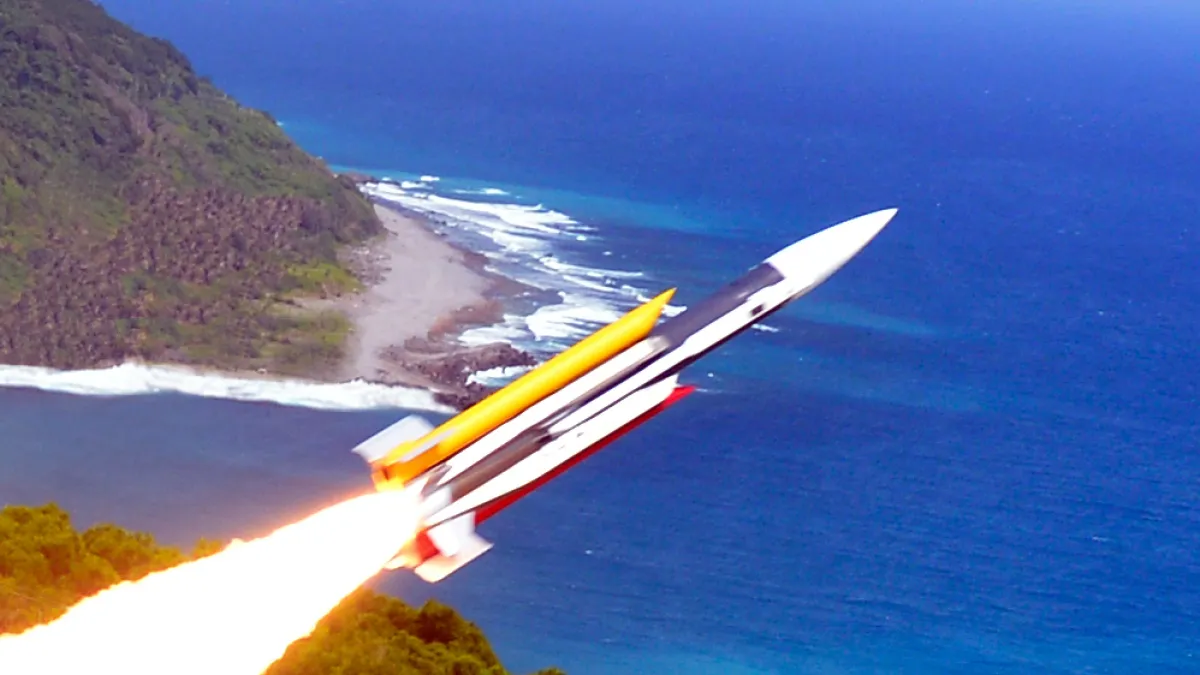
Taiwan's top military research institute has found a suspected Chinese-made component in equipment built for its air-launched Hsiung Feng III anti-ship missile program, Storm Media has learned. The missile is being developed to let Taiwan's fighter jets strike Chinese aircraft carrier groups and amphibious fleets.
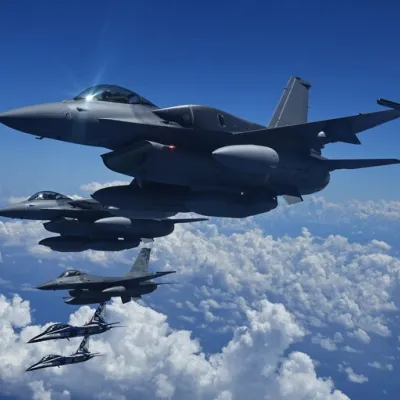
The part, a filter module, was supplied by a Taiwanese contractor for a long-range communications unit that is to be installed on the F-CK-1 Ching-kuo Indigenous Defense Fighter (IDF) under the program, code-named Project Hsiung Chih. The National Chung-Shan Institute of Science and Technology (NCSIST), the state-owned developer of Taiwan's indigenous missiles, confirmed to Storm Media that it had flagged the component during inspections and summoned the supplier to explain.
Institute Says It Caught The Part During Inspections
In a written response to Storm Media, NCSIST said it had stepped up checks for Chinese-made products and, during testing, found that a connector on the filter was suspected of being made in China. The institute said it immediately asked the contractor to come in and explain, in order to rule out the suspicion.
NCSIST played down the security risk. It said the filter used for communications testing in the Hsiung Chih project is a passive, mechanical cavity component, a precision-machined part made of a metal housing, a resonant structure and connectors that produces a high-frequency filtering effect. It "has no electronic parts and no transmission function," the institute said, adding that the part was still undergoing environmental testing at the institute and had not yet been fitted to a communications unit or tested together with an aircraft.
Insiders Question How The Component Passed Procurement
A person who tipped off Storm Media said NCSIST would certainly have required the contractor not to use Chinese-made parts when it placed the order, meaning something must have gone wrong at the acceptance stage. "How could Chinese-made items be allowed to turn up inside the long-range communications unit?" the person said.
Filters remove noise from signal bands, helping the missile hit its target more precisely. Using a Chinese-made part in such equipment, critics warn, risks exposing sensitive data.
Shrinking The Hsiung Feng III To Fit A Fighter Jet
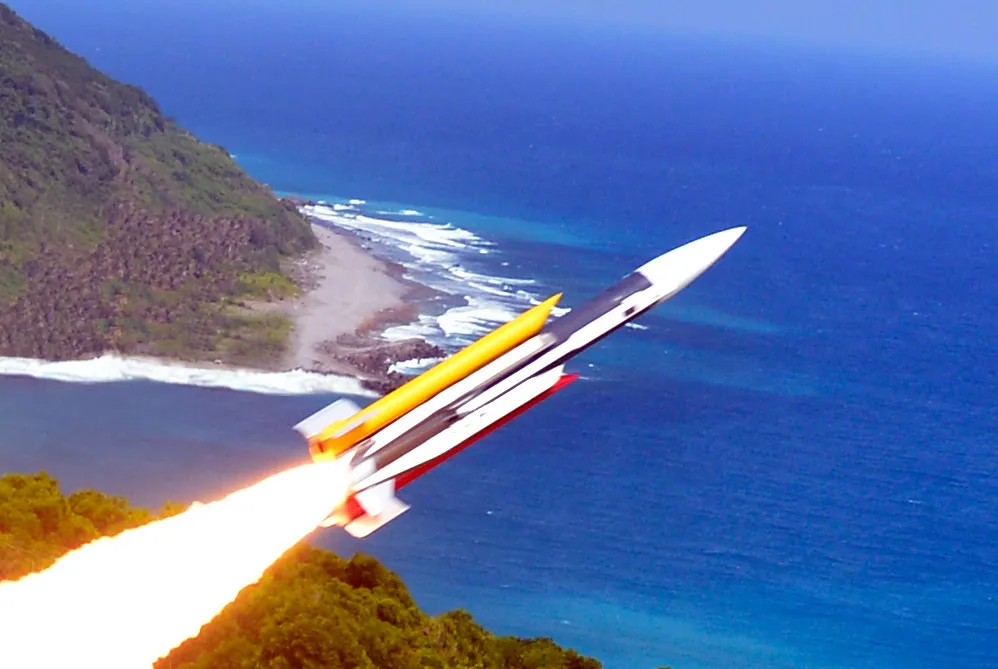
The Hsiung Feng series is Taiwan's main family of anti-ship missiles, and the military's strategy has shifted toward using land-based forces to control the surrounding seas. An air-launched Hsiung Feng III would give the air force's fighters a much stronger strike capability.
NCSIST began Project Hsiung Chih in 2022, running development and low-rate initial production together on a six-year schedule. The ship- and land-launched Hsiung Feng III missiles now in service weigh about 1,300 to 1,400 kg. To fit under the wing of an IDF, the missile body must be cut to no more than 5.5 meters long and 36 cm in diameter, and to less than 900 kg, a redesign that has already shown results through miniaturization and a more compact structure.
NCSIST completed carriage and flight tests of the air-launched missile on the IDF in 2025, and on July 1, 2026, it carried out the first live-fire test. The missile is mainly intended for medium- to long-range standoff strikes against Chinese carrier battle groups and amphibious landing fleets, with a preliminary planned range of 250 to 400 km. Once it completes operational test and evaluation, it is expected to greatly extend the depth of Taiwan's defensive operations.
Supplier Must Prove Origin Or Lose The Contract
A person familiar with the matter said NCSIST will require the contractor to provide an explanation as set out in the contract. The contractor must produce a certificate of origin before NCSIST will use the part; otherwise the institute will terminate the contract.