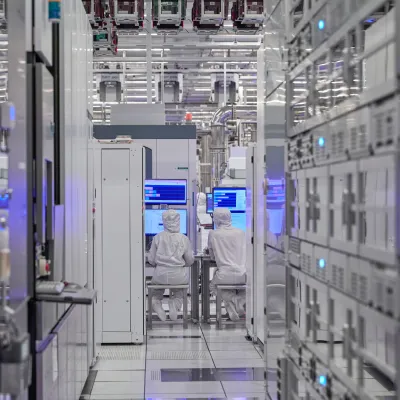
The rise of agentic AI is driving up demand for CPUs and networking chips at Taiwan Semiconductor Manufacturing Co. (TSMC), Chairman and CEO C.C. Wei said on October 15, adding that overall demand still exceeds what the world's largest contract chipmaker can supply.
Speaking at the company's third-quarter earnings call, Wei said demand for CPUs used in agentic AI, systems that carry out multistep tasks on their own rather than simply answering prompts, keeps climbing. Those chips, however, are not counted in TSMC's existing forecast for AI accelerator growth.
Wei Says AI Assistants Are Widening The Sources Of Demand
Wei described the AI market as strong and said recent developments are positive for the long-term demand outlook. As applications shift from chatbots to AI assistants, agentic AI is spreading and pushing up the computing power needed to run it.
Wider adoption of open-source AI models is also adding to demand, he said, by making AI more efficient to use and lowering the barrier to building applications, which in turn requires more advanced chips. On top of AI accelerators, the emergence of agentic AI CPUs and continued growth in networking chips are increasing demand for semiconductors.
That does not mean demand is moving from accelerators to CPUs. Asked by an analyst whether the mix of AI demand was changing, Wei declined to comment on the relative weight of accelerators and CPUs, but said rising CPU demand is a clear trend and that other demand is strong as well.
After weighing all these factors, he said, demand remains higher than TSMC's current capacity, and the company is working to close the gap.
CPUs Stay Outside TSMC's AI Accelerator Forecast
Analysts pressed further, asking whether TSMC's earlier forecast for AI accelerator revenue growth included CPUs driven by agentic AI. Wei answered plainly that CPUs are not part of the current calculation.
TSMC cannot easily tell whether a given CPU will end up in a traditional server or an AI server, he explained, since that depends on how customers use and configure their products. The company is therefore sticking with its narrower definition of AI accelerators.
Leaving CPUs out of that definition does not mean the demand falls outside TSMC's business. Jeff Su, TSMC's director of investor relations, noted during the question-and-answer session that it is still the company's business.
Su also recalled that TSMC had previously projected AI accelerator revenue to grow at a compound annual rate in the mid to high 50% range from 2024 to 2029. Management stressed during the call that demand is very strong and shows no sign of slowing, but did not give a new growth figure. The added CPU demand is therefore a new observation from the call, not a direct upgrade to the existing accelerator forecast.
TSMC Sent Teams To Check US Data Centers And Power
With AI spending surging, investors are increasingly focused on power supply, data center construction, and supply chain bottlenecks. Wei said that beyond talking with its customers and its customers' customers, TSMC has sent teams to the United States to check on the progress of data center construction and the state of the power supply, and the feedback so far has been good.
The company also factors in cloud service providers' investment plans, their funding, and the supply of other components, combining top-down and bottom-up analysis to reach its own view of demand.
Asked whether a strained power grid is pushing customers toward backside power delivery, a chipmaking technique that routes power through the back of the chip, Wei said adoption depends on each product's needs. Some accelerators may use it, he said, while products such as smartphones may not need it.
TSMC's reading of AI demand covers both customers' plans and conditions on the ground. For now its conclusion is that demand exceeds supply, though the company will keep watching for changes in power, funding, and the supply chain.