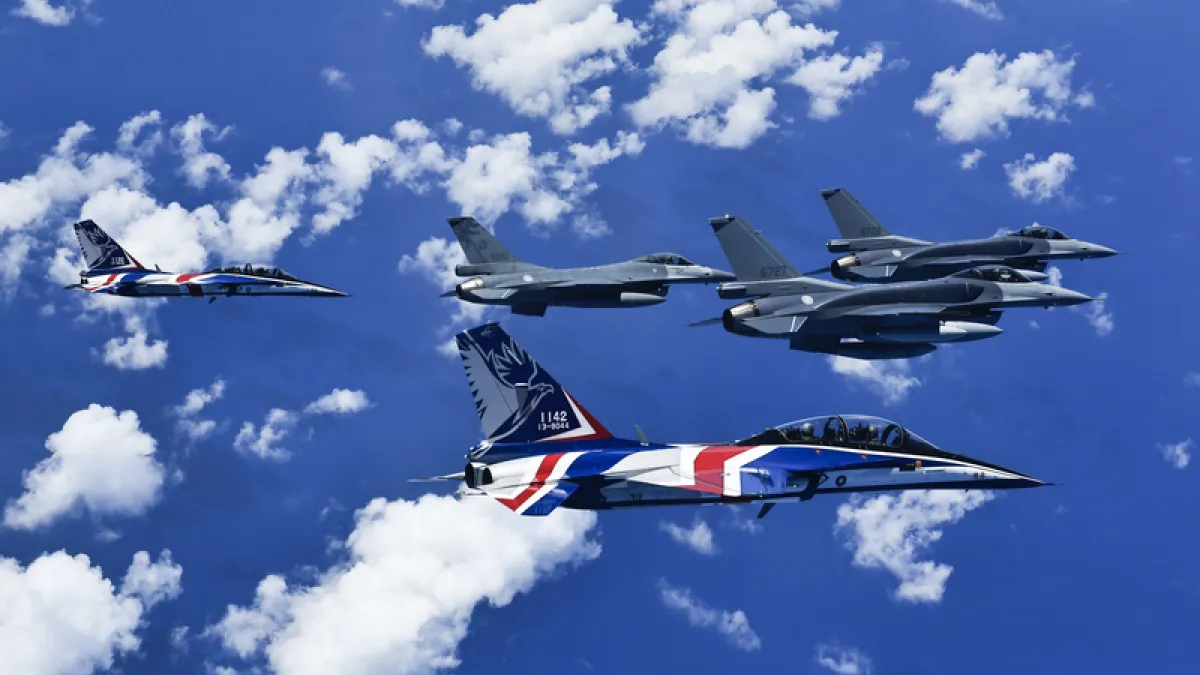
Two F-16 Block 70 fighters landed at Chihhang Air Base on October 2, the first factory-new fighters delivered to Taiwan in 25 years. But delivery is not combat power. The harder test is whether Taiwan's systems, people, and industry can turn 66 aircraft into a force that deters, and four gaps deserve scrutiny now.
Software Gaps Make The Delivery Incomplete
The jets arrived with their Viper Shield electronic warfare suite only partly installed and its software still in development, the Air Force told lawmakers on October 12. Modern air combat is a contest over the electromagnetic spectrum: the APG-83 radar lets a pilot see threats at range, and Viper Shield helps the aircraft survive them. Taiwan's potential adversary fields large, advanced surface-to-air missile and early-warning radar networks, so flying jets into that environment before the suite is proven carries real tactical risk. The work should be held to the highest standard, not rushed for a headline.
The older F-16Vs face a parallel problem. The Air Force now plans to install an automatic ground collision avoidance system on them by the end of 2028, a safeguard that pulls a jet up in the last seconds before impact if a pilot is disoriented or unconscious. Hardware alone does not protect anyone. Simulator training and routine practice must teach pilots how the system behaves in extreme conditions.
Pilot Safety Depends On Maintenance And Risk Control
An aircraft can be bought, but a pilot takes years and thousands of flight hours to produce. The Control Yuan found that the F-16V flown by Capt. Hsin Po-yi, who died in a January 6 crash, had suffered repeated navigation malfunctions in the week before the accident, that the military had not adequately assessed the risk of a night flight, and that maintenance rules had been broken, Focus Taiwan reported. Survival rests on a chain that runs from maintenance quality and system warnings to risk assessment and the condition of the crew.
If heavy workloads, airline recruiting, and the strain of constant gray-zone flights keep driving experienced pilots out, new jets will not fix the shortage. Taiwan should reduce avoidable equipment faults, schedule duty to limit fatigue, and keep survival gear and ejection seats at the highest standard. Retention bonuses alone will not do it.
Maintenance Capacity Must Match A 200-Jet Fleet
Once all 66 jets arrive, Taiwan will operate more than 200 F-16s. Without local maintenance, even the most advanced fighter is an expensive object on the ramp. The Aerospace Industrial Development Corporation (AIDC), the author's employer, upgraded Taiwan's F-16A/Bs to the F-16V standard under the Peace Phoenix Rising program. It also launched an F-16 maintenance center in Taichung with Lockheed Martin in 2020 and has said it wants to expand it into a regional hub.
The Block 70 raises the bar. Its AESA radar, new avionics architecture, and complex electronic warfare suite demand deeper repair skills. The questions are whether those skills can be transferred to Taiwan, whether AIDC can expand domestic production and overhaul of critical parts if U.S. supply is strained, and whether the center can turn jets around fast enough to keep availability high. Self-reliance does not mean reinventing the aircraft. It means keeping jets flying when shipping is disrupted.
Taiwan Needs A Plan For Late Deliveries
Delay has become the norm in defense procurement. L3Harris says Viper Shield is on order from eight nations, 233 systems in all, so factory capacity will be shared among many customers. Complaining after each slip is not a strategy. Taiwan needs what might be called delay resilience: the ability to adjust tactics, make full use of the existing F-16V fleet, and finish simulator and tactical training before the last component arrives.
The two jets at Chihhang are the start of a test, not its result. The questions that matter concern logistics, institutions, people, and systems, and the public should keep asking them. (Related: Taiwan's $8 Billion F-16s Land Without A Finished Electronic Shield | Latest )
Chang Hou-kuang works at the Aerospace Industrial Development Corporation (AIDC). The views expressed are the author's own.