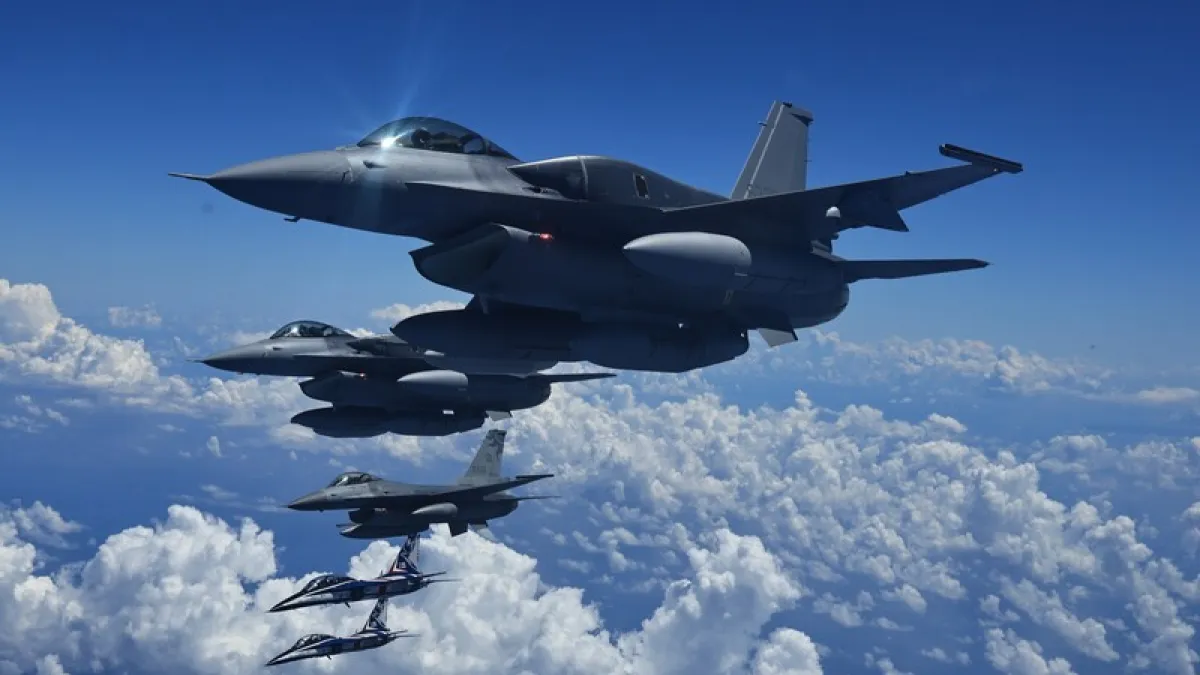
Taiwan's first two F-16C/D Block 70 fighters landed at Chihhang Air Base in Taitung County on October 2, and one defense analyst wants the air force to give them an unusually aggressive first assignment: long-range strikes on military targets along China's southeastern coast.
Chieh Chung, an associate research fellow at the Institute for National Defense and Security Research (INDSR), argues that the jets' longer reach and heavier payload suit them to that mission far better than to the air-defense work Taiwan's fighters have mostly flown.
The two single-seat jets left Guam at 8:30 a.m. and touched down at Chihhang around noon after a flight of about 3.5 hours. They are the first brand-new main fighters Taiwan's air force has received in 29 years, since the F-16A/B and French-built Mirage 2000 arrived in 1997, and delays in the delivery schedule have kept public attention firmly on them.
Conformal Fuel Tanks Stretch the Jet's Combat Radius
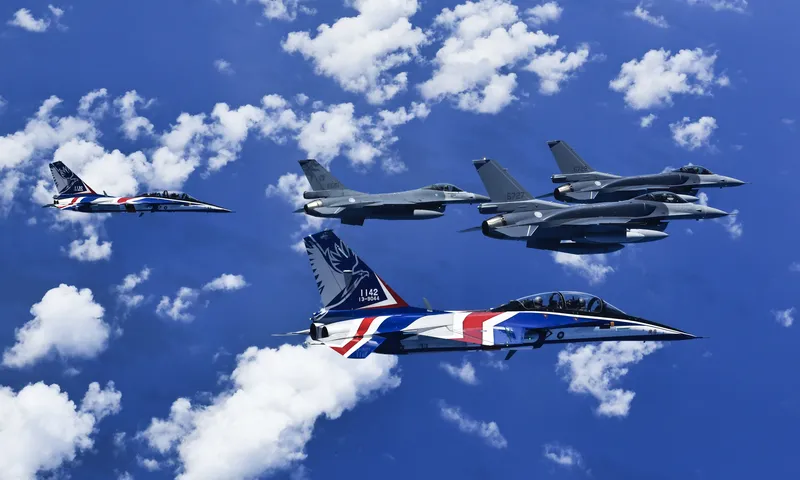
The most visible difference between the Block 70 and Taiwan's upgraded F-16AM/BM fleet is a pair of conformal fuel tanks (CFTs) molded to the top of the fuselage. Together they hold an extra 450 gallons of fuel. That extends range and time in the air, and it frees wing pylons that would otherwise carry drop tanks, leaving room for more air-to-air missiles and for air-to-ground and anti-ship weapons.
By Chung's figures, a single-seat F-16AM carries about 1,040 gallons internally and has a combat radius of roughly 550 kilometers on a typical mixed air-to-ground and air-to-air mission without drop tanks. A single-seat Block 70 with the conformal tanks carries about 1,490 gallons and can reach 700 to 800 kilometers under the same conditions.
The new jet also swaps in an F110-GE-129 engine rated at up to 29,500 pounds of thrust with afterburner, against 23,770 pounds for the F-16AM/BM. The extra power allows a higher takeoff weight, which Chung says lets the Block 70 carry nearly 20% more weaponry at the same radius. Add three external tanks, and its maximum radius on high-altitude intercept or standoff-attack missions stretches to between 900 and 1,200 kilometers, up from 700 to 900 kilometers for the F-16AM.
Longer Endurance Gives Pilots a Safer Way Home
Some critics have questioned whether an air force focused on air defense needs the tanks at all, arguing that the extra drag will only hurt the jet's performance in air combat.
Chung says the tanks pay off even in a purely defensive role. In wartime, Chinese joint fire strikes would likely damage Taiwan's runways soon after fighters take off. Jets that can stay aloft longer can fire their missiles, withdraw to safer airspace farther from Taiwan, and wait until other runways are repaired or reserve strips are opened before landing.
Without conformal tanks, crews must give up air-to-air missiles to carry drop tanks. Because those tanks add far more drag, pilots often have to jettison them before the fuel is used up, which wastes much of the added endurance. Conformal tanks offer a better trade: more missiles, longer patrols, and a better chance of getting down safely.
Chung estimates that a single-seat F-16AM carrying four AIM-120 and two AIM-9 missiles, with no drop tanks and a 15% to 20% fuel reserve, can stay on a combat air patrol for 45 minutes to one hour. A Block 70 with the conformal tanks could remain for one to 1.5 hours.
Washington Reportedly Wants Taiwan to Absorb the First Blow
Taiwan's military has sought the ability to strike China's southeastern coast the moment clear signs of an attack appear. Likely targets include troop assembly areas, supply depots, transport hubs, military airfields and ports, along with key command, control, communications, computers, intelligence, surveillance and reconnaissance (C5ISR) nodes.
Chung also cites reports that Taiwan's forces could be ordered to fire as soon as they detect a large launch of Chinese ballistic missiles, cruise missiles or rockets whose calculated targets are in Taiwan. Under that scenario, Hsiung Feng IIE cruise missiles, Chien Hsiang drones and F-CK-1C/D fighters armed with Wan Chien munitions would hit pre-selected targets without waiting for the first Chinese warheads to land.
According to the same unconfirmed reports, Washington has strongly urged Taipei to hold off. The reasoning is that if China is seen to have broken the status quo by force, with no room for argument, it becomes easier for the United States to justify intervening, both at home and abroad. That would mean Taiwan taking the first hit before it strikes back.
Airborne Strike Jets Could Outlast the Opening Barrage
That is a costly proposition. Taiwan has many mobile anti-ship, air-defense and cross-Strait strike missile systems, but the island is small and crowded, and it is hard to find enough secure places to hide them. Chung expects a considerable share of those launchers to be destroyed in China's first strike. Damage to C5ISR facilities would also reduce coordination, so the surviving missiles would fire less effectively.
Block 70 jets could offer a way around this. If they take off when Chinese missiles and rockets are detected leaving the ground, Taiwan would keep a relatively intact strike force in the air. Even if its own C5ISR network is damaged, the fighters could still receive fresh orders and targeting data from allied forces, including the U.S. military, over Link-16 or the future Link-22.
Greater range and payload would also give pilots more choices of target and approach route. That would force China to spread its limited number of advanced air-defense systems more thinly, making it easier for U.S. and Taiwan forces to find gaps.
It would also allow a finer division of labor. Missiles fired from Taiwan's land could first go after China's forward-deployed air-defense systems, opening holes in its coverage. Block 70s, F-16AM/BMs and even F-CK-1C/Ds could then hit logistics and C5ISR nodes at lower risk, weakening China's invasion force before it sets out.
Today that job falls mainly to the domestically built F-CK-1C/D. Its shorter radius and smaller payload limit the options, and it lacks Link-16, so it cannot share a battlefield picture or exchange intelligence in real time. Chung says the risk to those aircraft has grown year by year.
Weapons and Training Gaps Stand in the Way
The F-16AM/BM fleet has mostly flown air-defense and anti-ship missions for two reasons, Chung says: it has lacked suitable long-range land-attack munitions, and Taiwan has no good airspace or ranges nearby for training.
He sees the munitions problem easing. AGM-88 anti-radiation missiles are arriving, deliveries of AGM-154C Joint Standoff Weapon glide bombs are due to begin in 2027, and the AGM-84H SLAM-ER, which has some land-attack capability, could be fully delivered by the end of 2030. Once all 66 new jets are in service, he says, the shortage of suitable weapons should be much improved. It would be better still if Washington agreed to sell the AGM-158 Joint Air-to-Surface Standoff Missile (JASSM) and the AGM-158C Long Range Anti-Ship Missile.
For training, Chung suggests revising Taiwan's existing arrangement with the United States so that some Block 70 jets are based in Tucson, Arizona. Taiwanese pilots could then be sent there to practice long-range ground attack and the suppression of enemy air defenses, a mission known as Wild Weasel.
In Chung's view, the question for Taiwan's military is no longer whether the Block 70 can defend the island's skies. It is whether the air force will put the jets to the harder task of reaching across the Strait, and give its pilots the weapons and training to do it.
Original Article In Chinese (Related: Taiwan's First F-16V Block 70 Jets Land With 63 More In The Pipeline | Latest )