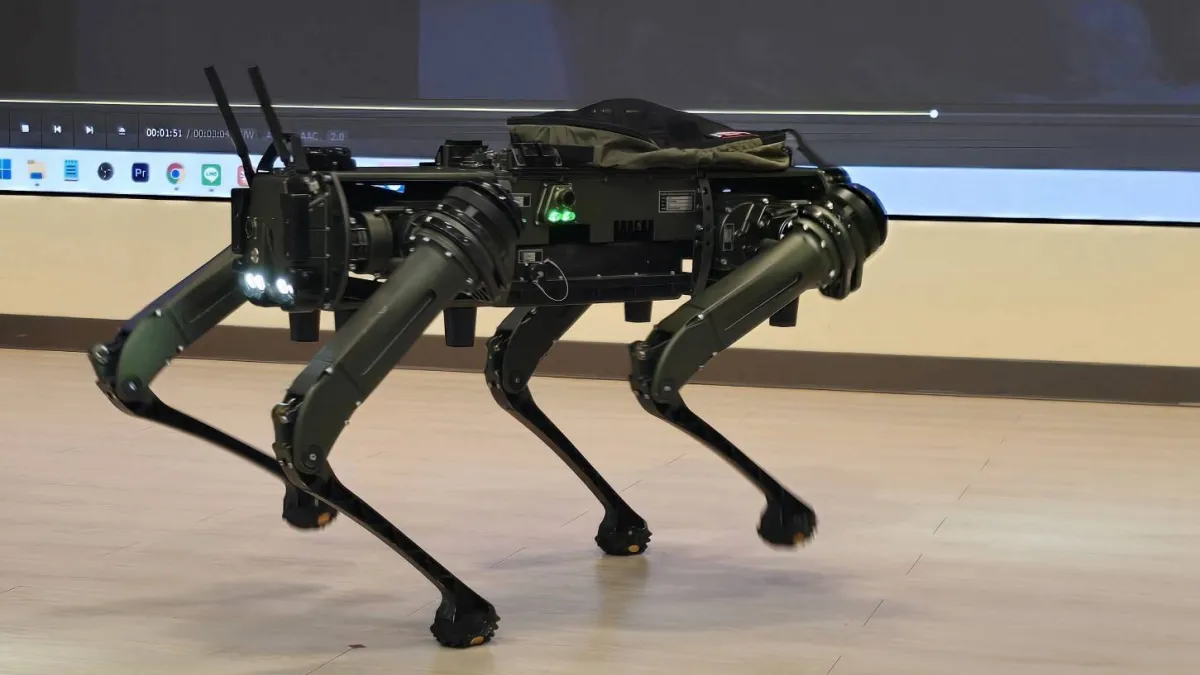
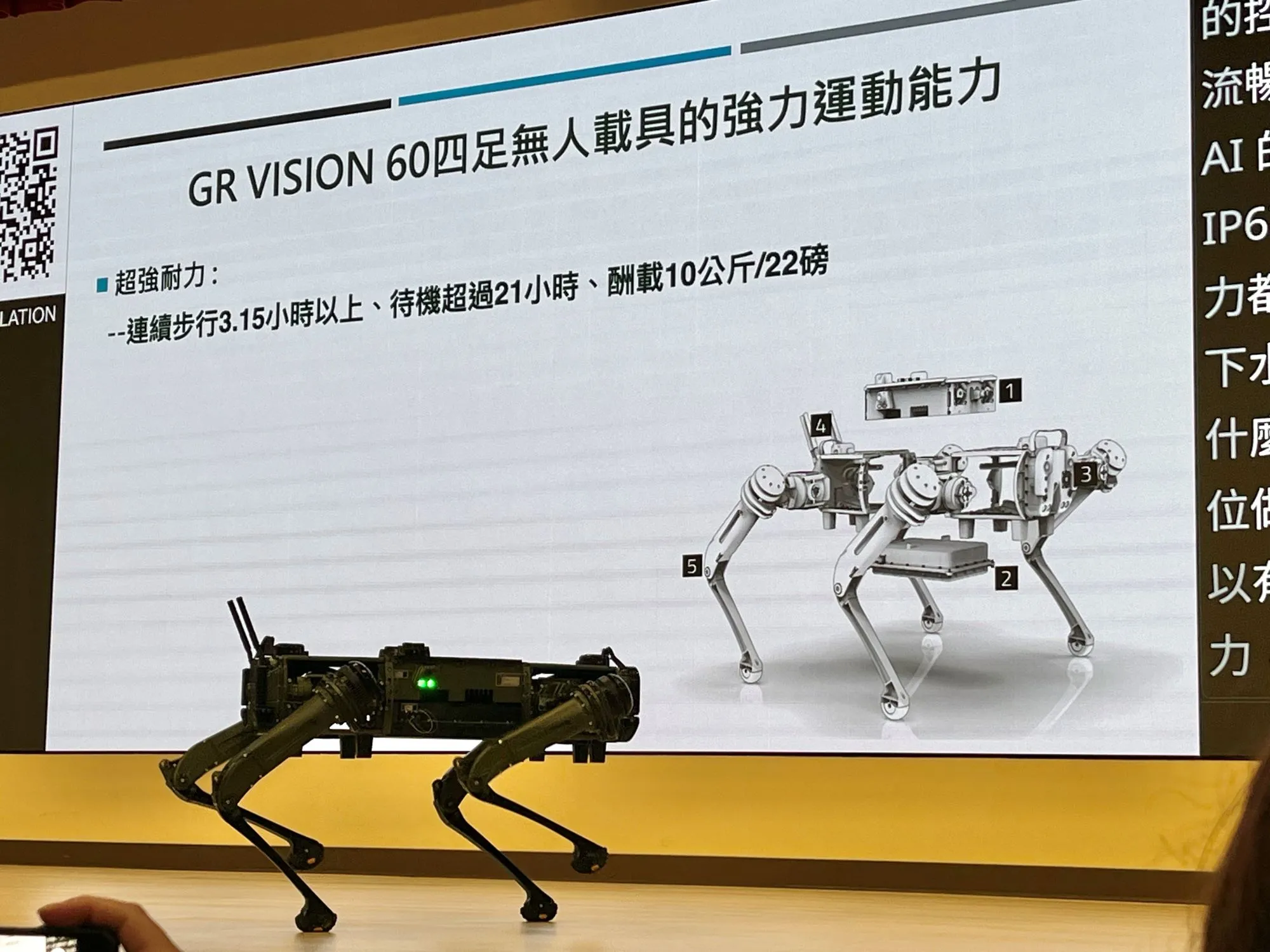
A four-legged robot already in service with the US military is now being built under license in Taiwan by a venture backed by food giant I-Mei Foods, and the machine went on public display at a Taiwan-Japan technology forum in Taipei on October 11, 2026.
The robot, Ghost Robotics' Vision 60, marks the arrival of Taiwan's unmanned systems push on land. The island's defense and industrial planners have so far focused on aerial drones and uncrewed boats, but a ground-based "robot dog" now joins the lineup.
The appearance at the Taiwan Japan Technology Future Forum, hosted by the Indo-Pacific Strategy Think Tank, was the platform's third public showing in Taiwan this year. It was first displayed at the National Chung-Shan Institute of Science and Technology (NCSIST), Taiwan's military-run research and weapons development agency, in June, and again at the Taiwan Automation Intelligence and Robot Show in August.

A Snack Maker Leads Taiwan's Robot Dog Venture
The Taiwanese licensee was set up in May 2025 by I-Mei Foods, one of Taiwan's best-known snack and food brands, together with two robotics component suppliers in which I-Mei has invested, Mirle Automation Corp. and Golden Saddle Machinery Co., and system integrator Syntec Technology. Known in English as Tansimo Robotic Manufacturing, the company has since changed its Chinese name from one meaning robot manufacturing to one centered on unmanned systems.
According to a Ministry of Economic Affairs release, the company holds an overseas production license from US-based Ghost Robotics. The Vision 60 has been adopted by the US Marine Corps, Army, and Air Force, and more than 1,000 units have been delivered worldwide.
The US military formally classifies such machines as quadrupedal unmanned ground vehicles, or Q-UGVs, according to research by the Institute for National Defense and Security Research, a Taiwanese government-funded think tank. Other makers in the field include Boston Dynamics and L3Harris.
China's Low Prices Make Mass Production The Real Test
Speaking on a forum panel, Owen Lin (林宏文), an adviser to Taiwan's Business Today magazine, said the Vision 60 costs around NT$10 million per unit. Comparable hardware made by Chinese robotics firms such as Unitree Robotics sells for only NT$200,000 to NT$300,000, he said, because China's huge domestic market lets manufacturers spread costs across far larger production runs.
Lin tied the issue to a proposal from Kiyofumi Iwata (岩田清文), the former chief of staff of Japan's Ground Self-Defense Force, a post equivalent to army commander. In his keynote at the same forum, Iwata urged Taiwan and Japan to start their defense industry cooperation with drones.
If the two sides do move forward on joint drone work, Lin said, bringing average costs down to an acceptable level will depend on mass production, so both governments and industries will need to plan for how to raise output.
Swappable Payloads Turn One Platform Into Many Tools
Wu Jung-tsan (吳榮燦), deputy general manager of Tansimo, told the forum that the robot's value lies in its mission payloads. Different equipment packages allow the same platform to handle inspection, search and rescue, protection, and detection work.
For navigation, the Vision 60 can carry lidar with advanced obstacle avoidance, letting it patrol or plot its own route across complex terrain around fixed or moving obstacles. It can also pinpoint its position indoors or underground where there is no GPS signal. Paired with a wireless charging dock, it can return on its own to recharge, which cuts maintenance costs and suits long-running security monitoring.
Its robotic arm has six degrees of freedom and is easy to mount and remove. Wu said the arm can open doors, pick up ammunition, and even pull open a zipper. It has a gripping force of up to 11.3 kg and can lift and move objects weighing 3.75 kg, making it suitable for explosive ordnance disposal, disaster rescue, and work in hazardous environments, while reducing the risk to personnel in riot control and when handling suspicious objects.
On the sensing side, its low-light camera can produce clear images at 0.0001 lux and is built to withstand impact, immersion, and extreme conditions. A pan-tilt-zoom camera offers 33x optical zoom, 360-degree horizontal rotation, 90-degree tilt control, and 255 preset positions with automated patrol routes. Built-in infrared LEDs extend night vision to 50 meters, even in total darkness.
A dedicated security payload processes camera feeds to detect targets and track their movements, enabling automated patrols and real-time monitoring. Combined with low-light and thermal imaging, it can capture clear images in poor lighting.
NCSIST Turret Adds Riot Control Firepower
Wu said another feature drawing attention is a gun turret developed with NCSIST that combines daylight video, thermal imaging, and laser rangefinding, and that can fire live riot-control rounds.
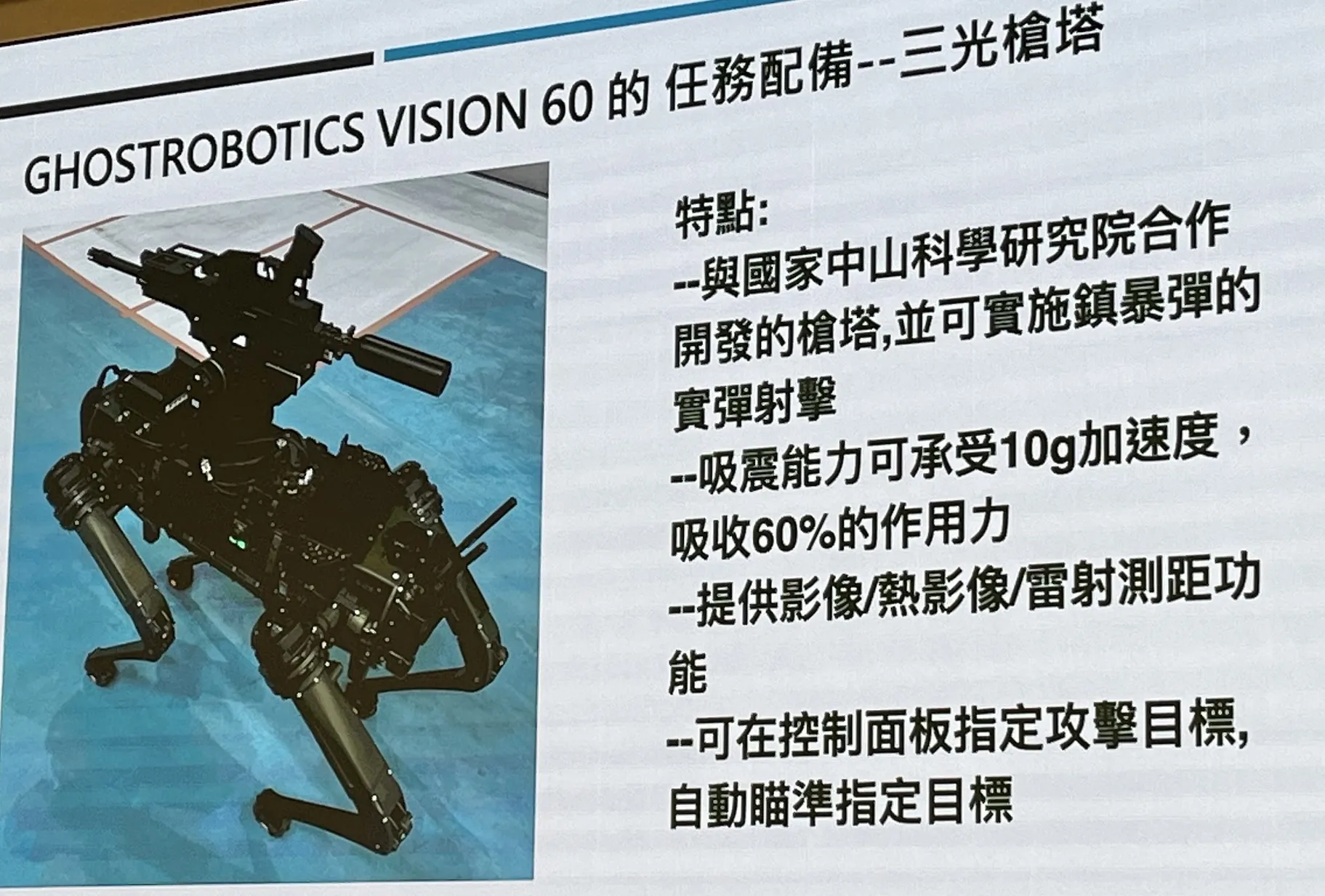
The turret's shock absorption system can withstand 10g of acceleration and absorb 60% of the impact force. Operators can designate a target on a control panel, and the system then aims at it automatically.
The joint work with NCSIST also highlights the platform's dual-use potential, with the same machine able to serve both military and civilian needs. (Related: Japan’s Ex Army Chief Pushes Taiwan Drone Alliance | Latest )