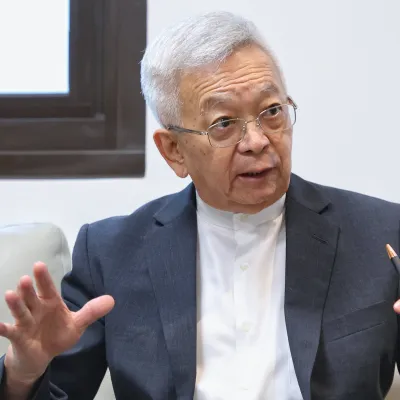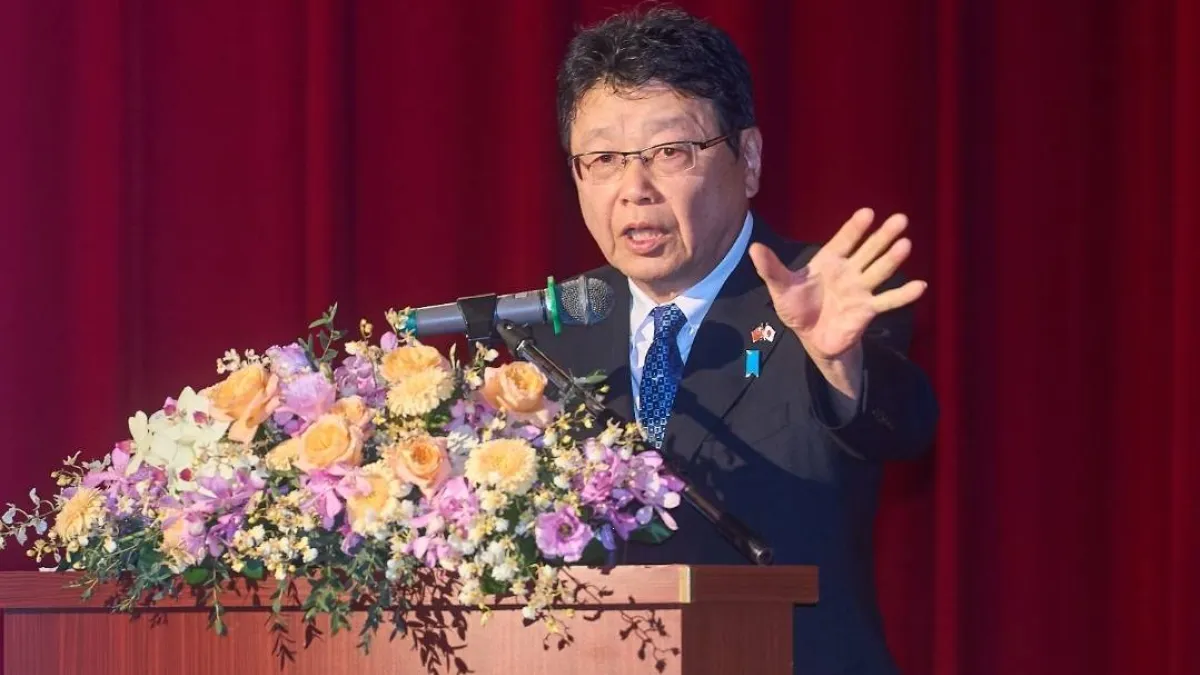
Makoto Nishida, secretary-general of Japan's Komeito party, told the upper house of the Diet on October 9 that Japan had acknowledged Taiwan's return to China under the 1972 Japan-China Joint Communique, a claim that drew swift condemnation from Japanese conservatives who accused him of rewriting history in Beijing's favor.
Nishida made the remarks during a representative interpellation in a plenary session of the House of Councillors, responding to Prime Minister Sanae Takaichi's policy address. He also pressed the government to state whether it regards Taiwan independence, like Chinese military action, as a unilateral change to the status quo that Tokyo does not support.
Nishida Ties Taiwan's Status To The 1972 Communique
In the section of his questioning on Japan-China relations and the Taiwan issue, Nishida pointed to two clauses of the 1972 document. Under Article 2, Japan recognized the government of the People's Republic of China as the sole legal government of China. Under Article 3, Japan stated that it "firmly maintains its stand under Article 8 of the Potsdam Proclamation."
"In other words, Japan acknowledged that Taiwan would be returned to China," Nishida said. "Not recognizing 'two Chinas' or 'one China, one Taiwan,' that is, not supporting Taiwan independence, has been the position of successive governments."
He argued that Japan's accommodation of Beijing's position rests on the premise that cross-Strait differences are settled peacefully and that stability in the Taiwan Strait holds. To make his case, he cited the September 22 joint statement issued after a meeting of the foreign ministers of the United States, Japan, and South Korea, which urged a peaceful resolution of cross-Strait issues and voiced opposition to any attempt to unilaterally change the status quo.
Nishida said that opposition naturally covers any use of force by China against Taiwan. But he added that, as he understood it, Tokyo and Washington also share the basic view that Taiwan independence would equally alter the status quo and is supported by neither government. He asked the Takaichi administration to clarify its position.
Kadota Says Beijing Never Ruled Taiwan
Ryusho Kadota, an author and veteran journalist, was among the first to respond, calling the remarks a jaw-dropping piece of nonsense delivered on the floor of the Diet. He noted that the Potsdam Declaration was issued in 1945, four years before the People's Republic of China was founded in 1949, and that the Chinese Communist Party has never governed Taiwan for a single day.
"Is there really any need in Japan for a party that helps China fabricate history?" Kadota wrote.
He later expanded on the criticism in a video on his YouTube channel, arguing that Chinese influence has seeped into nearly every sector of Japanese society. Kadota described Komeito as closely aligned with the Chinese Communist Party, said its positions in effect relay Beijing's interests, and warned that Nishida's questioning concealed a subtle distortion of history that the Japanese public must guard against.
Kitamura And Uehata Accuse Komeito Of Serving Beijing
Haruo Kitamura, a House of Councillors member from the Conservative Party of Japan, shared Kadota's post and said he was stunned. "I am truly astonished by this remark," he wrote. "Just how far will they go in their loyalty to the Chinese Communist Party!"
Kitamura added that he felt a measure of relief remembering that Komeito had left the ruling coalition last year. In a separate repost, he lamented: "To think that such a party was in government until last year." He acknowledged that the Liberal Democratic Party (LDP) also has a number of lawmakers with similar views, but said Komeito's current conduct was hard to accept.
Norihiro Uehata, an LDP member of the Kobe City Council, reposted footage of the session and branded Nishida "a traitor acting for the benefit of an enemy state." He said Nishida was effectively "serving as the mouthpiece of China, a brutal and lawless dictatorship."
Japanese Social Media Users Pile On
The clip also circulated widely online, where many Japanese users echoed Kadota's historical objection. One asked how Taiwan could be "returned" to a state that did not exist when the Potsdam Declaration was signed and has never ruled the island, calling Komeito's argument a fabrication.
"Huge bad news: Komeito has finally stopped pretending and no longer hides what it really thinks," another user wrote. A third remarked: "It's amazing that a party like this was still in the ruling coalition a year ago."
Why The Dispute Matters For Taiwan
The exchange touches on one of the most sensitive questions in Japan's postwar diplomacy. In the 1972 communique, Japan said it "fully understands and respects" Beijing's position that Taiwan is an inalienable part of the PRC, wording that successive Japanese governments have treated as stopping short of formal recognition of that claim. Under the 1951 San Francisco Peace Treaty, Japan renounced all right, title, and claim to Taiwan without specifying which government would receive it.
Komeito, which is backed by the lay Buddhist organization Soka Gakkai and has long cultivated ties with Beijing, ended its decades-long coalition with the LDP in October 2025. Its comments come as Takaichi, an outspoken advocate of closer Japan-Taiwan security ties, faces continued pressure from China over her earlier remarks on a possible Taiwan contingency. (Related: What Is a 'Taiwan Contingency'? A Timeline of the Japan-China Standoff Over Takaichi's Remarks | Latest )
Original Article In Chinese: 日本公明黨幹事長稱「日本承認台灣歸還中國」!北村晴男等保守派痛批效忠中共、捏造歷史