 |
Integrated solution strengthens IPsec VPN communications carrying sensitive data across data centre, cloud, and operational environments
SINGAPORE, Oct. 6, 2026 /PRNewswire/ -- Toshiba Asia Pacific Pte. Ltd. (TAPL), a subsidiary of Toshiba Corporation, today announced the successful validation of a quantum-safe communications solution developed in collaboration with SpeQtral and HPE, enabling Critical Information Infrastructure (CII) operators and government agencies to strengthen IPsec VPN connections against emerging quantum threats.

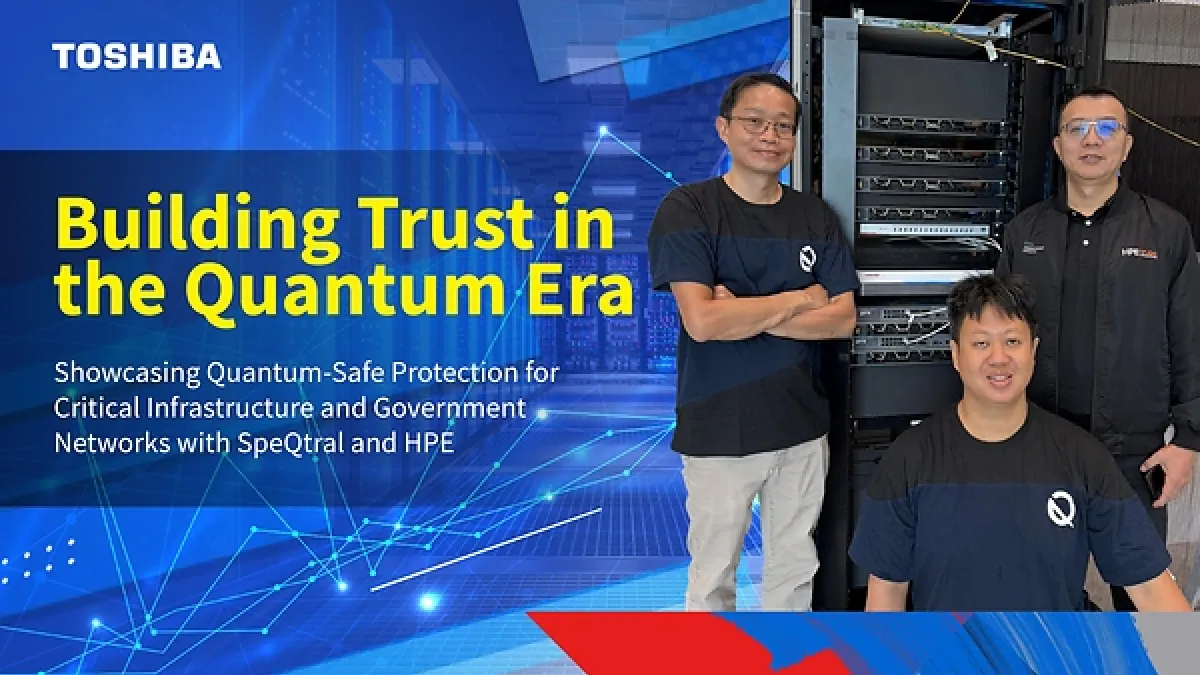
Building Trust in the Quantum Era
IPsec remains one of the most widely used protocols for securing sensitive communications across data centres, cloud environments and operational systems. As quantum computing advances, however, today's IPsec deployments face growing "harvest now, decrypt later" risks, where encrypted data captured today could be decrypted in the future. As a result, organisations are seeking crypto-agile, quantum-safe migration strategies that can strengthen protection while preserving existing network infrastructure.
Through the collaboration between Toshiba, SpeQtral and HPE, a validated quantum-safe solution integrates Toshiba's Quantum-secure Networking (QSN) Platform with HPE Networking SRX Next Generation Firewall, enabling organisations to introduce quantum-safe key material into existing IPsec environments.
The solution combines two quantum-safe technologies: Post-Quantum Cryptography (PQC), which uses quantum-resistant cryptographic algorithms, and Quantum Key Distribution (QKD), which uses quantum-generated encryption keys. By combining key material derived from both methods, organisations can strengthen the protection of sensitive communications without relying on a single technology, delivering defence-in-depth security while maintaining the crypto-agility needed to adapt to evolving security standards and future quantum threats.
SpeQtral is leading the solution integration, bringing together Toshiba's QSN Platform and HPE Networking SRX Next Generation Firewall in a deployment-ready model. The demonstration successfully verified interoperability and secure IPsec VPN operation using quantum-safe key material, providing organisations with a practical pathway to strengthen cyber resilience while preserving existing network investments.
"As organisations prepare for the quantum era, they need practical, non-disruptive pathways to strengthen security across their existing operations. Together with Toshiba and SpeQtral, we have demonstrated how quantum-safe capabilities can be integrated into existing IPsec environments using HPE's advanced firewall solution. We are delighted to collaborate with Toshiba and look forward to continuing our work together to help customers build stronger cyber resilience today while preparing for the quantum threats of tomorrow," said Mark Ablett, Vice President, Asia Pacific and Japan, HPE Networking.
Chune Yang Lum, Co-Founder and CEO of SpeQtral, said: "Organisations recognise the need to begin their quantum-safe transition, but they also require solutions that can be integrated into existing environments with minimal disruption. Working with Toshiba and HPE, we have demonstrated a practical and deployment-ready approach that combines quantum-safe technologies with established IPsec infrastructure. "
"CII operators and government agencies need confidence that their critical networks can remain protected as quantum risks grow. Crypto-agility is a key consideration for organisations planning their quantum-safe journey. Through our collaboration with SpeQtral and HPE, Toshiba is demonstrating how a layered QKD and PQC approach can strengthen IPsec communications today while providing the flexibility to adapt to future security requirements," said Anandaraman Sankaran, Strategic Partnerships & Marketing Lead, APAC of Toshiba Asia Pacific.
The integrated solution will be showcased at GovWare 2026, where attendees can explore how quantum-safe capabilities can be integrated into existing IPsec VPN environments and gain insights into practical, crypto-agile approaches for protecting critical communications against future quantum-enabled threats.
Meet Toshiba at GovWare 2026
Date: 13-15 October 2026
Venue: Sands Expo and Convention Centre, Singapore
Booth: B23
Registration: https://asia.toshiba.com/event/govware-2026/
About Toshiba Asia Pacific Pte. Ltd.
Toshiba Asia Pacific Pte. Ltd. (TAPL), a subsidiary of Toshiba Corporation, was established in 1995 as Toshiba's regional headquarters for operations in Southeast Asia, India and Oceania. TAPL supports Toshiba companies across the Asia Pacific region by driving growth in Energy Solutions, Digital Infrastructure Solutions, and Devices & Technology. TAPL's commitment aligns with Toshiba's unwavering drive to deliver integrated solutions that support sustainable growth, infrastructure resilience, and the achievement of carbon neutrality and a circular economy.
Find out more about TAPL at https://asia.toshiba.com/
(Related:
ICP DAS to Showcase Industrial Communication and Reliable I/O Solutions at Measurement and Control Show NEXT 2026
|
Latest
)