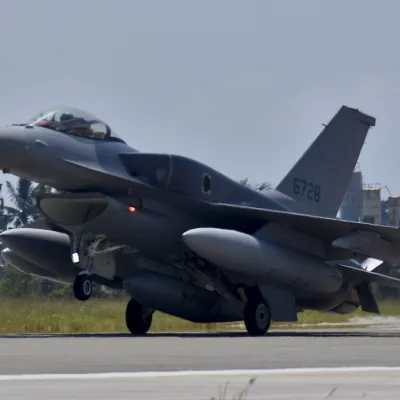
When Chinese military aircraft and warships swarmed the waters around Taiwan in mid September, much of the coverage in Taiwan framed the surge as Beijing's answer to the island's own military exercises and to a visit by President Lai Ching-te (賴清德) to the Jiupeng (九鵬) military base. Lu Wen-hao, a researcher at the Chinese Society for Strategic Studies, argues that the record tells a different story. In his reading, a key trigger was the passage of two New Zealand navy ships through the Taiwan Strait on September 18, and the People's Liberation Army (PLA) had been preparing for them for days.
The Numbers Behind The Mid September Surge
Media reports at the time said Chinese aircraft had been present in Taiwan's southwest airspace for 70 consecutive hours. The PLA appeared to stage three straight days of joint drills over the Taiwan Strait and the southwest airspace from September 16 to 18, including a "joint combat readiness patrol" on September 17. On September 18, the day Lai inspected Jiupeng, Chinese military aircraft began entering the strait in rotation at 7:10 a.m. and did not fully withdraw until 7 p.m. the next day, a run of 36 hours. As many as 11 PLA warships and two other Chinese government vessels were operating around Taiwan.
Lu cautions against reading such activity solely through the lens of Taiwan's own drills. If the PLA simply mirrored every major Taiwanese exercise, he notes, it should have deployed large air and naval forces every day of this year's Han Kuang 42 exercise, which it did not. He also points out that experts have complained Taiwan's defense ministry now releases less detail than it once did, which makes careful analysis more important.
How The Author Tracks PLA Activity
Lu's method is to follow the data day by day, check it week by week, review each month as a whole and compare it with the same period a year earlier. He divides the waters around Taiwan into four sectors: the north, the west, the southwest, and the east through the southeast.
Applying that approach to ship counts published by Taiwan's Ministry of National Defense reveals a clear rhythm. On September 17, the day of the joint patrol, only seven PLA warships and two government vessels were reported. The warship count jumped to 11 on September 18 and 19, while government vessels rose from three to six. By September 20, warships had fallen back to seven and government vessels to four. On September 21, warships returned to a routine level of six, but government vessels climbed again from three to six on September 22 and stayed there through September 23.
A Pattern Tied To Taiwan's Leaders And Diplomacy
Lu has long observed that the PLA's Eastern Theater Command tends to hold joint combat readiness patrols just before Taiwan's president or vice president travels abroad, and again at some point after they return. Between early and mid September, the PLA carried out three such patrols, on September 5, 9 and 17.
He links the September 9 patrol to remarks Lai made on September 5 at a dinner marking the 79th Lawyers' Day hosted by Taiwan's national bar association, where the president accused China of misusing United Nations General Assembly Resolution 2758 internationally on top of its military intimidation and infiltration of Taiwan. The September 17 patrol, Lu argues, followed Vice President Hsiao Bi-khim's (蕭美琴) trip to Italy, where she attended the 2nd European Conference of Ventotene for Freedom and Democracy on September 11 at the invitation of European Parliament Vice President Pina Picierno and Carlo Corazza, head of the parliament's office in Italy. Hsiao returned to Taiwan on September 14.
Why New Zealand's Transit Changes The Picture
The decisive evidence, in Lu's view, lies in what happened next. According to Taiwanese media, HMNZS Aotearoa, a polar class replenishment ship and the largest vessel in New Zealand's navy, began a north to south transit of the Taiwan Strait at about 5:28 a.m. on September 18. Chinese state media reported that the frigate HMNZS Te Mana and the Aotearoa passed through the strait that day and that the PLA tracked and monitored them throughout, with the situation "fully under control."
A chart released by Taiwan's defense ministry on the morning of September 19 shows that from 7:10 a.m. on September 18 to 6 a.m. the next day, PLA fighters, helicopters and drones flew 11 sorties in airspace west of the strait, stretching from east of the Zhejiang and Fujian border to southeast of Dongshan in Fujian. Four of those sorties crossed the median line across the northern, central and southern sections of the strait.
Taiwan's government has said it will not disclose the movements of friendly forces. But Lu argues that laying the official chart alongside the New Zealand ships' route makes the interaction visible. For low, slow surveillance of a ship at sea, helicopters are the best tool, followed by drones, while fighters assert control of the air and sea. That mix of aircraft, he says, fits a mission to shadow the New Zealand ships. On that basis, he dismisses the theory that the September 16 to 18 drills were aimed only at Taiwan's armed forces and its president.
A Broader Signal Ahead Of Exercises Near Scarborough Shoal
The transit came just before a multinational naval exercise held from September 20 to 23 by the United States, Japan, Australia, the Philippines, India, New Zealand, Singapore and Brunei, which ran from Subic Bay in the Philippines to waters near Scarborough Shoal. Lu argues that New Zealand's decision to route its ships through the Taiwan Strait on the way clearly angered Beijing. The PLA's Southern Theater Command later organized air, naval and coast guard forces for joint combat readiness patrols near Scarborough Shoal.
He suggests that the jump from eight to 11 PLA warships may reflect three ships assigned to keep the New Zealand vessels east of the median line. The rise in Chinese government vessels, he adds, resembles July 21, when China Coast Guard ship 2102 monitored foreign vessels southwest of Taiwan while the Chinese research ships Sun Yat-sen University and Dong Fang Hong 3 carried out ocean surveys in the same area. Some of the increase may also reflect coast guard patrols near Taiwan's outlying islands and in waters southeast of Taiwan.
That eastern presence has since become explicit. On September 26, the Chinese military channel CCTV-7 reported that China Coast Guard ship 2503 Zhujiajian had stood watch east of Taiwan around the clock on the Mid Autumn Festival, even photographing the ship against the full moon. On September 29, China Coast Guard spokesman Jiang Lue said the Zhujiajian formation was conducting "regular law enforcement patrols" east of Taiwan. Taiwan's Coast Guard Administration said that at about 4 p.m. that day, the Zhujiajian and the Chongming (1401) were operating 97 nautical miles northeast of Green Island and 146 nautical miles east of Orchid Island respectively, under continuous monitoring by Taiwanese patrol ships.
Early Warning Signs In The Northern Strait
Lu traces the buildup back to September 13, when Taiwan's defense ministry reported six PLA warships and two government vessels. On September 14, warships rose to seven, and a shipborne helicopter was shown operating north of the Diaoyutai Islands, implying a warship was deployed there. On September 15, warships reached eight and Chinese aircraft began operating over the northern strait. On September 16, aircraft extended from the northern strait to the 27th parallel north of the Diaoyutai Islands. Part of the September 17 joint patrol also continued in the northern strait. To Lu, this shows the PLA rehearsing air and sea control and setting up early warning for foreign ships about to enter the northern end of the strait.
The September 17 patrol also featured the H-6K, a strategic bomber in active service with China's air force. Its combat radius has been extended from just over 2,000 kilometers to more than 3,000 kilometers, its maximum penetration speed is around Mach 0.8, and it can carry six CJ-10 cruise missiles.
What A Year On Year Comparison Reveals
The pattern echoes September 2025. On the morning of September 12 last year, the US destroyer USS Higgins and the British frigate HMS Richmond, part of a UK carrier group, transited the strait from north to south. At 8 a.m. the next day, the Eastern Theater Command sent out 27 sorties, including J-16 fighters, H-6 bombers, KJ-500 early warning aircraft and drones, 26 of which crossed the median line and its extension into Taiwan's central, southwest and eastern airspace and over the Western Pacific for a joint combat readiness patrol and air and sea training.
This year the sequence ran in a different order. From 8:45 a.m. on September 17, the PLA first conducted its joint patrol, sending 19 sorties of J-11, J-16 and JH-7 fighters, H-6K bombers, KJ-500 early warning aircraft, Y-8 electronic warfare aircraft and drones, 15 of which crossed the median line into Taiwan's southwest and central airspace. The next day, Lu writes, the PLA was waiting for the New Zealand ships to sail into the strait.
The Long Way Round From Japan
International media reported that the New Zealand task group left Devonport Naval Base in Auckland on June 12, joined the RIMPAC 2026 exercise in Hawaii and the Pacific Dragon drill, and from mid August to early September monitored United Nations sanctions on North Korea in waters around Japan. It trained with the Japanese destroyer JS Amagiri (DD 154) south of the Kanto region on September 7 and 8, made a goodwill port call at Yokosuka from September 8 to 15, and sailed on September 15.
The shortest route from Yokosuka to the South China Sea would have been south through the Western Pacific. Instead, the ships took the longest path, passing near Japan's southwestern islands and the waters north of Taiwan before entering the strait from its northern end. Lu notes that the task group also transited the strait on September 25 and November 5 last year, making this its third passage in about a year.
On September 21, Reuters quoted a New Zealand Defence Force spokesperson confirming that the two ships passed through the strait on September 18 as part of a three month Indo Pacific deployment. Prime Minister Christopher Luxon told reporters in Wellington it was a routine activity carried out in a safe and professional manner, fully consistent with international law and in international waters. Lu expects the choice of a longer route to prompt faster and tougher PLA responses to foreign warships in future.
How The PLA Watches Foreign Warships
Lu believes the PLA's intelligence, surveillance and reconnaissance units were tracking the New Zealand ships from the moment they left Japan, and that the PLA has developed a set procedure for monitoring foreign warships. Chinese electronic reconnaissance ships routinely shadow multinational exercises to collect electronic signatures, which can later serve as early warning data for tracking ships at sea.
He compares the New Zealand route with that of the Japanese destroyer JS Ikazuchi, based at Yokosuka, which on April 17 this year sailed through the Taiwan Strait from north to south for the first time. Two other Japanese ships, the helicopter carrier JS Ise from Sasebo and the transport ship JS Shimokita from Kure, headed for the South China Sea by way of the Western Pacific east of Taiwan and the Bashi Channel. Both groups, which joined the Philippine and US Balikatan exercise from April 20, were tracked by Chinese intelligence units from the time they left port. The New Zealand ships, Lu says, followed the Ikazuchi's pattern: heading south along the Western Pacific as a feint, then turning west to take the long way into the strait.
Helicopters And Drones Working In Tandem
Lu identifies the helicopters in the ministry's charts as attack helicopters of the Eastern Theater Command's army aviation, which he says the PLA sends out over the sea to control the airspace and waters along a foreign warship's route. His records of PLA responses to foreign ship transits in recent years support that conclusion. The pattern first caught his attention on May 10, 2022, when a Chinese army Z-10 attack helicopter crossed the median line to monitor the US guided missile cruiser USS Port Royal (CG 73) as it transited the strait.
Activity continued after the New Zealand transit. On September 19, between 6 a.m. and 7:05 p.m., a helicopter and a drone flew two sorties from east of Wuqiu (烏坵) to south of Kinmen, crossing the median line southeast of Wuqiu and between south of Kinmen and southwest of Penghu. On September 20, between 9:45 a.m. and 6:45 p.m., another helicopter and drone flew from east of the Zhejiang and Fujian border to east of Quanzhou, with one crossing the median line southeast of Wuqiu. A helicopter was again reported east of Wuqiu on September 21.
Lu argues the two aircraft types are cooperating to watch targets in the strait, noting that PLA army aviation airfields now also host drones. Even when they do not fly side by side, he says, they can coordinate remotely through data links, which can only be detected and decoded with specialized equipment. Chinese military literature he has reviewed describes using attack helicopters to strike a ship's command center and paralyze its central control systems, and teaming them with army aviation drones for shared situational awareness, target designation, coordinated strikes, relay guidance and defensive operations. Together, he says, these support a defense strategy stretching from China's coast to the median line of the strait.
What To Watch Before Taiwan's National Day
Lu's broader point is that PLA activity follows recurring cycles that can be anticipated. Taiwan's defense ministry reported on October 1 that from 6 a.m. on September 30 to 6 a.m. on October 1, 23 Chinese aircraft sorties were detected, 16 of which crossed the median line into Taiwan's northern, central and southwest airspace, along with seven warships and seven government vessels. Within that window, the Eastern Theater Command sent out 21 sorties of J-10, J-11 and J-16 fighters, JH-7 fighter bombers, Su-30 fighters, KJ-500 early warning aircraft, Y-8 electronic warfare aircraft and drones from 9:12 a.m. on September 30, with 15 crossing the median line for a joint combat readiness patrol.
Lu had predicted this on his blog on September 27. Last year, the PLA held a joint patrol on September 29, a make up holiday for Teachers' Day in Taiwan, so he expected another before the end of September. This year's patrol came on September 30, one day after the holiday, making it the fourth joint patrol of the month.
China has now entered its seven day National Day holiday, during which the PLA traditionally goes on heightened alert across its regions and sea areas. With the northeast monsoon strengthening from the evening of October 1 and bringing rain to northern and northeastern Taiwan, Lu expects only a few Chinese aircraft on patrol and a larger number of warships deployed around the island. Weather forecasts suggest conditions will stabilize around October 7. Since the PLA held a joint patrol on October 7 last year ahead of Taiwan's National Day on October 10, Lu expects it to choose a day of suitable weather for its October patrol before this year's Double Ten celebrations.
Lu Wen-hao is a researcher at the Chinese Society for Strategic Studies. The views expressed are the author's own.