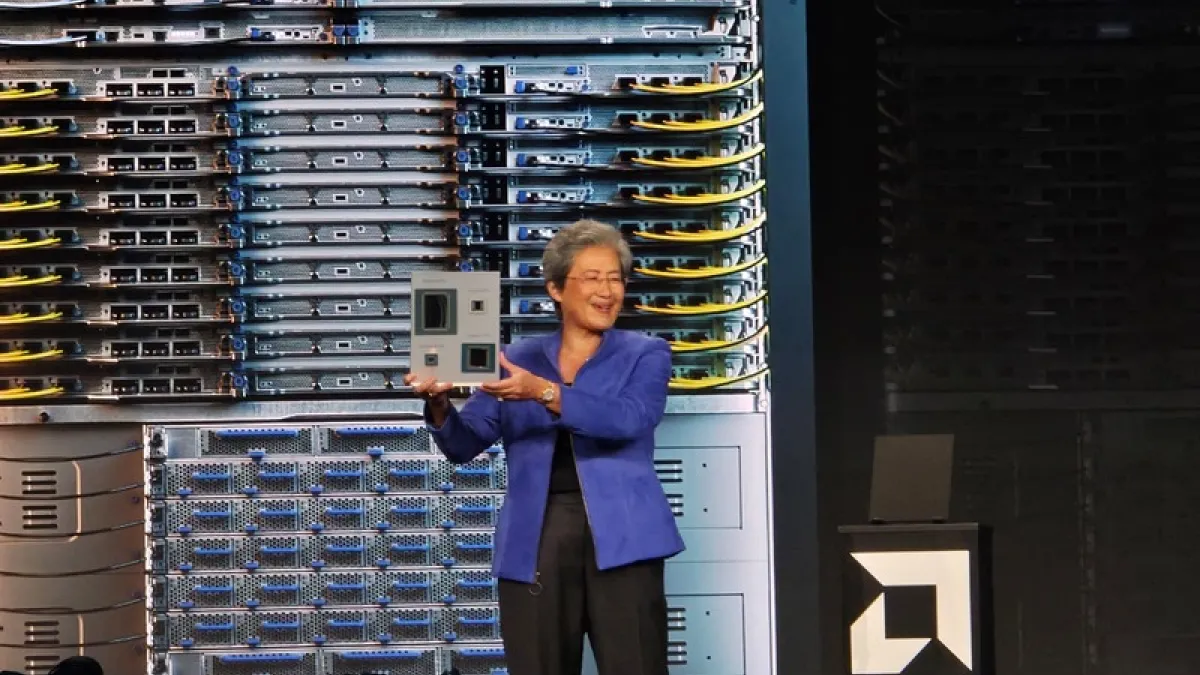
AMD's stock jumped 9.6% on September 21, pushing its market capitalization above $1 trillion for the first time. The milestone says less about one strong trading session than about where the real competition in AI chips has moved: from building the fastest processor to building the fastest factory.
AMD's rally reflects its shift from component supplier to full system builder. Its Helios rack scale platform packages GPUs, CPUs, networking and software into a single integrated offering, following a path Nvidia set years earlier as it expanded from GPUs and its NVLink interconnect technology into the CUDA software platform and what CEO Jensen Huang calls the AI factory. Broadcom is chasing the same goal from another angle, helping cloud providers design custom AI chips and build out Ethernet based networking, while Huawei is assembling its own AI computing stack around Ascend chips, CANN software and proprietary interconnects. The unit of competition in AI hardware has grown from a single chip to an entire factory.
A Race That Now Spans Entire AI Factories
That shift has exposed a bottleneck nobody fully solved first. Chips can now compute faster than data can move between them, and much of the industry was built around the opposite assumption for years.
Picture an AI factory as a fast growing city. The GPUs are skyscrapers, the high bandwidth memory sitting next to each chip is a warehouse built right beside the tower, and the interconnect network linking it all together is the city's roads and railways.
For the past several years, the industry has mostly built skyscrapers. Each new chip generation, from Nvidia's H100 and Blackwell to the upcoming Rubin, pushed raw compute higher, and AMD, Google, Amazon, Meta and Huawei have all kept pace with chips of their own. But adding 10 times more buildings without widening the roads produces exactly what it sounds like: a city that grinds to a halt at rush hour. That is the jam now facing AI data centers.
Faster Chips Still Need Faster Roads
A single GPU can compute extraordinarily fast. Get 100,000 of them working together and it becomes a different problem entirely. Training a large model requires every chip in the cluster to constantly exchange data and synchronize parameters with the others. The moment the network clogs, those expensive chips sit idle waiting for data to arrive.
That shared problem explains why Nvidia built NVLink, AMD is pushing an alternative called UALink, and Broadcom is betting on Ethernet. Each is trying to solve the same question: how to make 100,000, or even 1 million, AI chips function as if they were one. Every major chipmaker has, in effect, started paving its own AI city's roads.
Copper Highways Give Way To Optical Rail
Even those roads have limits. Most data still moves between chips and servers as electrical signals, carried over copper, which is cheap and well understood over short distances, like a city's highway system. But as the city grows and the volume of cargo increases, relying entirely on trucks on highways eventually runs into diminishing returns.
High speed electrical signals face the same math. The faster and farther they travel, the worse the signal loss, power draw and heat become. As AI data centers scale toward hundreds of thousands of GPUs, simply moving data between them starts consuming enormous amounts of electricity. The industry's answer has been to build the equivalent of high speed rail: optical interconnects, which carry far more data with a meaningful energy efficiency advantage over longer distances. The notable trend now is that optics keep creeping closer to the chip itself, which is what is driving rapid interest in co packaged optics, or CPO.
CPO Brings The Rail Station To The Chip
Conventional optical modules typically sit on a switch's front panel. Data leaving the switch chip still has to travel part of that electrical highway across a circuit board before it reaches the optical module and converts to light. Co packaged optics effectively moves the rail station right next to the switch chip itself.
Under this approach, data converts from electrical to optical signal almost immediately after leaving the chip, shortening the distance the slower electrical signal has to travel before switching to fiber for the bulk of its journey. The logic is straightforward: since electrical signals strain more with every added meter, get the data onto light as early as possible.
Optical links first connected separate data centers, then spread to connections between server racks. As AI compute density keeps rising, optics may keep pushing closer still, into the chip package itself. The next phase of the hardware race increasingly comes down to one question: how close can light get to the GPU?
Building Light Roads And Digging Water Channels
That question explains two technical directions now developing in parallel across the AI hardware industry. One track, building the light roads, covers silicon photonics, co packaged optics and high speed optical interconnects, aimed at solving the data movement problem. The other, digging the water channels, covers liquid cooling, microfluidic channels and new materials designed to carry away the enormous heat that dense AI chips generate. Both responses trace back to the same root cause: AI is packing more compute and power into smaller spaces while demanding that ever more chips work in concert.
For decades, the semiconductor industry's central engineering question was how to pack more transistors onto a single chip. The AI era has added a second, equally demanding question: how to make 100,000 separate chips behave as though they were one. As a result, competitive advantage in AI hardware is spreading outward from the GPU itself, elevating the importance of high bandwidth memory, advanced packaging, high speed switches, silicon photonics, co packaged optics, power delivery and liquid cooling all at once.
Taiwan's Next Battle Is Connecting Chips With Light
That spreading competition is exactly where Taiwan's next test lies. During the GPU era, Taiwan secured a central position in the global AI hardware supply chain through TSMC's advanced manufacturing and CoWoS packaging technology, paired with the server assembly capacity of companies such as Foxconn, Quanta, Wistron and Wiwynn. Entering the optical interconnect era, that advantage has to extend further rather than simply hold.
Chinese manufacturers already have a deep base in mass producing high speed optical modules at competitive cost, while American firms control critical technology in switch chips, high speed signaling and system architecture. Taiwan's task now is to extend its semiconductor manufacturing and advanced packaging strength into silicon photonics, co packaged optics and broader optoelectronic integration.
As optical components move closer to switch chips, industries that once operated separately, semiconductor manufacturing, advanced packaging and optical communications, are converging. That convergence may be exactly where Taiwan's next opportunity lies. Jensen Huang was the first to reframe the GPU race as an AI factory race, and AMD, Broadcom and others are now building their own competing ecosystems around that same idea. As AI factories keep growing, the competitive frontier naturally shifts to whatever physical bottleneck comes next.
In the first half of the AI buildout, Taiwan's most valuable capability was simply making the chips. Entering the AI factory era, the next test is whether it can connect those chips with light. This race to the speed of light will decide whether Taiwan can carry the advantages it built during the GPU era into whatever comes next.