The wars in Ukraine and the Middle East are turning drones from expensive, low volume aerospace showpieces into industrial goods that can be redesigned quickly and mass produced. As Washington searches for a supply chain outside China, Taiwan's chips, electronics, optics, motors, molds, plastics, carbon fiber and precision machinery have, for the first time, a real chance to be assembled into a new strategic industrial chain.
Washington Is Looking Beyond Chips For A Trusted Drone Supplier
In September 2024, a US Commerce Department delegation of drone companies visited Taiwan. In March 2025, Defense Minister Wellington Koo (顧立雄) said publicly that Taiwan and the United States were working together to build a "non red" drone supply chain. In January this year, drones, artificial intelligence and technology cooperation were added to the agenda of the Taiwan US Economic Prosperity Partnership Dialogue. By July, American Institute in Taiwan (AIT) Director Raymond Greene went further still, telling a drone industry forum in Taichung that Taiwan's drone sector represents a historic economic and security opportunity, one that could enter a "platinum era" and become the country's next strategic mountain of industry, following semiconductors.
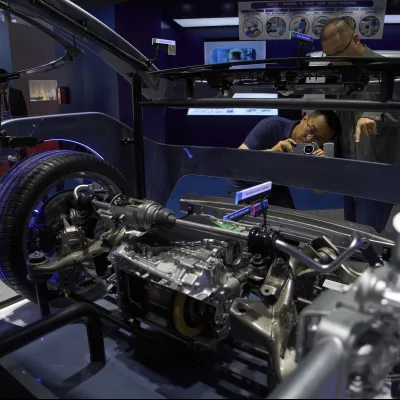
Together, these moves point to a shift: Washington has started to see Taiwan as an important base for a trustworthy drone supply chain, and not simply because of its chips. A drone is essentially a miniature version of national industrial capacity. It needs semiconductors, printed circuit boards, optical lenses, image sensors, communications modules, motors, batteries, composite materials, molds, plastic injection parts, metalwork and software. Decades of manufacturing experience Taiwan built up making PCs, laptops, phones, bicycles and auto parts happen to be exactly what is needed to integrate all of those scattered components.

US China rivalry is pushing Washington to cut its reliance on Chinese made drones and components, while the war in Ukraine has exposed how slow and expensive traditional American and European defense production can be. Taiwan sits at an unusual intersection of the two trends: a national security need has created a market, existing manufacturing capacity can supply it, and the United States needs a partner that can produce at scale from outside China.
War Has Turned Drones From Precision Aircraft Into Consumables
Military drones used to be designed more like fighter jets: high performance, long service life, exhaustive certification, and price tags that could run into the tens of millions of Taiwan dollars or more. The war in Ukraine has pushed the industry down a different path. Large numbers of FPV drones, loitering munitions and long range attack drones are shot down, jammed or simply used up every day. They behave more like ammunition than platforms meant to last a decade.
Reuters has reported that Ukraine planned to procure roughly 4.5 million FPV drones in 2025, more than double its 2024 total, with this year's target set at 7 million and some estimates running as high as 10 million. That scale of consumption has pushed drone competition beyond the performance of any single aircraft and into cost, capacity, supply chains and how quickly a design can be revised. "Being able to design an advanced drone only proves you have the technology," said Max Lo (羅正方), chairman of Lingxiao Aerospace (凌霄航太). "Being able to reliably produce thousands or tens of thousands of them every month is what actually makes an industry."
Taiwan already has design experience with mid to large military drones. Lo notes that the Chien-Hsiang (劍翔) loitering munition and the Albatross (銳鳶) reconnaissance drone, developed jointly by the National Chung Shan Institute of Science and Technology (中科院) and Aerospace Industrial Development Corporation (漢翔), show that aerospace design, flight control and mission integration are not starting from zero. The real bottleneck, he says, is cost and volume: a product that used to be built piece by piece for tens of millions of dollars has to be redesigned around standardized parts and simplified assembly so it can be built on a production line as a consumable good, which is as much a challenge for procurement culture and industrial organization as it is an engineering one. "Starting from the manufacturing logic Taiwan built up in PCs and phones," Lo said, "a drone is basically a phone that can fly."
The Real Shortage Is Not Another Drone But A Production Line That Never Stops
Small quadcopters get most of the camera time, but Taiwan's real gap may not be yet another short range FPV design. Judging by what actually dominates the battlefield in Ukraine, one way attack drones, which carry a warhead to the target and are not built to return, have become the mainstream weapon. Skipping landing gear, return fuel and some of the structure needed for a long service life lets these systems put their cost into range, navigation, communications and strike effect instead.
Small one way attack drones are suited to close range vehicles and positions, while medium and large versions can reach much further, threatening ports, radar sites, command nodes, staging areas and ships. For Taiwan, the value of the larger versions is that they extend long range firepower at a fraction of the cost, so that expensive anti ship missiles, cruise missiles and manned aircraft do not have to carry every mission themselves.

But deterrence requires more than a handful of prototypes. On a single night in Ukraine, hundreds or even more than a thousand drones can be launched or intercepted. Experts say what Taiwan needs is production capacity that can keep being replenished through a war, including readily available airframes, motors, navigation modules, warhead interfaces and ground control systems. The real key is not any one drone, in other words, but the production line behind it that never stops running.
Three Types Of Companies But No National Team Yet
Taiwan's drone players currently fall into roughly three groups. The first are established aerospace companies such as Aerospace Industrial Development Corporation, Evergreen Aviation Technologies (長榮航太) and Asia Aeronautical (亞洲航空), which can take on systems integration, airworthiness, quality management and mid to large platforms. The second are companies with no aerospace background that have entered the field through investment, such as food maker I Mei Foods (義美) and electronics manufacturer Wistron (緯創), which bring capital, management and mass production experience. The third are small and mid sized specialist firms that have worked in drones for years, with smaller teams but deep expertise in particular airframes, materials, controls or mission applications.
Each type has its strengths and its limits. Large aerospace firms understand military specifications and quality control, but their costs and development pace may not suit a consumable product. Large electronics and traditional manufacturers are good at mass production but need to add flight safety and military mission experience. Small drone companies move quickly but are often constrained by capital, orders and capacity. If the government simply picks a handful of companies to form a so called national team, Lo warns, the likely result is a scattered race in which everyone tries to build a complete aircraft on their own. A real national team, he argues, should instead be a division of labor system that lets companies of different sizes work in relay under shared specifications.

This is also why drones could help drive a broader transformation of Taiwan's traditional manufacturing base. Wings and fuselages need carbon fiber, fiberglass and injection molded plastic. Motors need coil winding, magnetic materials and precision machining. Propellers, connectors, housings, wiring harnesses and heat sinks do not require six nanometer chips to build. Lo points to Formosa Plastics' (台塑) carbon fiber, motor technology out of National Cheng Kung University (成大), and electromechanical and machining capability from motor and machinery makers, as examples of how, if drone orders are broken into standardized modules, Taiwan's traditional manufacturing clusters in Chiayi, Taichung, Changhua and Kaohsiung could re enter the drone supply chain as hidden champions. What he says he wants to do is bring the logic of an automobile assembly line into large scale drone production.
Three Mountains Still Stand Between Taiwan And A Self Sufficient Supply Chain
Having a complete electronics manufacturing base does not mean every critical material is available domestically. Lo does not shy away from the point: Taiwan's drone supply chain still has three mountains to climb before it can call itself self sufficient. The first is rare earth permanent magnets. Taiwan can design, wind and build motors, but the upstream supply of high performance magnets is heavily concentrated in China. The second is batteries. Taiwan has battery module and power management capability, but cells, cathode and anode materials and graphite supply remain heavily dependent on China. The third is infrared thermal imaging, which night and poor weather operations require, and which involves advanced materials, chips, lenses and export controls of its own.
Lo says no single airframe maker can climb these three mountains alone. Taiwan needs to build materials and component partnerships with the United States, Japan, Australia and Europe, while also keeping backup domestic capacity in motors, battery modules, optics, thermal imaging and flight control. Government procurement, he argues, also needs to build requirements on component sourcing, cybersecurity, maintainability and second sourcing into its specifications, or a drone labeled as made in Taiwan risks being little more than final assembly done locally.

Lo also points to the Chiayi Minsyong Aerospace and Drone Industrial Park (嘉義民雄航太暨無人機產業園區) as a space for research, testing and industry clustering, though he cautions that a park by itself will not grow an industry. What matters, he says, is shared specifications, testing sites, sustained orders and a fast testing and iteration process. He cites the Chien-Hsiang and Albatross systems, developed with the state run National Chung Shan Institute of Science and Technology and Aerospace Industrial Development Corporation and evaluated by the navy, along with the gradual localization of maintenance work on the Cardinal reconnaissance drone, as evidence that Taiwan can build up experience through maintenance, subsystems and evaluation work. The next step, he says, is to turn that project by project experience into a production process that can be repeated at scale.
An Ecosystem Needs Combat Testing Export Markets And A Military Willing To Use Its Own Drones
Government procurement can generate orders in the short term, but it does not guarantee an internationally competitive industry. Chi Li-ping (齊立平), former head of the aeronautics research division at the National Chung Shan Institute of Science and Technology and now a professor of electrical engineering at Feng Chia University (逢甲大學), says a self sustaining drone economy needs three things: products validated in or near actual combat conditions, access to international markets, and strong domestic willingness to use them. Miss any one of the three, he warns, and government support risks becoming a single wave of policy driven orders that cannot sustain long term investment.
The first hurdle is combat validation. Drones need to fly in conditions close to real operations to generate data on communications range, jam resistance, weather tolerance, attrition rates and mission success, data that then feeds directly into the next generation of design. Ukrainian, Israeli and Turkish products, once battle tested, tend to draw fast attention in international markets. Taiwan lacks that combat record, and legal airspace for large scale, long range, multi terrain testing is also limited, with beyond visual line of sight flight still constrained by permit procedures, no fly zones, insurance requirements and crash liability rules.
Chi argues that Yunlin County's (雲林) lack of a commercial airport is actually an advantage now, and has proposed linking Gukeng (古坑), Douliu (斗六), Huwei (虎尾) and the Zhuoshui River (濁水溪) basin down to Taixi (台西) into a mountain to sea testing corridor that could gradually grow into a base for unmanned systems and defense technology testing.
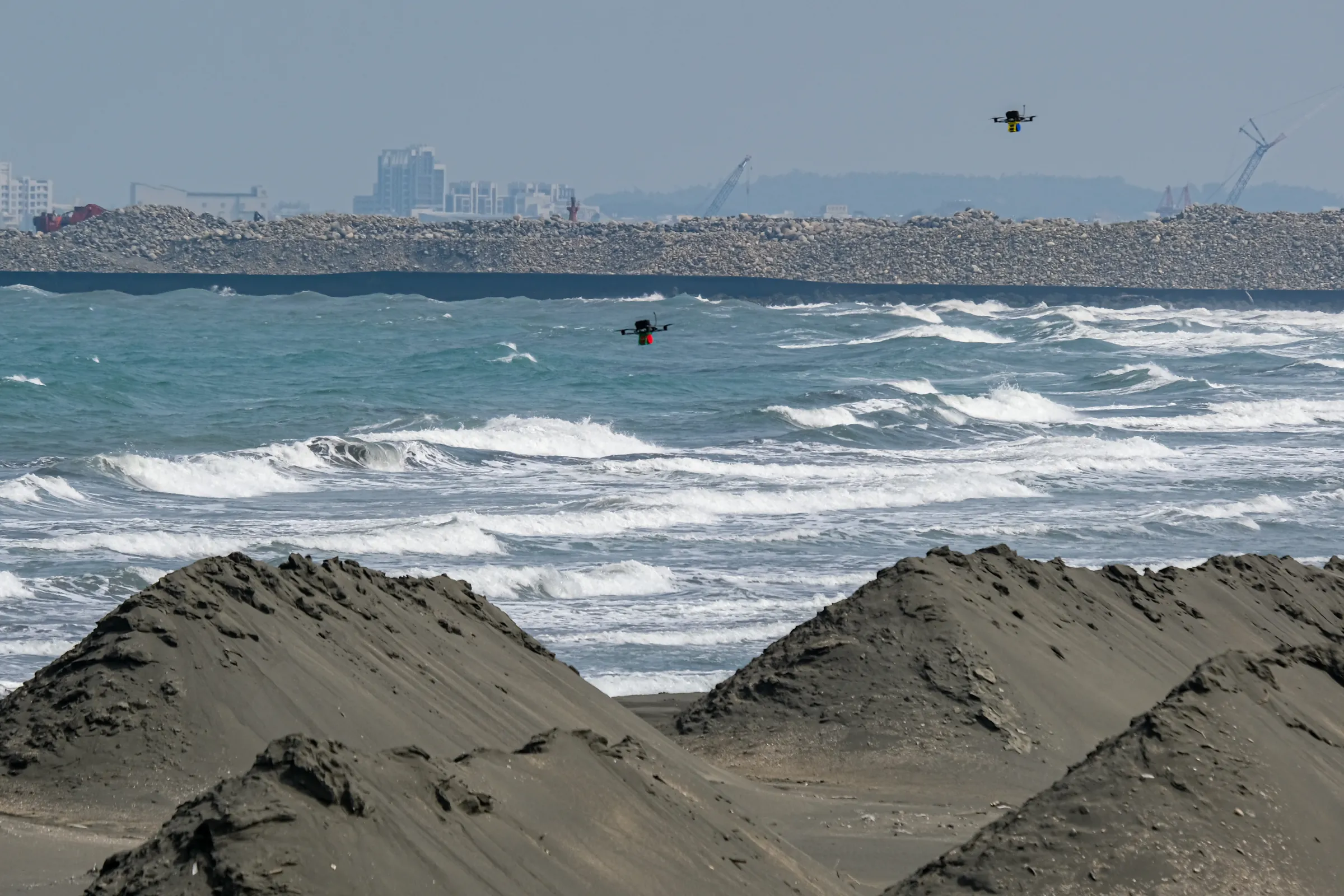
The second hurdle is exports. Taiwan's domestic market is too small for government contracts alone to spread out research, certification and tooling costs, let alone sustain an expanded production line over the long run. Taiwan's opening lies in building trusted supply chains with the United States and its democratic allies, but a demand for entirely non Chinese content pushes up costs, and without a combat record or international certification, smaller manufacturers will struggle to compete immediately with drone producers in China, Turkey and Israel.
The third hurdle is a willingness to use drones boldly at home. While combat experience and export markets are still being built, the government and the military need to generate demand through procurement, testing, training and exercises. Chi argues the defense ministry should become Taiwan's largest user and consumer of drones, feeding operational experience back into research and development. He believes the military still treats drones as precious, specialized equipment with limited use at the unit level, and that the Han Kuang exercises have not fully shown drones operating jointly with missiles, artillery, electronic warfare and command systems. What the government needs to build, he says, is a cycle of continuous production, continuous use and continuous redesign, consuming drones regularly in training and exercises and then feeding in new flight control, communications, jam resistance and artificial intelligence technology.
Whether the industry can develop over the long term also depends on whether the core technology stays in Taiwan. A memorandum of understanding or an off the shelf module is not the same as genuine capability. Taiwan needs to master flight control, data links, systems integration, maintenance and upgrades, and software and hardware modification, and to build alternative sources for key components. That is both wartime resilience and the foundation for winning export orders, providing after sales service and sustaining future upgrades. Taiwan's earlier strategic industries were built on global markets, sustained technology accumulation and economies of scale, and if drones are to become its next mountain range of strategic industry, they cannot rely on patriotic orders and national security slogans alone.
That will mean letting large aerospace firms, small innovative teams, the electronics industry and traditional manufacturers each find a place where they can survive over the long term, and turning Taiwan's strengths in fast manufacturing, flexible supply and continuous iteration into products its allies actually want to buy. Perhaps the most promising part of the drone story for Taiwan is a cluster of hidden champion traditional manufacturers in central and southern Taiwan, long overshadowed by the glow of semiconductors, that now have a chance to become central players in national security and economic transformation once again.
(Related:
Exclusive | Taiwan's Military Buys American Drones Then Discovers The Chargers Are Made In China
|
Latest
)