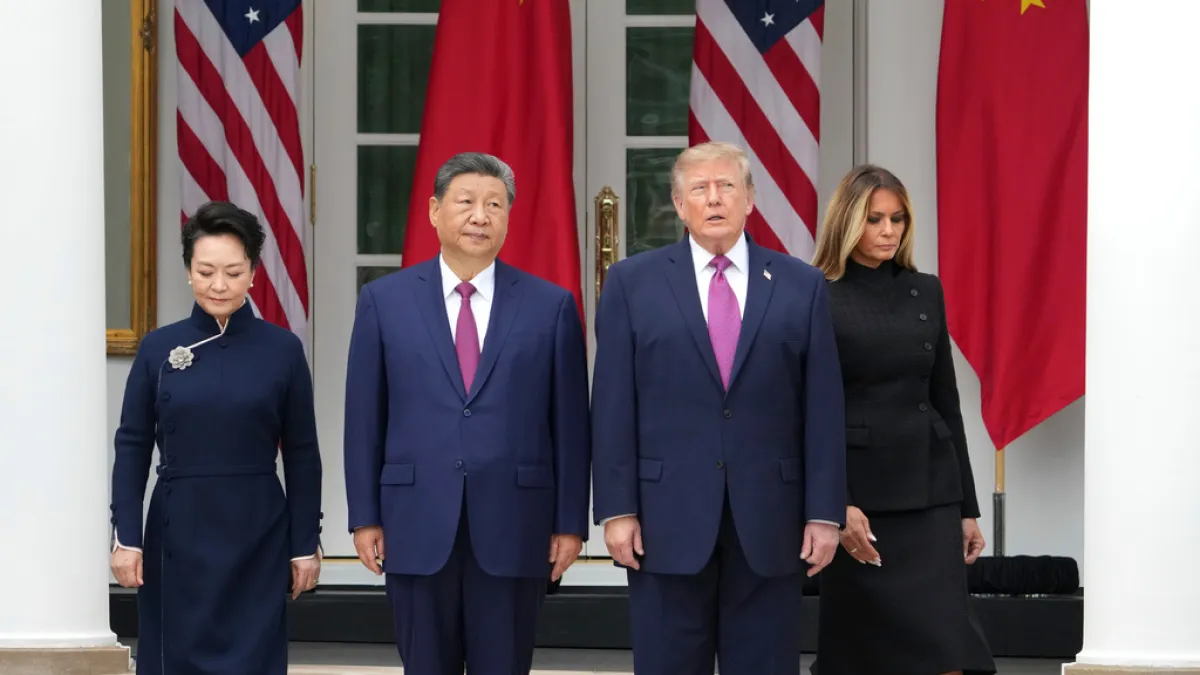
President Donald Trump and Chinese President Xi Jinping held their second meeting of the year on September 24 in Washington, and it produced no breakthroughs on Taiwan. Xi again pressed Trump to oppose Taiwan independence and to handle the Taiwan question with caution, yet neither the White House's nor Beijing's own summary of the talks listed Taiwan among the meeting's outcomes.
That omission leaves Taiwan exactly where it has sat for years: unresolved. The island was not traded away, and Washington did not hand Beijing new concessions. But nothing was settled either. The Taiwan question simply remains open, a pending matter that both capitals seem content to leave hanging rather than force to a conclusion.
Neither Sacrificed Nor Resolved
For nearly 70 years, Taiwan has watched China's rise from what real estate agents might call a front row seat on the coast. It never got the collapse some once predicted. It got an economic and military power that now sits across the negotiating table from an American president, and Taiwan had a hand in building it, supplying investment, technology, and manufacturing expertise that fed China's growth for decades.
Over the last decade, though, Taipei has largely written that contribution out of its own story and chosen confrontation with Beijing instead. The result is not safety. It is exposure: Taiwan has become one of the more sensitive variables in a relationship between two powers that did not even list it as a summit priority.
A Fight Over Who Fought Japan
The summit's most awkward exchange had nothing to do with trade or arms sales. Trump told Xi that the United States and China were "allies" in World War II who "fought side by side" to win it. Xi answered in kind, describing a joint Chinese and American resistance to Japanese militarism.
Taiwan's Mainland Affairs Council pushed back hard, insisting that the true wartime ally was the Republic of China, not the People's Republic, which was not founded until 1949. The council has a point, but not the whole one. The Chinese Communist Party dates to 1921 and operated as one of many parties inside the Republic of China; in 1937 it publicly agreed to join the resistance against Japan alongside the Nationalists. The Nationalist government led the conventional fighting, and the Communists fought largely from behind Japanese lines. Assigning credit here is a matter of degree, not a matter of one side having none at all.
Taipei's Own Retreat From Wartime Memory
Taiwan's deeper problem is that its own governing party has spent two decades distancing itself from that wartime history. Starting with the Chen Shui-bian administration, official language quietly shifted from "War of Resistance" to the more neutral "end of the war." Foreign Minister Lin Chia-lung's first major act as Taichung's mayor was restoring a Japanese Shinto shrine. A Democratic Progressive Party candidate for Taipei mayor has proposed rebuilding a bridge named for Japan's Meiji emperor. Three consecutive Democratic Progressive Party presidents have pushed to tear down statues of Chiang Kai-shek, with little regard for his leadership of the resistance against Japan or his decades of anti-communist rule, the same Chiang Kai-shek that Washington counted as its wartime ally.
The irony runs deeper still. Taiwan itself, then a Japanese colony, was not part of the "China" Trump meant. Only a small number of Taiwanese resistance fighters have any real claim to that legacy, and the Democratic Progressive Party, founded in 1986, has none. Yet as the party now governing the Republic of China, it has abandoned much of that Republic's own history, discarding the pre-1949 period and rewriting the one that followed, to the point that President Lai Ching-te has publicly said Nationalist rule was worse than Japanese colonial rule. Trump's offhand reference to a wartime ally was an unplanned reminder that the Republic of China's legitimacy has not been fully spent, even if Taipei has largely stopped drawing on it.
An Old Grievance Taiwan Cannot Escape
Push the history back further and the stakes come into sharper focus. China's long list of grievances against foreign powers — invasions, unequal treaties, looted treasure — includes the loss of Taiwan to Japan after the First Sino-Japanese War. Along with Hong Kong and Macao, Taiwan is one of the last unresolved pieces of what Beijing calls its century of humiliation. Western capitals may not fully absorb what that narrative means to Chinese leaders, but Taiwan's own government has no excuse not to understand it. A policy that treats independence as a safe bet against that backdrop is not bold. It is reckless.
After the summit, Foreign Minister Wang Yi, a member of the Communist Party's Politburo, called "head of state diplomacy" the anchor of the U.S.-China relationship, noting that Trump and Xi have now met twice within six months. The two are due to cross paths again at the G20 and APEC summits over the next three months. Beijing's demand that Washington oppose Taiwan independence and handle the issue with caution is unlikely to soften, and Trump is unlikely to pick a fight with Xi over it. Whether Washington continues, delays, or resumes arms sales to Taiwan, and whether senior American officials keep meeting their Taiwanese counterparts, matters far less by comparison.
Learning To Manage Its Own Risk
Taiwan's real dilemma is structural. If U.S.-China relations spiral into open confrontation, the risk of conflict in the Taiwan Strait rises. If they stabilize instead, Beijing may find more room to press Washington on Taiwan, and Washington may be more inclined to keep the issue from derailing a relationship it would rather manage than fight. Taiwan cannot force the United States to choose between Beijing and Taipei. It can only make itself matter enough that Washington has to weigh Taiwan's security into its own calculations.
What Taiwan cannot do is build its national security on the assumption that American help is guaranteed, or on the assumption that Washington and Beijing will remain adversaries forever. The Taiwan question did not disappear after this summit, and Taiwan was not turned into a bargaining chip. The two powers are learning how to manage their own rivalry. Taiwan's task now is to learn how to manage its own risk inside that arrangement, because no one else is going to manage it for them.