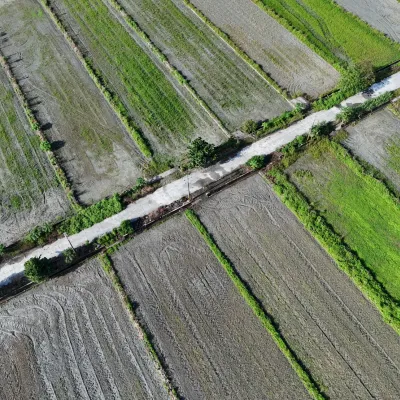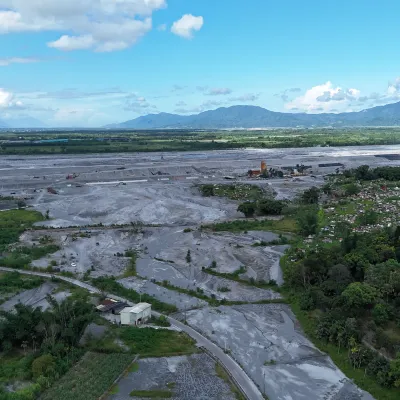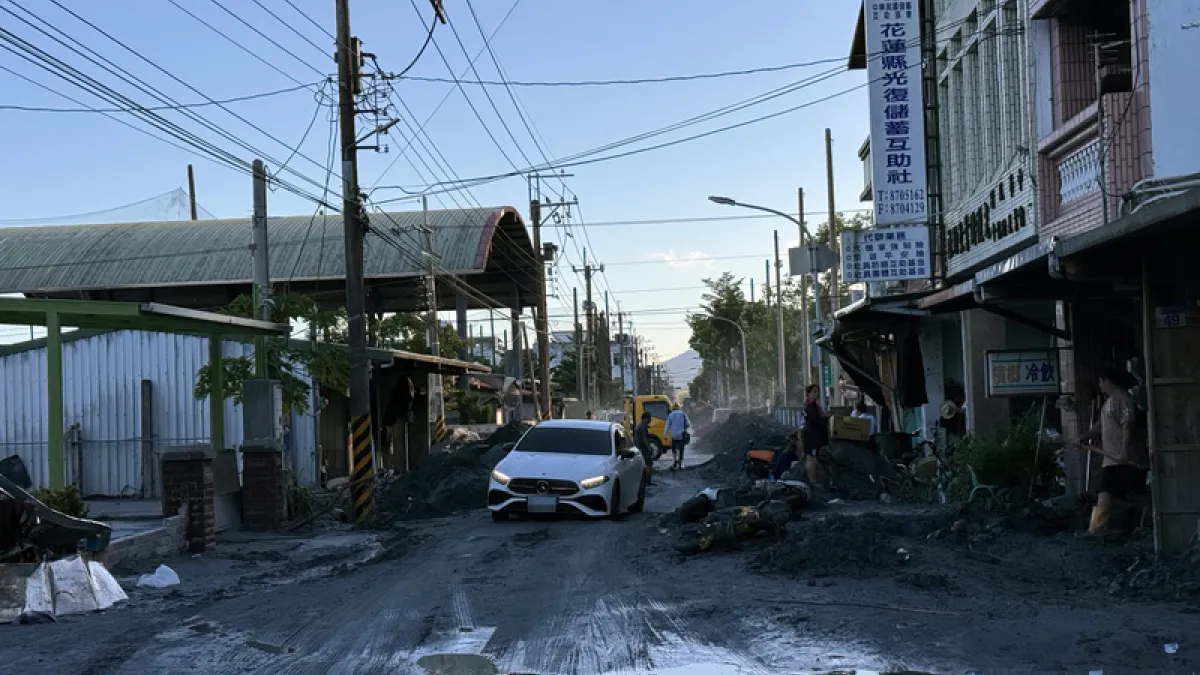
A year after the barrier lake on Matai'an Creek burst and sent mud and rock through the township of Guangfu in eastern Taiwan, killing 19 people, the lake that produced the disaster no longer exists. Fly over the upper catchment today and there is no sheet of water, only a river.
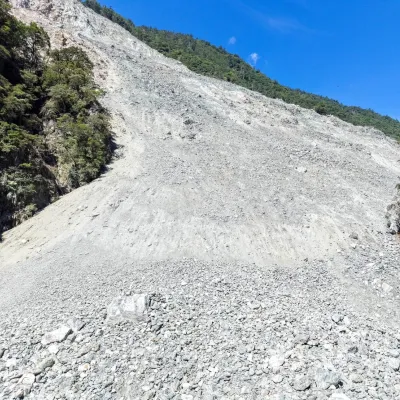
What is still there is everything the water was carrying. Taiwan's Forestry and Nature Conservation Agency counts about 236 million cubic meters of rock and sediment in the remnant dam, the collapse deposit on the left bank of the old overflow outlet, and the channel itself. The water found its way out in weeks. The material did not.
The Lake Held 91 Million Cubic Meters
Before it overtopped on September 23, 2025, the lake covered about 140 hectares and held an estimated maximum of 91 million cubic meters of water.
How much of that came down at once depends on who measured it and when. Taiwan's Central Emergency Operation Center, working backward from the flooding downstream, estimated that more than 60 million metric tons left the lake on the afternoon of the breach. Anniversary reporting by the Central News Agency described the event as roughly 90 million cubic meters of water carrying sediment with it.
The collapse was not gradual. By September 28, 2025 — five days later — aerial survey put the remaining lake at 13.5 hectares and about 6 million metric tons, 6.6% of what it had held. By November 22 it was 8 hectares and 309,000 cubic meters, or 0.34% of the pre-overflow volume, with the water level down a cumulative 132.7 meters.
The last of it was drained by hand. Over roughly a month of excavation work on the remnant dam, storage fell from 279,000 cubic meters to 26,000 by January 26, 2026. After that the site held no water at all.
The Water Went Back Into the River System
A barrier lake forms when a landslide blocks a river and the water behind it has nowhere to go. Breach the blockage and the water simply resumes the route it was always taking.
Matai'an Creek runs out of Taiwan's Central Mountain Range, crosses the plain at Guangfu and joins the Hualien River, which runs north up the East Rift Valley and empties into the Pacific south of Hualien City. The lake water did not disappear over the year. It went down that line — through the breach, then through continued overflow, then through the drainage work — and back into the sea.
Rock Does Not Travel Like Water
Sediment behaves differently. Water runs downhill and keeps going; silt, gravel and boulders drop out along the way and are picked up again by the next flood.
The forestry agency's September 28, 2025 survey estimated the natural dam had originally contained about 200 million cubic meters of material, of which roughly 88.1 million had been scoured away by the overflow, leaving a remnant dam of about 111.9 million. Taiwan's Water Resources Agency put the upper catchment's total collapsed volume at close to 200 million cubic meters and said tens of millions of cubic meters had since moved down into the channel — which is why dredging has continued.
That material did not wash out to sea either. Much of it settled in the riverbed and across the flooded ground below, and is being removed a contract at a time: one job alone, running from below the Provincial Highway 9 bridge to the confluence with the Hualien River, covers about 500,000 cubic meters. Because sediment keeps moving, settling and being dug out, no single figure can say where all of it ended up.
Why 236 Million Is Not More Than 200 Million
On August 28, 2026, the forestry agency reported that the original lake held no water but that about 236 million cubic meters of material remained across the remnant dam area, the left-bank collapse deposit at the overflow outlet and the channel. On September 11 it added that this material could still slide and block the river again, and that long-term monitoring was required.
At a glance, 236 million looks larger than the 200 million estimated for the dam in 2025, as though the disaster had somehow produced more rock. It has not. The two figures cover different ground. The 2025 estimate described the natural dam itself; the 2026 figure covers the remnant dam, the collapse deposit, and the sediment sitting in the channel. Subtracting one from the other is meaningless, and the difference is not a 36-million-cubic-meter gain.
No Lake Does Not Mean No Risk
Drone surveys at the end of August 2026 found no significant movement across the slopes as a whole and no sign of a new barrier lake forming. They did find localized rockfall on both sides of the upper channel.
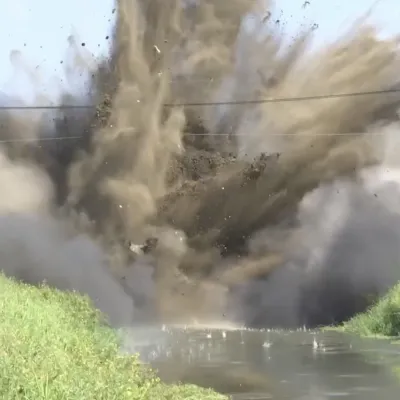
That is the shape of the risk a year on. The lake is gone and the water is back in the river, but the terrain the disaster produced has not settled. Heavy rain, an earthquake or a fresh slope failure could move the remaining material again, and could block the channel again — which is also why a natural dam is far harder to deal with than digging it out or blowing it up.
It is the reason Taiwan's forestry agency is still flying drones over a valley with no lake in it.
Figures in this article are drawn from published monitoring data and statements by Taiwan's Forestry and Nature Conservation Agency (Hualien branch), the Water Resources Agency's Ninth River Management Office and the Central Emergency Operation Center, together with Central News Agency reporting. Terrain, sediment volumes and channel conditions continue to change; the responsible agencies' latest announcements take precedence.
(Related: Taiwan's Landslide Dam, One Year On 1 | 200 Hectares Marked, No One Asked the Village | Latest )