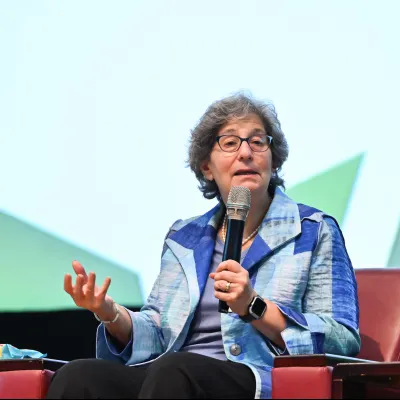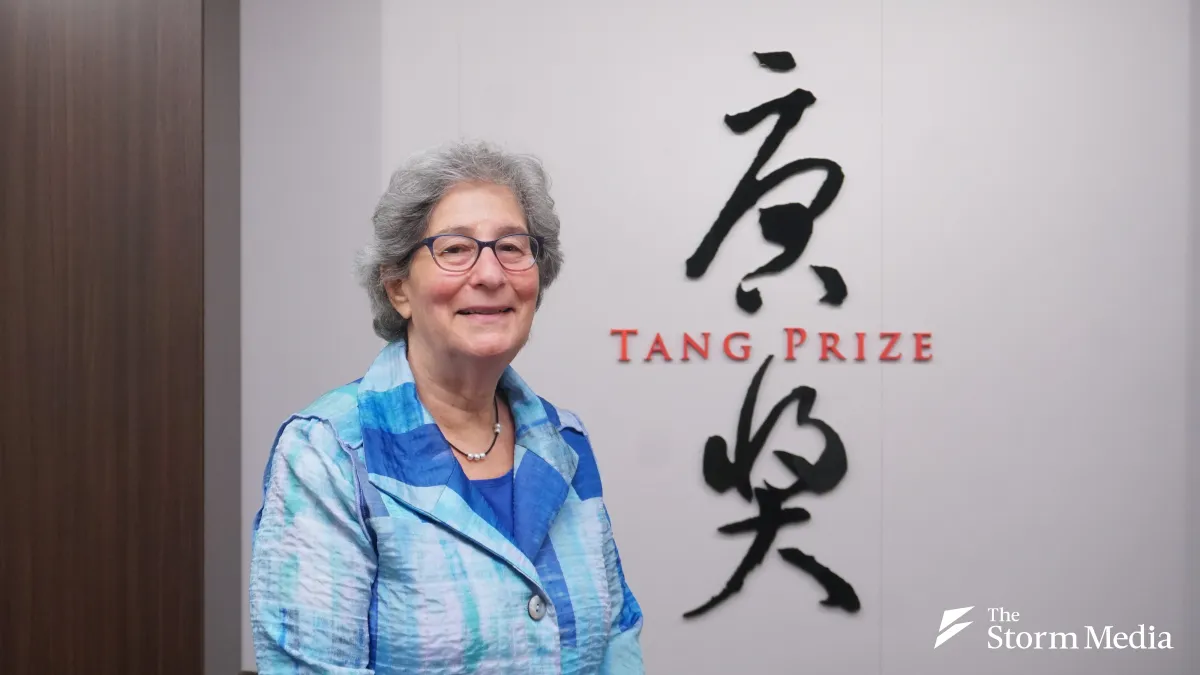
Susan Solomon, the American atmospheric chemist who won the 2026 Tang Prize in Sustainable Development, told Storm Media in an exclusive interview in Taipei that Taiwan should move faster on geothermal energy and reduce an electricity system that still draws more than 80% of its power from thermal generation. The shift will not happen on its own, she said: "We have to change the energy system, and that has to be done by governments. I believe social movements can work. People have to put pressure on governments to drive change."
Solomon, 70, is a professor in the Department of Earth, Atmospheric and Planetary Sciences at the Massachusetts Institute of Technology, which she joined in 2012 after 30 years at the U.S. National Oceanic and Atmospheric Administration. She received the Tang Prize in Taipei on September 18 and appeared at the laureates' forum the following day, her first visit to Taiwan, in a year that also marks four decades since the Antarctic expedition that made her name.
Geothermal Gives Taiwan A Practical Next Step
Asked how Taiwan can balance economic growth, energy security, and emissions cuts, Solomon began with cost. "In many countries around the world, renewable power now costs less than coal and natural gas," she said. "In the United States, coal and gas generation cost more than solar and wind. Looking at the broad trend, economics will clearly push us toward renewable power."
She acknowledged that renewables in Taiwan remain more expensive than thermal generation at this stage. Her recommendation was to treat the retirement schedule as the opening. Coal and gas plants that have run for decades will reach the end of their service lives, and those units, she argued, should be replaced with renewable capacity rather than more of the same. In the United States, she noted, solar has become highly competitive and now undercuts both coal and gas by a wide margin.
Taiwan also has an asset most economies lack. The island sits on volcanic and geothermal resources, and Solomon urged the government to accelerate geothermal development as a firm, domestically sourced complement to solar and wind.
Citizens Not Governments Start Every Environmental Win
Solomon returned repeatedly to the argument that energy policy follows public pressure rather than leading it. She pointed to the United States in the 1960s and the civil rights movement as the model. "Why did the United States change how it treated Black Americans? It happened because of a social movement, because society demanded change and cared enough about the problem to demand it," she said. "Every improvement on an environmental problem happened because people demanded change."
The record, she said, is consistent. Cities across the United States and Europe cleaned up their air. DDT was banned. Leaded gasoline was phased out. The Antarctic ozone hole was put on a path to repair. "In every one of those cases, it was citizens who demanded the change," Solomon said.
Prosperity For Billions Is Straining The Planet
Pressed on what she considers the world's biggest challenge, Solomon framed global warming as a byproduct of something otherwise welcome. A century or two ago, she said, only a small minority enjoyed modern medicine, electricity, sanitation, and comfort. Today far more people do.
"From many angles, more people are benefiting from modernization, but it is placing enormous stress on the planet, and that is why we face global warming," she said. The arithmetic has changed with the population. Roughly 1 billion people once shared the benefits of modern life; the global total now exceeds 8.3 billion, and a growing share of them are becoming wealthier.
"Enormous human demand puts enormous pressure on the Earth, with vast quantities of fossil fuels burned, and that path is hard to sustain," Solomon said. "So the core of the sustainability problem is tied to inequality. We want to reduce inequality, but doing so puts more pressure on the planet's resources than ever before. That is the great challenge of sustainable development." Her follow-up question was blunt: "Is this really the life we want? Do we want to be separated from nature? The closer we stay to nature, the less pressure we put on the Earth. We can choose not to burn fossil fuels."
Carbon Dioxide Lingers For A Thousand Years
Solomon published research in 2009 showing that most carbon dioxide emitted by human activity is absorbed by the oceans and can persist for centuries, in some cases for a thousand years. "Many people do not know that when humans burn fossil fuels, the carbon dioxide produced can stay in the atmosphere for a thousand years," she said. "I was shocked by that finding, and saddened by it."
The discomfort is personal. "I was very glad to visit Taiwan, but flying here emitted a great deal of carbon dioxide, and that makes me sad," she said, adding that she envies the Swedish activist Greta Thunberg, who sailed to a United Nations meeting in the United States rather than fly. "That whole process was itself a statement. People can choose not to burn fossil fuels." Solomon is a pescatarian and eats mainly vegetables, fruit, and fish, on the grounds that raising animals emits far more greenhouse gas than growing produce.
Data Centers Cut Both Ways On Emissions
On artificial intelligence and climate, Solomon declined to pick a side. Communities across the United States have begun resisting new data centers, and she reads that resistance as substantive rather than reflexive. "People are starting to question what data centers do to their communities, and how AI affects society is one of the important reasons they are asking," she said. "People do not want a data center in their backyard because it may raise their electricity bills and worsen air pollution. When power supply runs short, data centers may run their own generation, usually by burning fossil fuels."
The other side of the ledger is real too. Data centers that burn fossil fuels accelerate warming, but AI can also help balance supply and load on a grid. When heat waves drive air-conditioning demand up and force emergency dispatch, and when nuclear plants shut down because they lack sufficient cooling water, AI can help redistribute load and call on solar, wind, and other sources. That capability, Solomon suggested, is one Taiwan could put to work on its own grid.
Solomon Calls Ungoverned AI Extremely Dangerous
Solomon's sharpest warnings in the interview were about AI itself rather than its power consumption. "I am deeply worried. AI may bring many benefits in medicine and manufacturing, but AI is extremely dangerous," she said. "It could develop biological entities that destroy humanity. AI drones could cause enormous damage. AI could bring catastrophe to humanity and to civilization."
"The most fundamental problem is that we have no controls at all over potentially dangerous AI," she said. "People are now starting to think about this, which is very good. The world must put appropriate regulation on AI."
She is unconvinced by the industry's promise to police itself. Technology companies can take part in drafting policy and standards, she said, but responsibility for writing them belongs to governments, and the rules have to be international because AI crosses network firewalls and reaches anywhere. "Imagine a country like North Korea developing AI and building biological weapons hostile to other countries. That could be a catastrophe for humanity," Solomon said.
Her other concern is cognitive. "The danger AI brings is that people let computers think for them. People lose the capacity for critical thinking, and it makes them stupider," she said. "What worries me most is that AI will affect our ability to think. AI has to be controlled. We have to teach children critical thinking from a young age, so they do not just press a button, wait for an answer, and believe it."
Taiwan Feels Extreme Heat Before Colder Latitudes
"Extreme heat is the clearest way people experience climate change," Solomon said. "The climate of our era is very different from the climate of our grandparents' era, and the first and largest changes in extreme heat begin in tropical countries like Taiwan."
The reason is statistical. Low-latitude regions have less natural variability than high latitudes, so when the climate warms, the signal shows up in the measurements sooner and more plainly. Taiwan, Malaysia, the Philippines, India, and Sri Lanka register the shift most clearly, and island climates vary less than continental ones, sharpening the contrast further.
"The largest global warming signal appears at high latitudes, especially the Arctic," she said. "If you live in northern Sweden you may be living through the most extreme warming on the planet, but because variability at high latitudes is so large and temperature swings are so wide, people find it hard to actually notice that it has gotten warmer." Meanwhile the physical consequences are accelerating. Glaciers are disappearing at the fastest rate on record, and scientists are still investigating the severe glacier collapse and debris flow that struck the Nepal-Tibet border in late August, an inquiry that may take months.
Consumers Forced The Montreal Protocol Through
The Montreal Protocol on Substances that Deplete the Ozone Layer was signed by 197 United Nations member states on September 16, 1987, phasing out chlorofluorocarbons to save the Antarctic ozone layer. The United Nations later designated September 16 as World Ozone Day. Solomon was still taking ozone measurements in Antarctica when the signing took place. "It all happened so fast that I may have been the last scientist to find out the member states had signed," she said.
CFCs were then in everyday consumer goods, including hairspray and deodorant, and Solomon attributes the treaty's speed to shoppers rather than diplomats. "The Montreal Protocol was signed so quickly mainly because of consumer power. Consumers recognized how serious the ozone hole was and boycotted, which forced chemical companies to stop producing CFCs," she said.
She draws a direct lesson for climate policy, while acknowledging the difference in scale: the fossil fuel problem is far larger than the CFC problem ever was. "The successful citizen movement that stopped the ozone hole from expanding can be applied to fighting global warming. What matters most is that citizens wake up and demand that governments change," Solomon said. Science supplies the evidence that makes the demand credible. "That is why I led a team to Antarctica in 1986 to investigate the causes and the chemical mechanism of the ozone hole. Science can show people how big the difference is, because science has real measurements to prove it."
Swiss Retirees Opened A Second Legal Route
U.S. President Donald Trump does not accept climate change, and in his second term he has withdrawn from the Paris Agreement and the United Nations Framework Convention on Climate Change, cut climate science funding sharply, and canceled subsidies for renewable energy and electric vehicles. Solomon sees two channels still open to the public. "Citizens can create change through protest, so governments know what the public is demanding, and the other route is litigation," she said.
She pointed to the European Court of Human Rights, which issued a landmark ruling condemning the Swiss government for failing to take adequate and timely legislative action to mitigate climate change. The case was brought by a group of elderly Swiss women who argued that older people face the greatest risk of death from extreme heat. Heat waves across Europe, Canada, and the United States this year have killed large numbers of people, most of them elderly, which is what gives the ruling its symbolic weight.
A United Nations Environment Programme report released in September concluded that exceeding the 1.5 degrees Celsius target is now unavoidable. "This report shows that the world's emissions reduction efforts are not enough," Solomon said. "If we want to stay below the 2 degrees Celsius threshold, we have to redouble our efforts. Governments must move faster to control carbon emissions and reduce dependence on fossil fuels."
On loss and damage, she used sea level rise to illustrate the gap between rich and poor countries. The Netherlands, much of it low-lying, built dikes long ago because it had the resources to do so. Coastal Bangladesh faces both rising seas and land subsidence without comparable means. Under the Paris Agreement, wealthy countries are obliged to provide resources and financing to poorer ones, and Solomon said that obligation requires collective follow-through.
A Grandmother, A Card Catalog, And Antarctica
Solomon's path into atmospheric science began with luck and a library. As a chemistry undergraduate thinking about graduate school in 1976, she worked in a professor's laboratory where the team was measuring how fast hydroxyl radicals react with ethylene. She knew nothing about hydroxyl, so she went to the library. There was no internet and no chatbot; she worked through the card catalog, found a book on planetary atmospheres, read about Jupiter, and realized she could study chemistry on a planetary scale instead of in a test tube.
Her doctoral advisers were the American atmospheric chemist Harold Johnston, then a professor at the University of California, Berkeley, and Paul Crutzen, who shared the 1995 Nobel Prize in Chemistry. "Paul Crutzen was a wonderful adviser with a special intuition for chemistry, and I seem to have inherited it," she said. On the same Berkeley oral examination committee sat Yuan T. Lee, the Nobel laureate in chemistry, whom Solomon met again in Taipei during this trip.
When a British team reported the Antarctic ozone hole in 1985, Solomon was running one of the best stratospheric numerical models in the world, one of roughly six groups doing that work. Why the hole formed over Antarctica and not the Arctic became her question. Back in the library, she pulled out the red books recording ozone at different altitudes over Antarctica, built her own charts by hand over several days, and found the loss concentrated near 20 kilometers, precisely where polar stratospheric clouds form. The paper ran in Nature in 1986. Then came the fieldwork.
She reached the Antarctic continent at midday on August 21, 1986, as chief scientist of the U.S. National Ozone Expedition at McMurdo Station and the only woman on the team. The temperature was minus 40 degrees Celsius, the only company on land was penguins, and satellite phones were not yet available. She credits her grandmother, who raised two daughters alone through the Great Depression after her husband died of heart disease and who took over his wholesale grocery business rather than accept public assistance, for the disposition that got her there. "I had a vision. I knew where I could go and what I could achieve, and no matter what happened I was going to do it. I did not even think about obstacles," Solomon said. "I go where I want to go, and I do not let anyone stand in my way."
Her grandmother lived to 101, and that is the number Solomon has in mind for the ozone hole she helped close. "What is exciting is that in some years before 2050, the Antarctic ozone hole will disappear," she said. "I hope to live as long as she did, long enough to witness the Antarctic ozone hole disappear. Perhaps that day will come sooner. Just thinking about it is exciting."
Original Article in Chinese
(Related: Susan Solomon, Who Solved the Ozone Mystery, Takes Her Fight to Taiwan | Latest )