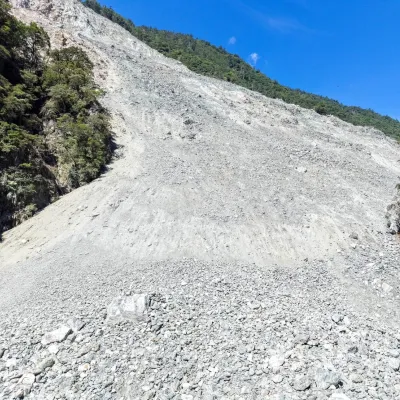
On August 26, 2026, shortly after 8:37 a.m., a slab of rock and glacier ice broke off the north face of Langtang Lirung, a 7,227-meter peak in Nepal's Rasuwa district near the Chinese border. The front of the flow it became averaged about 190 kilometers per hour over its first 22 kilometers. Nepal's flood forecasting division sent text alerts to some 679,000 people 38 minutes after the collapse; Timure, the settlement nearest the border, had less warning time than anywhere downstream and went under. By September 12, 1,429 people were confirmed dead across Nepal and Tibet and 5,649 were still missing. Nepal's national planning commission and its disaster authority put the rebuilding bill at US$4.73 billion.
Eastern Taiwan saw its own version coming for two months, and it was not enough. A landslide dammed Matai'an Creek above Hualien County on July 25, 2025; Taiwan's forestry agency flew 17 surveys over the lake that formed, and 8,524 people were ordered out before it failed on September 23. Nineteen people died and five are still missing. Of the first 14 victims identified, 13 were over 60, most drowned on the ground floors of their own homes, and every one of them was inside the evacuation zone. A year on, Storm Media returns to Guangfu, where the farmers who lost the most land turned out to qualify for the least help. This is Part 3 of a three-part series.
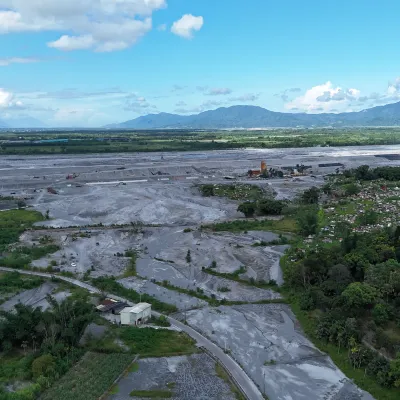
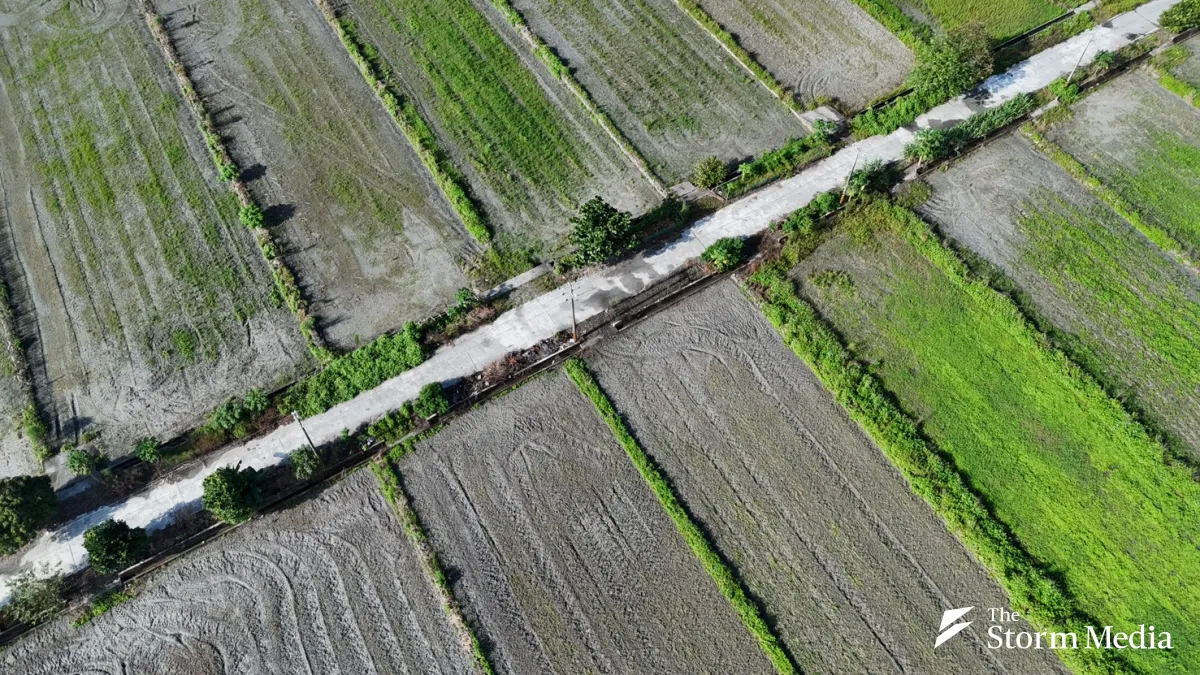
The flood buried about 770 hectares of farmland around Guangfu, a township in eastern Taiwan. In the year since, the Hualien research station of Taiwan's Agriculture Ministry has guided fewer than six hectares into new crops.
That figure understates the recovery a little — Taiwan's Agriculture and Food Agency counts roughly 224 hectares that farmers have brought back themselves, 138 of it commercial-scale grain — and understates the problem not at all. Hualien registered 307 hectares of special fallow for this year's first crop. Most of the buried land is still buried.
Xiaolin Got a Farm. Guangfu Got a Referral.
Taiwan has a benchmark for this. When Typhoon Morakot obliterated the village of Xiaolin in southern Taiwan in 2009, the government of the day, working with the Taiwanese Buddhist charity Tzu Chi and the electronics manufacturer Hon Hai, resettled survivors onto a state-owned sugar estate in Kaohsiung — the Yonglin Farm, which gave displaced farmers land to work again.
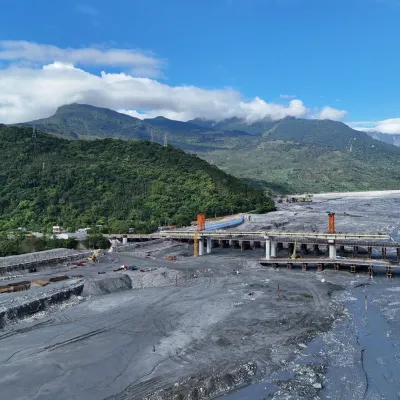
Guangfu was not relocated. Taiwan's current government chose instead to protect the township with a heavily engineered second levee, which spared more than 10,000 people the loss of their town. What it did not do was give the farmers anywhere to farm.
When the opposition Taiwan People's Party caucus toured the disaster zone in May, residents told them they had petitioned the local works station repeatedly and been told each time that the matter would be referred upward. Nothing followed. Farmers waiting for a land rehabilitation plan found instead that fields under more than 50 centimeters of sediment had been designated for reforestation or memorial parkland. One put it bluntly: having survived the flood, they were being finished off by the policy, and the only route left was to sell.
In March, at a demonstration meeting on returning fields to production, Chen Chin-te, a minister without portfolio in Taiwan's Cabinet, was photographed holding radishes grown on a trial plot and said he could see hope and spring.
A 50-Centimeter Line Decides Which Fields Return
That line does a great deal of work. Land under more than 50 centimeters of sediment is classed as severely damaged, to be acquired by Taiwan's forestry agency and contracted out for planting. Land under less goes to the research station's rehabilitation program, split again at 20 centimeters: lightly damaged fields get tillage and organic fertilizer, while fields between 20 and 50 centimeters get excavator turning to a depth of 40 to 70 centimeters.
To have that work done, farmers had to file a consent form, with submissions closing on June 30. About 160 hectares were filed by the end of June — and some of those parcels sit inside the severely damaged zone, which may disqualify them.
The published rules of Taiwan's Agriculture Ministry cover the money rather than the engineering. A damage grant issued in October 2025 and amended in January pays NT$1,000 for every 0.01 hectare of affected farmland, capped at NT$100,000 a hectare. A second measure, published on March 9, 2026, covers 80% of the cost of domestic organic fertilizer, up to NT$5 a kilogram and 20 metric tons a hectare, with applications open until the end of this year. Neither document sets out the sediment-depth tiers, the tillage depths or the consent-form deadline. Those were described to Storm Media by the officials running the program.
Taiwan Deputy Agriculture Minister Huang Chao-ching said the underlying constraint is water. The creek bed now sits higher than the fields on either side and parts of the irrigation network were destroyed, so gravity-fed irrigation no longer works. Channels have been repaired in the Beifu and Dongfu areas; elsewhere the ministry has drilled emergency wells to support dry-field crops, which is why the strategy is conversion rather than restoration. Desilting of the lightly damaged category, 383.1 hectares in all, was tendered in July and is about half done.

For farmers who accept acquisition, the ministry told Storm Media it is offering negotiated purchase priced on pre-disaster market value. For those who still want to farm, Taiwan's state property and sugar agencies have identified 49.6 hectares of public land available to rent, with a subsidy of up to NT$40,000 per hectare a year. So far 8.2 hectares have been matched.
Hsieh Ching-po Takes a Dozen Calls a Day
Hsieh Ching-po moved from Taipei to Wanrong, in Hualien County, and rents about 14 jia — roughly 13.6 hectares — to grow soybeans, black beans and other field crops. The land belongs to around 200 separate owners. About seven jia were hit, first on September 23 and again in November.
On the day itself he drove his four-wheel-drive up onto a meter-high field bank as the second surge came through. The water, he said, was about a story high and came at him in a rush. He was trapped in the vehicle for more than 30 hours before he was reached.
He is candid about why he was still there. Alerts had come and gone for weeks beforehand without consequence. "It was the boy who cried wolf," he said. "And then the wolf actually came."
What arrived after the flood was the phone. Landowners, worried about liability, compensation and their position if the land is acquired, began calling to terminate leases — sometimes a dozen calls in a day. For an owner, damaged land can sit and wait for a payment. For the tenant working it, a canceled lease cuts off the ground preparation, seed, equipment and next season's income all at once.
Farmland in the area rents for NT$50,000 to NT$60,000 a hectare a year, he said, and better plots for well over NT$100,000. Many Hualien landowners are elderly or live elsewhere and hand their fields to whoever actually works them. When a disaster comes, the deed holder controls the compensation and the lease, and the farmer absorbs the crop loss and the unemployment.
"The people who have land don't farm it," he said. "The people who farm it don't have land."
The Subsidy Follows the Deed, Not the Plow
The gap runs through the paperwork. The damage grant is calculated on the affected parcel, and crop-loss, fallow and land compensation are assessed largely on ownership and registry records, so a tenant without a complete contract or receipts struggles to prove what he put in. Hsieh described a fruit grower whose damaged trees qualified for a little over NT$2,000 in compensation, and who spent more than NT$3,000 obtaining the certification needed to claim it.
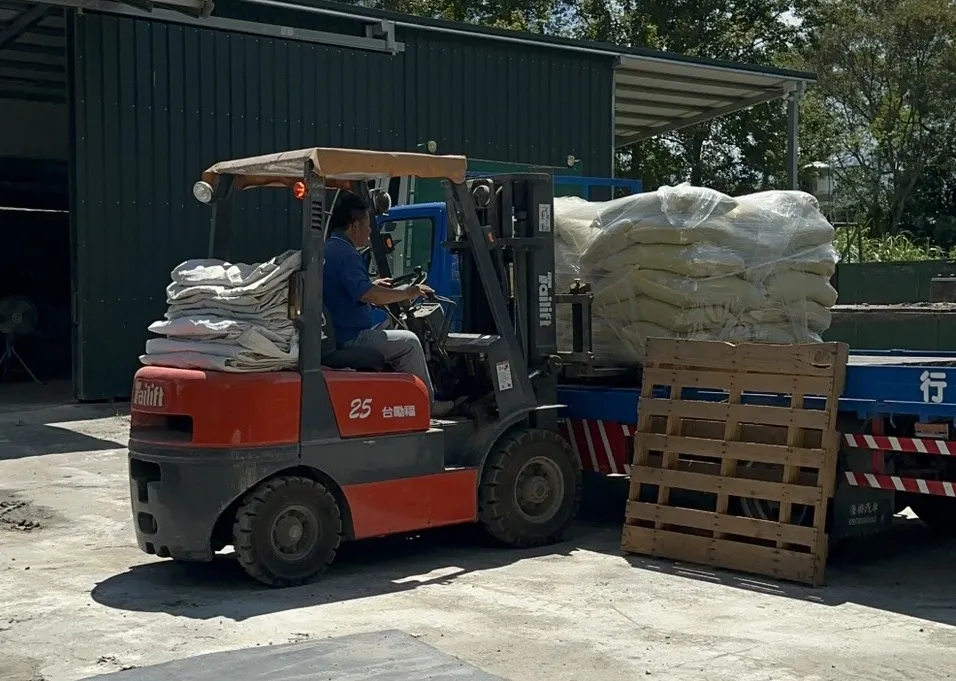
Applications also run through the local farmers' association, which small growers are reluctant to antagonize because an individual usually cannot file a plan alone. The association does not necessarily buy the resulting harvest; some produce goes on consignment, with the farmer paying freight. At the moment they most need a reliable buyer, small farmers are rescuing their soil and finding customers at the same time.
Lin Ching-fu, known to everyone as A-fu, farms rented ground at Tafalong on the south bank. A former Taiwanese navy petty officer, he came home to farm with his wife. About two-tenths of a hectare went under sediment close to a meter deep. He did not wait for a program: he hired an excavator himself, scraped off the surface layer, picked out the debris and leveled the field. The shape of the paddy came back before the soil did.
His rice huller, worth more than NT$800,000, was ruined by the water. The compensation came to about NT$100,000. Machinery, seedlings, storage, labor already spent and income lost while the field sat idle do not fit into a single category.
He is keeping the paddy anyway, on a plot small enough that transplanting and weeding have to be done by hand, knowing the harvest will not cover the labor. "It has cultural value," he said. Growing rice, for him, preserves a way the community relates to the land.
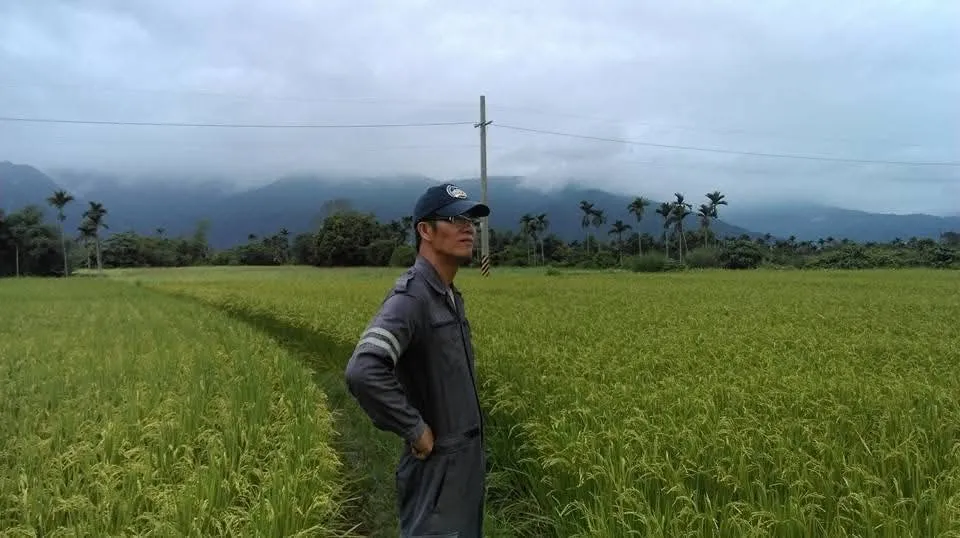
He also remembers driving toward Guangfu with water and supplies on the night the dam broke, and being trapped in a vehicle with a dozen others before they got out. Of the people who came from across Taiwan to dig, deliver and donate, he said: "This is the most beautiful strength in Taiwan. What is most beautiful in Taiwan is its people."
262 Kernels on One Ear of Corn
The soil can be rebuilt. The fine silt the flood deposited has a pH of about 8.3 — alkaline, dense, and hard once dry. Machinery sent into the worst fields jammed on buried debris, and contractors refused the work until testing confirmed the sediment carried no heavy metals. The research station then ran rehabilitation trials on 9.8 hectares.
When Chen returned to Guangfu in August, Taiwan's Cabinet said soybean and corn yields on the demonstration plots had recovered to near pre-disaster levels. It released no figures.
The research station gave Storm Media the numbers. After a year of green manure and 20 metric tons of organic fertilizer per hectare, organic matter in the trial soil rose from almost nothing to about 0.5%. On one former dragon fruit plot, corn came in at 262 kernels an ear, indistinguishable from a normal crop. On untreated ground beside it, an ear carried 39.
The station is aiming at 300 hectares within two years. At that rate, the method works and the arithmetic does not: 770 hectares went under.
Hsieh Ching-kuei, who founded a sustainable farming cooperative in Taiwan after years working on disasters internationally, has been routing corporate and foundation support to what individual farmers actually lack — a small tiller here, seed or packaging there, and above all a buyer who keeps buying. A one-off donation covers an emergency. Agricultural recovery runs across several growing seasons, and a farmer will only commit to the next one if he knows the crop will sell. (Related: Taiwan's Landslide Dam, One Year On 1 | 200 Hectares Marked, No One Asked the Village | Latest )
Which returns to the question the 50-centimeter line cannot answer. Whether tenants can claim support, how leases are protected after a disaster, whether the owner's compensation and the farmer's losses are calculated separately, and whether public land is genuinely available to rent are all policy choices. A system that reads only the deed will exclude the people working hardest to bring the fields back.