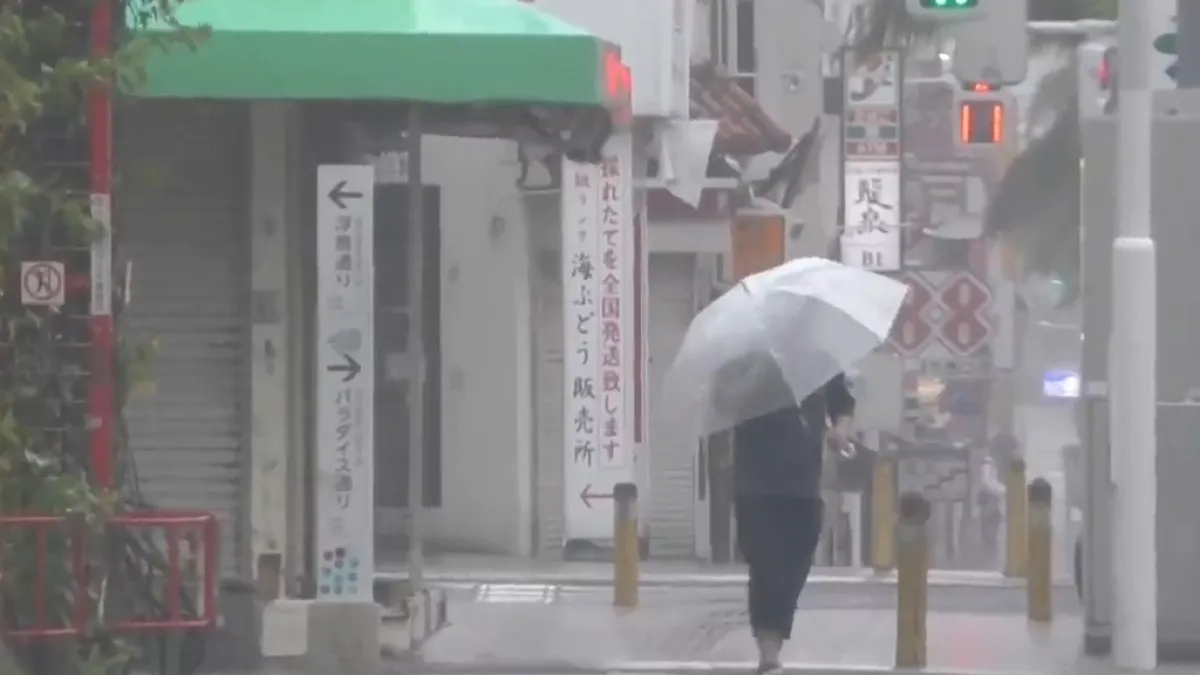
Typhoon Dujuan, the 25th named storm of the season, has battered Japan with torrential rain over the Kanto region, prompting Japan's Meteorological Agency to classify it as a "large and strong" typhoon. The storm has already disrupted Prime Minister Sanae Takaichi's travel plans to the United States, even as one of the region's biggest tourist draws, Tokyo Disneyland, chose to stay open through the downpour.
Record Rain And A Top Level Warning For The Izu Islands
Rainfall on the Izu Islands has topped 800 millimeters, prompting authorities to issue the country's highest level sediment disaster warning, a designation reserved for situations where a life threatening landslide is considered highly likely and residents are told to secure their safety immediately. Chiba and Yokohama have both recorded their highest 24 hour rainfall totals for the month of September on record. As of Monday afternoon, Dujuan was positioned south of Katsuura in Chiba Prefecture and moving north-northeast at roughly 35 kilometers per hour, with forecasters expecting it to pass closest to the Kanto region overnight before approaching the Tohoku region on Tuesday. Authorities have urged residents of the Izu Islands and greater Kanto area to remain on maximum alert for violent winds and high waves through the night.
Takaichi's Flight To Washington Pushed Back Four Hours
The storm has reached all the way to the prime minister's schedule. Takaichi had been set to depart Haneda Airport Monday evening for New York to attend the United Nations General Assembly, but the typhoon forced her flight to be pushed back roughly four hours, from a planned 7 p.m. departure to 11 p.m. Japanese officials said her itinerary after arriving in the United States remains unchanged. Takaichi is scheduled to meet with President Trump on Monday, US time, where the two are expected to discuss China related issues, including the recent Trump-Xi summit.
Tokyo Disneyland Stays Open As Visitors Queue In The Storm
While most tourist attractions across the storm's path shut down as a precaution, Tokyo Disneyland, located in Chiba Prefecture, remained open for business as usual, drawing considerable attention on Japanese social media. Visitors at the park posted on X that wind and rain inside the resort were worse than expected, with drainage systems overwhelmed and large puddles forming on park walkways, though many guests could still be seen queuing under umbrellas for rides.
The decision divided opinion online. Some critics argued the park was disregarding visitor safety, noting that train service had already been suspended and that not every guest was staying at an on-site hotel, meaning road closures could leave many unable to get home. Others defended the operator, pointing out that Tokyo Disneyland has no history of closing entirely for typhoons, that individual attractions can be shut as conditions warrant, and that the park has an obligation to guests who have already checked into its higher priced on-site hotels for the night.