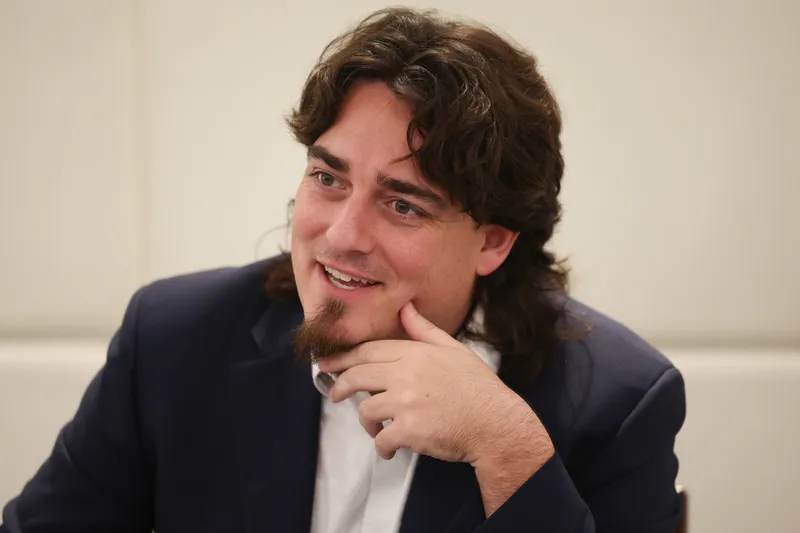
Taiwan cannot fight China fairly and should stop trying, Anduril Industries founder Palmer Luckey told a Presidential Office forum in Taipei on September 19, arguing that an adversary outspending the island eight to 10 times over on defense leaves it no option but to "cheat."
"You can't fight fair. You need to come up with things that are more asymmetric… You need to have no honor in fighting," he said.
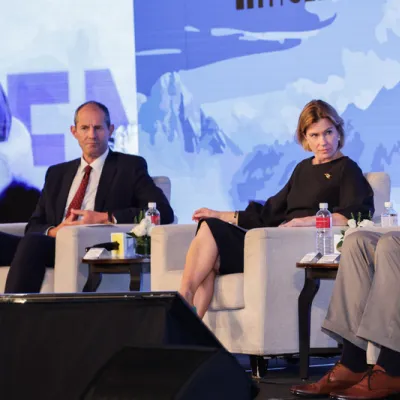
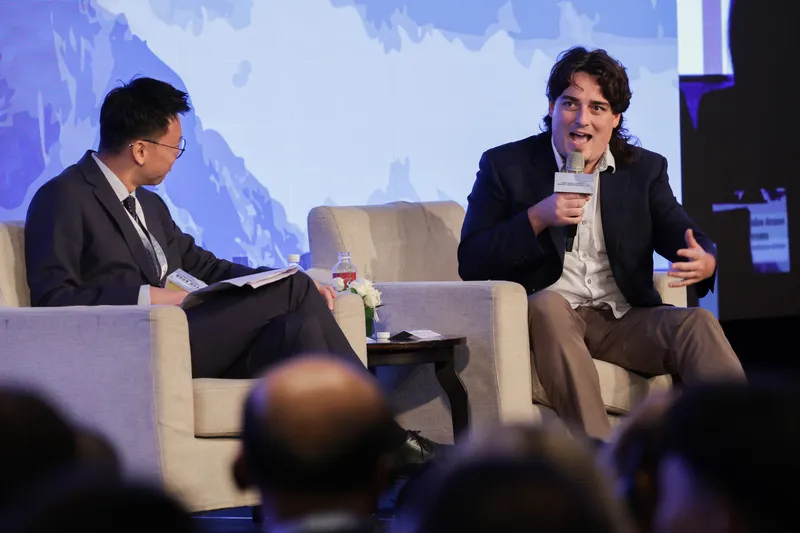
Luckey delivered the keynote, titled "Responding to Emerging Threats and Modern Warfare," at the 2026 Resilient Taiwan for Sustainable Democracy International Forum, staged by the Office of the President Whole-of-Society Defense Resilience Committee at the Grand Hyatt Taipei. President Lai Ching-te opened the forum that morning. Beijing sanctioned Luckey last year over Anduril's weapons and drone sales to Taiwan.
He began with a disclaimer: he sells weapons for a living, and the audience should weigh everything that followed against that.
Freedom Is Taiwan's Weapon, Not Just Its Cause
His central argument inverted the way Taiwan usually talks about itself.
"Freedom usually gets described as the thing that Taiwan is defending, but I think freedom is the most powerful weapon that Taiwan has," he said.
He traced the idea to building his first company — the virtual reality maker Oculus, which Facebook bought in 2014 — and watching Chinese firms take technology developed in the United States while their own government shielded them. What Beijing could not replicate, he concluded, was "a country where people are free to improvise, experiment, to ask, act without permission and come up with a lot of this technology in the first place."
Taiwan can turn that advantage into resilience, he said, economically and militarily, changing both how it fights and how Beijing calculates victory.
Operational Resilience Is Assembly, Not Invention
Luckey broke resilience into three strands. The first, operational resilience, is not a matter of scientific breakthroughs that change the nature of technology. It is a matter of integrating existing technologies, assembling them, mass-producing them cost-effectively and then using them effectively in combat.
"The kinds of technologies that Taiwan needs to steel itself against adversaries' assaults are already abundant," he said.
Taiwan already leads in many of those technologies in industrial and consumer markets, he said. What it has not done is apply them to defense. He urged Taiwan to ask itself "what the final stage of Taiwan's deterrence will look like, one that will persist for years, decades and centuries, and start working towards that steady state today."
Turn Machine Tools Into Weapons Production Lines
The second strand is industrial. Taiwan already builds cost-effective, high-quality machine tools, semiconductors, precision components and advanced composites. Those production lines, Luckey argued, need to become increasingly interchangeable with weapons production, at volumes measured in the millions.
Domestic demand alone cannot sustain the defense industrial base required for a level of deterrence that cannot be broken. His proposal was to make other countries depend on Taiwan for advanced defense capabilities the way the commercial world already depends on Taiwan Semiconductor Manufacturing Co.
"The goal should be for everyone in the world, whether they're buying from you or just afraid of you, to see a label that says, 'designed in Taiwan, made in Taiwan,' on a weapons system, and immediately understand what it means," he said.
A Fortress Of Freedom Built From The Inside
The third strand is the one no foreign partner can supply. The "fortress of freedom," Luckey said, can only be built together by the people inside it, and its purpose is to convince Beijing that the cost of winning is insanely high and that there is no victory in invading Taiwan at all. What the Chinese Communist Party imagines as a short military operation would in fact be the opening of a fight that could run for years.
He set a specific political condition for that deterrent to hold. If Taiwan can reach a durable, shared view of its own future — one that may look slightly different to each person who holds it — and if the CCP grasps that this view survives any political fight, disagreement, election campaign or round of economic coercion, then Beijing would understand the war to be winnable but not worth winning.
Home Advantage Means Making It Painful Enough
Asked by Lin Fei-fan, deputy secretary-general of the National Security Council, who moderated the session, to assess China's military buildup, Luckey said seizing Taiwan is Beijing's major strategic objective and that it has prepared accordingly. Even so, "Taiwan has a lot of home advantages."
"It is going to be much harder for China to fight on your shores than it will be for you. You don't need to go and invade China. You just need to make it so painful for them and for them to know that it's so painful that they don't come for you," he said. "I think that that is absolutely a doable task."
Pressed on how a far smaller force could hold off the People's Liberation Army, he reached for Afghanistan, where the U.S. military met an opponent almost nobody expected it to struggle against. Measured by weapons alone it should have been unwinnable for the other side — proof, in his telling, that overwhelming power does not guarantee a win. The American colonists who fought the British, he added, did not fight honorably either.
Despair Is A Weapon Beijing Is Already Using
Luckey's sharpest words were for the argument that Taiwan's position is hopeless. Nobody in Taiwan should believe that, he said, and the people who say it have their own reasons — many of them funded by adversaries who want Taiwanese to give up hope and surrender their right to self-determination.
If the fight really were an easy win for those adversaries, he argued, they would not be flooding social media with the idea that nothing can be done.
He closed on his own exposure. Anduril is itself betting that Taiwan will continue to exist, he said, buying Taiwanese chips, Taiwanese sensors and Taiwanese suppliers. The more companies that place the same bet and double down on it, the likelier Washington becomes to conclude that losing Taiwan to China would be a strategically unacceptable outcome for the United States.