Taiwan's 96% dependence on imported energy is its most exposed vulnerability in a confrontation with China, the top British and European Union envoys in Taipei said on September 19, delivering a blunter assessment than the American representative seated beside them.
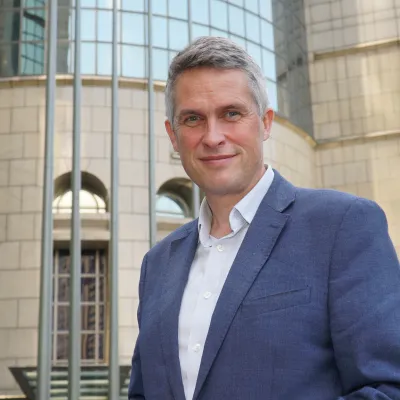
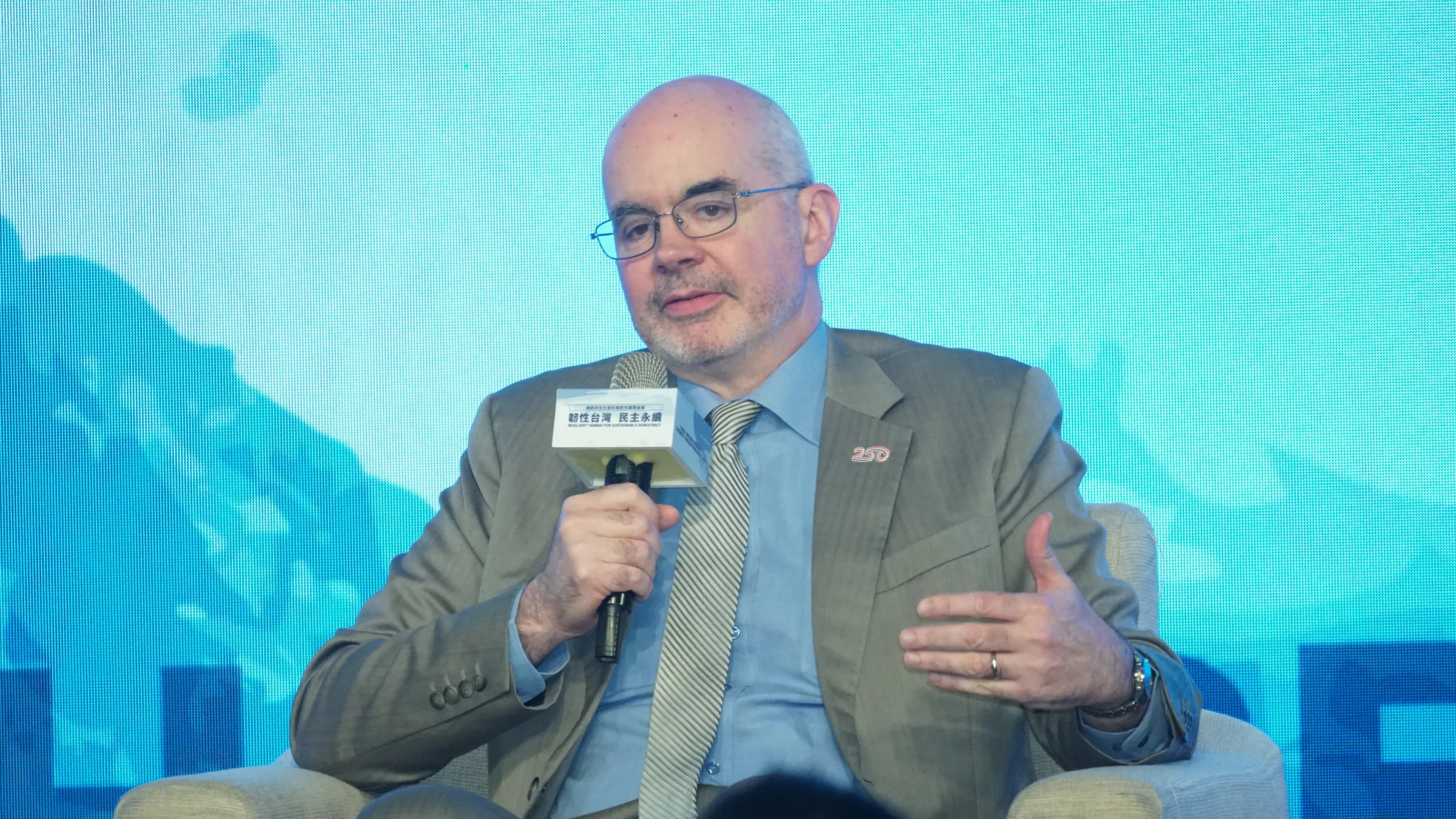
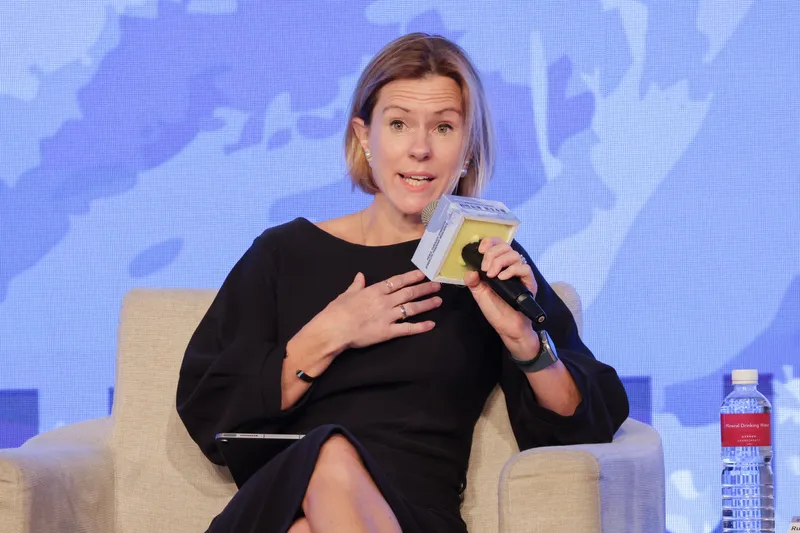
Raymond Greene, director of the American Institute in Taiwan's Taipei Office, Ruth Bradley-Jones, representative of the British Office Taipei, and Lutz Güllner, head of the European Economic and Trade Office, shared a panel titled "Taiwan's Whole-of-Society Defense Resilience from an International Perspective," the first afternoon session of a Presidential Office forum held at the Grand Hyatt Taipei.
All three praised what Taiwan has built over the past two years before turning to the three pressure points the session was organized around: energy, maritime security, and foreign information manipulation and interference, the European term for state-backed disinformation campaigns, abbreviated as FIMI.
The event was the 2026 Resilient Taiwan for Sustainable Democracy International Forum, the second staged by the Office of the President Whole-of-Society Defense Resilience Committee, a body set up in 2024 under President Lai Ching-te to draw civilian agencies, local governments and private industry into Taiwan's defense planning. The committee is approaching its second anniversary. More than 500 domestic and international participants attended, among them former White House deputy national security advisers Matt Pottinger and Anne Neuberger, former Philippine national security adviser Hermogenes Esperon, and former Lithuanian deputy defense minister Tomas Godliauskas.
Greene Calls 2026 Taiwan's Year Of Integration
Greene's assessment was that the separate strands of preparation built up since the committee's creation have finally been stitched together.
"We consider this year the year of integration where we've really seen all of these different preparatory efforts done across these different actors brought together, whether it's civ-mil integration through this year's Han Kuang together with Urban Resilience exercises, or whether it's local-central coordination like the 9-21 exercise... Right now, you can feel—across society, agencies, and local governments—that there is real understanding and commitment to achieve effects," he said.
Han Kuang is Taiwan's annual live-fire military exercise, staged alongside the Urban Resilience civil defense drills since 2025. The 9-21 exercise is the nationwide disaster response drill held each September to mark the 1999 Chi-Chi earthquake, which killed more than 2,400 people.
AIT's Greene Rejects The 14-Day Gas Benchmark
Greene framed Taiwan's energy security as an international problem rather than a domestic one. Taiwan sits at the center of critical supply chains and its weight in the global economy keeps growing, he said, which makes the resilience of its power supply a shared interest. Energy has become a second major focus of the Presidential Office committee, he added, and recent progress has been substantial.
He then took aim at the number that dominates the debate. Analysts routinely note that Taiwan holds roughly 14 days of liquefied natural gas and treat that figure as the clock on how long the island could hold out. Taiwan is developing a set of options and tools that would stretch that supply, Greene said, and the framing itself is wrong: the question is not how long Taiwan's energy would last, but how long the global economy could keep running at full speed without trading with Taiwan.
"The time the global economy can withstand is far shorter than the various timelines involved in Taiwan's energy security, and the consequences far more serious," he said.
Bradley-Jones And Güllner Press Taiwan On Import Dependence
Bradley-Jones said Greene's answer would reassure many in the room, then offered what she described as a more contentious view from a different angle. "I do think energy security is a very significant vulnerability for Taiwan," she said.
Her prescription was specific: raise the share of low-carbon power generated at home, push hard on energy efficiency through storage, grid upgrades and new technology, and speed up the government approval processes that slow offshore wind and geothermal projects.
Güllner arrived at the same place by a different route. Taiwan imports 96% of its energy, he said, a dependence that makes the vulnerability obvious, and the answer lies in diversification and a clearer strategic direction. He urged heavier investment in domestically generated power, particularly solar and wind, alongside gains in how efficiently Taiwan uses what it produces.
Güllner Urges Exposure And Accountability Over Manipulation
On disinformation, Güllner spoke as someone who spent six or seven years of his career working the problem intensively, and he offered no clean solution. It is one of the most complex areas any government faces, he said, because it collides with several principles at once. For liberal democracies that treat free expression as their most important asset, he said, everyone is struggling in this space.
What he proposed was a sequence. Governments first have to be clear-eyed about the nature of the threat. Then two efforts have to run in parallel: building a counter-narrative and public media literacy on one side, and on the other, holding the tools to understand how a manipulation campaign actually works, exposing the operators and making the information environment transparent. The final step is accountability — attributing interference operations and the tactics behind them to the actors running them, so that they bear a cost.
Greene Says AI Has Raised Disinformation's Ceiling
Taiwan has led the field on FIMI for the past five or six years, Greene said, for the unhappy reason that it met organized disinformation earlier and more often than most countries. But he agreed with Güllner that the challenge is changing shape. Artificial intelligence has lifted disinformation to a different level and made debunking harder.
Taiwan's overall media literacy is high, he said, yet pockets remain exposed — older citizens, and a very young cohort that rejects established sources — which is why the response has to come from several directions at once.
Bradley-Jones Names Election Interference Her Biggest Worry
Of everything Taiwan faces from foreign information operations, Bradley-Jones said, elections worry her most. From the early internet era through to the AI era, nearly every democracy has run into election interference, and Taiwan stands "closest to the fire," absorbing damage she described as hard to bear.
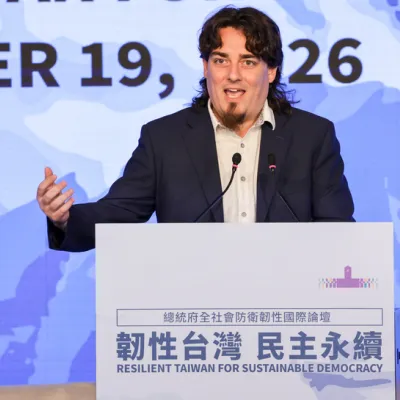
She closed by picking up the morning keynote from Palmer Luckey, founder of the U.S. defense technology firm Anduril Industries, who had told the same forum that Taiwan cannot afford to meet China on even terms. "You can't fight fair," Luckey said. "You need to come up with things that are more asymmetric… You need to have no honor in fighting."
That belongs at the level of national defense, Bradley-Jones said. When it comes to the ballot box, she told the audience, she hoped Taiwanese would be able to vote fair and square.
Original Article In Chinese (Related: Taiwan Must 'Cheat' to Beat China, Anduril Founder Palmer Luckey Says | Latest )