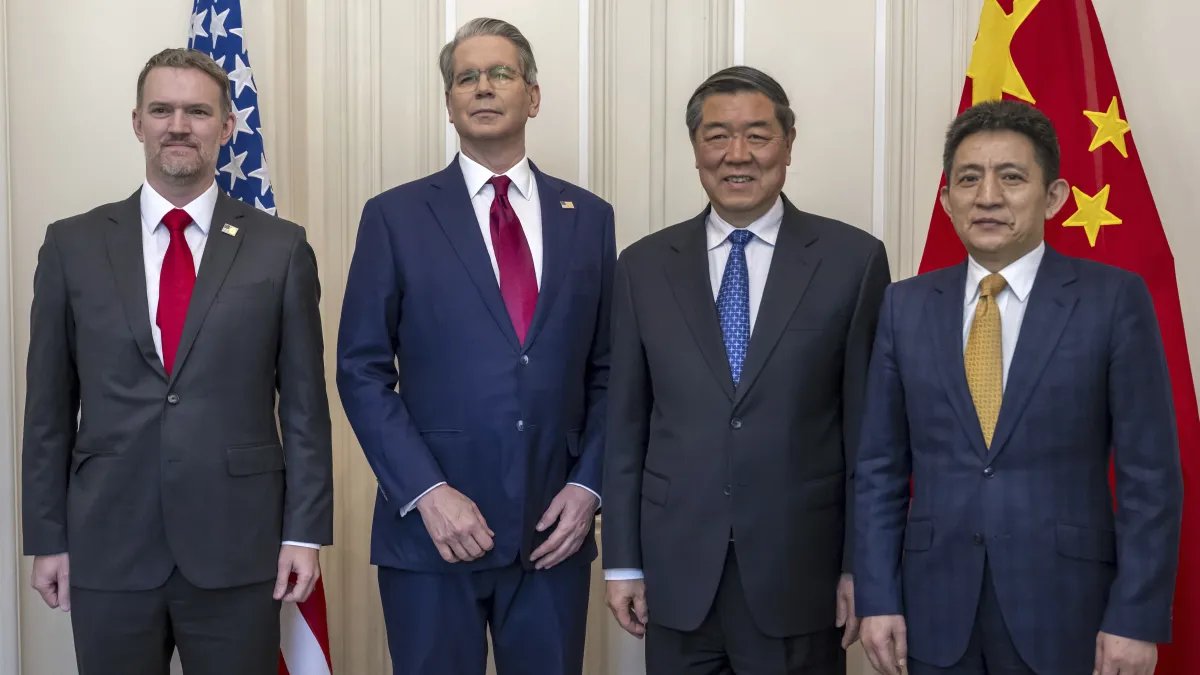
The United States and China agreed on September 20 to open a standing dialogue on artificial intelligence, the most concrete result of an eight-hour negotiating session in New York held four days before President Donald Trump receives Xi Jinping at the White House.
Treasury Secretary Scott Bessent, who led the American side, described the day as "very successful" in remarks to reporters afterward. He met Chinese Vice Premier He Li-feng at JPMorgan Chase's global headquarters in Manhattan, joined by U.S. Trade Representative Jamieson Greer and Li Cheng-gang, China's vice commerce minister and chief trade negotiator. Working-level teams were due to reconvene on September 21.
Bessent Proposes A Notification Channel For AI Incidents
Under the framework the two governments sketched out, Washington proposed a notification system that would let each side alert the other to AI-related incidents serious enough to reach the level of national security. Bessent argued the logic is no different from any other flow across borders.
"We think that, just like with any cross-border activity, that moving from opaque to more transparency between the number one and the number two AI powers in the world is very important," Bessent told reporters after the session.
Artificial intelligence climbed the bilateral agenda after Trump and Xi met in Beijing in May 2026. The two leaders discussed the technology then, but no formal channel followed. The New York round is the first attempt to institutionalize that conversation, and it begins deliberately with shared risk rather than with the commercial rivalry that divides the two capitals.
Chip Export Controls Stay Outside The New Framework
American officials said U.S. export restrictions on advanced processors and semiconductor manufacturing equipment are not on the agenda of the AI mechanism. Leaving those controls out removes the single most contentious item in the technology relationship, and it is what made an early understanding possible at all.
The choice of subject matter is itself the story. By starting with incident notification rather than market access or hardware, the two governments picked the one corner of the AI relationship where their interests overlap instead of collide. The opening is narrow, and it was built to be narrow.
Why The Chip Carve Out Matters For Taiwan
For Taiwan, the exclusion keeps the status quo intact for now. Taiwanese foundries manufacture most of the world's leading-edge logic chips, and it is Washington's export-control regime that decides which of those chips, and which pieces of production equipment, may reach Chinese customers. Any later decision to fold export controls into the AI dialogue would draw Taiwan's largest industry into a negotiation in which it holds no seat.
Greer Says The Trade Board Is Now Operational
The second outcome was procedural but real. The "Board of Trade" the two sides agreed to in earlier rounds has begun to function, and Greer said the mechanism is now operational. It will start with goods that carry no direct national security weight.
On the Chinese side that list could cover consumer products and low-technology manufactures. On the American side it could include energy, agricultural commodities and medical devices. The arrangement does not dismantle tariffs. It ring-fences a block of non-strategic trade so that those goods are less likely to be swept up the next time either government reaches for trade measures.
"These are the two most powerful countries on earth, whether it's in trade or AI, and it's imperative that they're able to work together," Greer told reporters.
Greer described the New York talks as groundwork for the leaders' meeting, while acknowledging that the relationship still carries serious problems.
Tariff Truce And Rare Earths Remain Unsettled
Neither delegation announced what markets were watching for. The truce struck in October 2025, which caps U.S. tariffs on Chinese goods at roughly 20%, expires on November 10, 2026, and no extension was confirmed. There was also no breakthrough on rare earths and critical minerals. Washington has spent months pressing Beijing to improve supply to American manufacturers, and nothing announced on September 20 moved that dispute.
Beijing's earlier pledges remain outstanding as well: roughly $17 billion a year in U.S. agricultural purchases and orders for more than 200 Boeing aircraft. Those commitments are likely to resurface on September 24, when Trump, who wants results he can show voters before the November midterm elections, negotiates with Xi face to face.
What emerged in New York is a pair of working mechanisms: an AI safety dialogue taking shape, and a trade board handling goods neither side treats as strategic. The heavier questions of tariffs, rare earths, farm purchases and aircraft orders were left exactly where both delegations intended to leave them, on the table between the two presidents.
Original Article In Chinese (Related: Exclusive | Taiwan Must Arm Faster, Says Former UK Defense Chief | Latest )