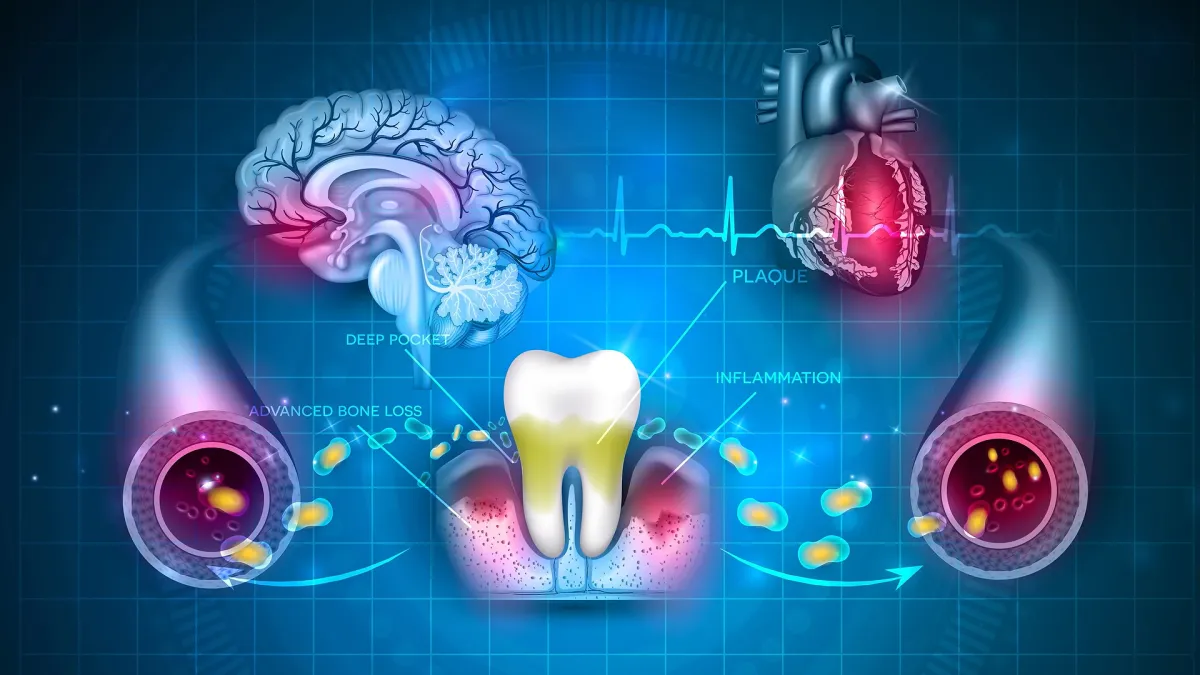
Two Taiwanese specialists say the bacteria that collect in dental plaque do not stay in the mouth, and that one species in particular, Porphyromonas gingivalis, can pass into the bloodstream and the brain, where researchers have tied it to atherosclerosis, poorly controlled diabetes and Alzheimer's disease.
Fresh plaque is easy to ignore. It forms as a colorless or milky film along the gumline and in the spaces between teeth, and for the first day or two it is all but invisible. Left alone, it soaks up pigment from tea, coffee and tobacco and darkens into yellow or brown patches, then binds calcium from saliva and hardens into tartar, known clinically as dental calculus. That hardened layer is what turns routine gum irritation into periodontal disease.
Genomic Medicine Specialist Links Brushing To Stroke And Diabetes
Chang Chia-ming, a specialist in genomic medicine and director of the Division of Genetics and Prenatal Diagnosis at Taipei Veterans General Hospital, said most people still treat brushing as a defense against cavities and bad breath and nothing more.
"Whether or not you brush thoroughly may also affect whether you have a stroke, develop diabetes, or even develop dementia early," Chang said.
He pointed to a 2019 paper in Science Advances that examined the relationship between P. gingivalis and Alzheimer's disease and neurodegeneration, and to a 2025 paper in Signal Transduction and Targeted Therapy that looked closely at the bacterium's role in atherosclerosis and cardiovascular disease. Comparable studies have continued to appear since.

In the clinic, Chang said, he sees patients whose blood pressure and blood sugar readings are normal but who still develop cardiovascular trouble or persistent fatigue. What those patients tend to share is years of accumulated plaque and chronically inflamed gums, a condition most of them dismiss as nothing worse than an overdue cleaning.
"Periodontal pathogens such as Porphyromonas gingivalis take advantage of the tiny ulcers formed by inflamed gums and periodontal pockets to enter the blood circulation and stimulate the body's chronic inflammatory response," Chang said. "Over the long term, this not only causes hardening of the arteries but also raises the risk of myocardial infarction and stroke."
Shuang Ho Dentist Calls Periodontitis An Open Wound
Huang Mao-shuan, a professor-level attending physician in the dentistry department at Taipei Medical University Shuang-Ho Hospital in New Taipei, said periodontal disease and diabetes make each other worse. A diabetic patient whose severe gum disease goes untreated will find blood sugar harder to control, and a patient with severe gum disease whose diabetes is poorly managed will find the gum disease harder to treat.
Once plaque and tartar have progressed into periodontitis, Huang said, the patient is effectively carrying an open wound of at least four to five square centimeters inside the mouth. Where there is a wound there are bacteria, and those bacteria can travel in the blood and reach the heart.

That risk, Huang said, is why dentists give patients with congenital heart disease, rheumatic heart disease or a prosthetic heart valve 2 grams of a penicillin class antibiotic an hour before an extraction, as a guard against infective endocarditis, a step he described as long established in American cardiology. Current American Heart Association guidance specifies amoxicillin as the oral drug of choice for that purpose and restricts prophylaxis to a defined group of high risk patients, among them those with prosthetic valves, a previous episode of endocarditis and certain congenital heart defects.
The gut appears to be exposed as well. A Japanese systematic review found a clear association between periodontal disease and ulcerative colitis, suggesting that when the oral environment loses its balance it can unsettle immunity more broadly, possibly through an oral-gut-immune axis that drives chronic inflammation of the intestinal lining.
Porphyromonas Gingivalis Is Not The Only Suspect
P. gingivalis is the most thoroughly studied periodontal pathogen, but it is far from the only one under scrutiny. Researchers have also investigated Fusobacterium nucleatum, Treponema denticola, Aggregatibacter actinomycetemcomitans and Tannerella forsythia, along with the compounds they produce, for their relationship to systemic inflammation, the blood-brain barrier and neuroinflammation.
What sets P. gingivalis apart is the toxic proteins it releases, a family of enzymes known as gingipains, together with the outer membrane vesicles it sheds. Both may travel through the circulation and act on blood vessels and the blood-brain barrier. If the species is the final boss of periodontal infection, a long list of lesser ones is still being investigated.
Biofilm Blunts Antibiotics Inside Periodontal Pockets
Antibiotics can kill P. gingivalis in the laboratory. The clinical difficulty, Chang said, is that dentists are almost never dealing with a single free floating, or planktonic, organism. They are dealing with an entire community sheltered inside the biofilm of a periodontal pocket, which makes killing the bacterium in a dish and clearing it from a mouth two very different problems.
Current evidence indicates the organism generally remains susceptible to amoxicillin, amoxicillin with clavulanate, metronidazole and doxycycline, and one review of resistance data found most strains still sensitive to a range of antibiotics in laboratory testing. Signals of resistance to metronidazole, tetracyclines and macrolides have nonetheless started to appear in a small number of strains.
The biofilm itself is the real obstacle. Once P. gingivalis settles into the biofilm of plaque and periodontal pockets, antibiotics penetrate poorly and the bacteria shift their metabolic state. Studies have found that organisms embedded in biofilm need far higher antibiotic concentrations to kill than planktonic ones, and can survive at levels many times the usual minimum inhibitory concentration.
European Guidelines Put Mechanical Cleaning Before Drugs
For that reason, periodontal treatment is not built around a pill. It begins by destroying the environment the bacteria live in: scaling away calculus, root planing, plaque control and daily cleaning between the teeth. Current treatment guidelines place mechanical disruption of the biofilm, known as subgingival instrumentation, in the first line of care.
Antibiotics remain an adjunct reserved for particular cases. The European Federation of Periodontology does not recommend routine systemic antibiotics for all periodontitis patients. A periodontist may consider adding them for patients who are young, whose disease is advancing rapidly or is unusually severe, or who respond poorly to appropriate periodontal treatment.
Nor is the goal to drive the bacterium down to zero. A 2026 review in the British Dental Journal made that point directly, noting that P. gingivalis can live in a healthy mouth, and that whether disease develops depends on the strain, the surrounding microbial community and the host's own immune response.
Twice Daily Brushing And Scaling Every Six Months
A more sensible clinical target, Chang said, is to reduce the load of P. gingivalis and pathogenic biofilm, improve conditions inside the periodontal pockets, bring down persistent inflammation and let the oral microbiome settle into a steadier state.
Diet and topical agents can contribute. Curcumin, catechins and resveratrol have been shown to inhibit bacteria, act as antioxidants and interfere with bacterial adhesion, and can be taken in through food or through toothpaste and mouthwash containing them. Oral probiotics are also coming into wider use; certain strains, among them Limosilactobacillus reuteri, long classified as Lactobacillus reuteri, can help rebalance the oral microbiome and reduce both plaque formation and gum inflammation, with particular benefit for people with diabetes and for children.
Chang's own list is unglamorous. Brush twice a day for at least two minutes. Use floss on the gaps a brush cannot reach. Use a plaque disclosing agent from time to time to find the spots being missed. Have the teeth scaled every six months so plaque does not harden into calculus, a visit Taiwan's National Health Insurance covers. Lozenges containing specific probiotic strains can help build a friendlier bacterial environment.