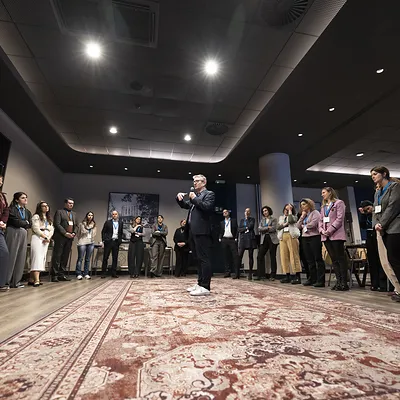
Deloitte Taiwan convened manufacturers, roboticists and government researchers in Taichung on September 15, 2026, to confront a question the island's export-driven factories can no longer defer: how to move Physical AI systems out of pilot demonstrations and onto the actual production line.
The one-day forum, titled "Physical AI's New Game," drew executives from central Taiwan's dense cluster of machine-tool, precision-component and contract-manufacturing firms, many of them the kind of small, specialized "hidden champion" companies that dominate narrow global niches with little consumer name recognition. Unlike conventional automation, which simply executes fixed instructions, Physical AI refers to systems that sense their surroundings, reason under uncertainty and act through robotic hardware, a leap that speakers said demands new standards for investment, safety and oversight rather than mere proof that the technology works.
Chiang Shu-ching, Deloitte Taiwan's regional director for central Taiwan, said the region's tightly linked supply chain, spanning Taichung, Changhua and Nantou counties, gives smaller manufacturers a natural testing ground because design, machining, assembly and end-use customers often sit within a short drive of one another. She said a new generation of company leaders is more willing to adopt digital tools, but most small and midsize manufacturers still lack the data infrastructure and cross-department talent needed to turn a working prototype into a scalable operation.
Turning Veteran Instinct Into Machine Readable Rules
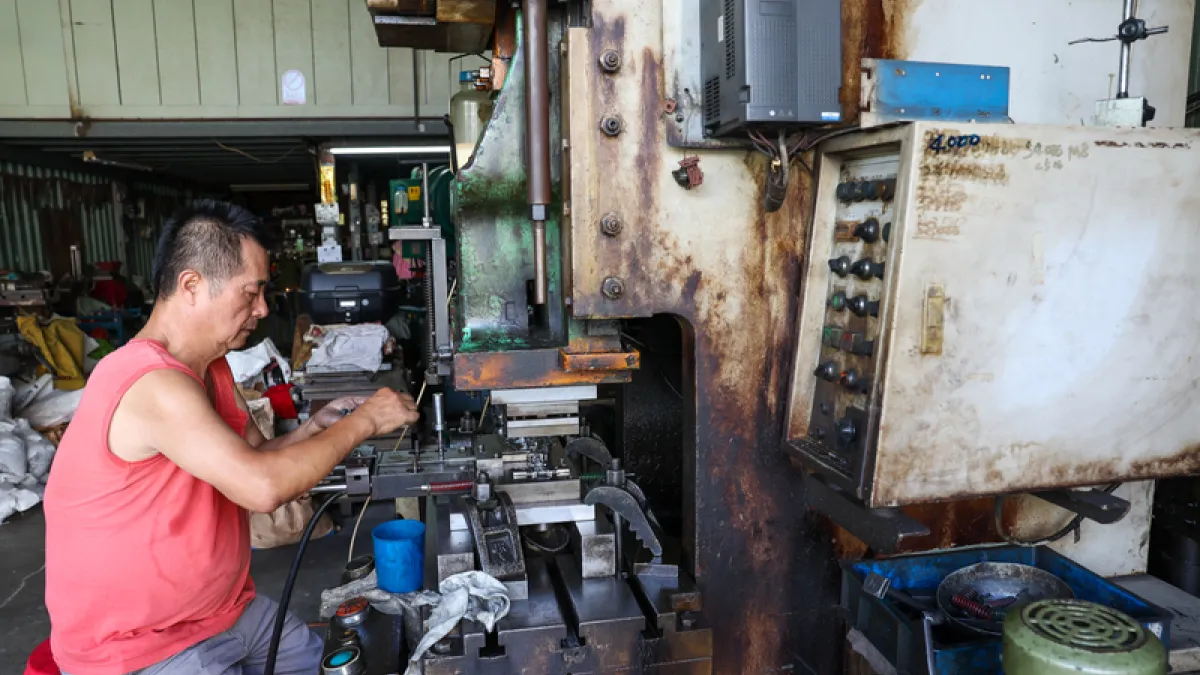
Kuo Ping-chen, a program director at the Taiwan AI Academy, said the central challenge is capturing decades of tacit shop-floor knowledge, such as a veteran technician's ability to detect a problem from the sound of a machine or the feel of a material, and converting it into data and rules an AI system can act on. He said that kind of expertise is often something workers can perform but cannot fully explain, and it risks disappearing as those workers retire.
Kuo added that once an AI model's judgment is translated into a robot's force, speed or movement, an error can halt a production line, damage equipment or endanger workers, which makes validation protocols and safety boundaries as important as the underlying algorithm. He said the talent manufacturers will need next combines information technology, mechanical engineering and process knowledge, the same mix required to translate shop-floor conditions into instructions a machine can carry out.
Component Strength Must Become System Strength
Tsai Hung-ying, president of the National Applied Research Laboratories, Taiwan's largest state-funded research network, said intelligent robots must ultimately answer practical needs such as labor shortages, elder care and hazardous work, but the harder problem is integrating sensing, control, mechanical design and software onto a single platform.
Tsai said Taiwan already has a solid base in components and subsystems, and the next dividing line will be system integration, including motion control, simulation, data feedback loops and communication between machines as robots evolve from operating alone to coordinating in groups. He said a government push to cultivate system-level startups matters less for how many companies join the supply chain than for whether Taiwan can build its own development capability while industry standards are still being written, a step that could move the country from a components supplier toward a genuine participant in robotics platforms and applications.
A National Testbed To Absorb The Cost Of Error
Lin Chun-liang, vice president of the National Applied Research Laboratories, said Physical AI differs fundamentally from earlier automation because machines must learn and make judgments in unpredictable conditions, which means the way those systems are validated has to change as well. He pointed to Taiwan's experience building its own satellites: engineers who worked on satellite systems abroad were kept from the critical payload installation stage, a gap that later pushed Taiwan to build independent satellite manufacturing capability and underscored how integration skills are acquired only through hands-on practice.
Lin said Taiwan now needs an environment where systems can be tested, corrected and debugged repeatedly, because individual factory production lines have little tolerance for trial and error. He said the National Intelligent Robotics Research Center is meant to provide that testing ground through shared facilities, computing power and cross-disciplinary collaboration, so that failures surface during validation rather than after a product has already been deployed.
Digital Twins Let Factories Rehearse Before They Build
Wen Shao-chun, who leads Deloitte Taiwan's energy, resources and industrials practice, said Taiwan's earlier wave of digital transformation largely connected equipment to networks and gathered data to monitor production, while Physical AI pushes artificial intelligence into the machines and equipment themselves, extending it from reading information to sensing, deciding and acting. He said Taiwan's Ministry of Economic Affairs recently began promoting AI upgrades and modular sensing components for manufacturers and robot makers, reflecting a deeper push toward combining software and hardware. The question for companies, Wen said, is shifting from which equipment to install toward what capability Physical AI can create, including which processes to redesign, which data and core competencies to keep in-house and how to allocate capital and partnerships.
Wu Chih-chung, a senior solutions architect at NVIDIA, said the next stage for smart factories is not isolated automation at a single station but connecting equipment, robots, AI and production data into a system that can be simulated, forecast and continuously optimized. He said NVIDIA's Omniverse digital-twin platform and its Isaac robotics simulator let manufacturers design and validate a production line before installing physical hardware, lowering the cost of adoption and the risk of a line shutdown, while generating simulated data that can further train and refine the AI models involved.
Investors Look Past Growth To Unit Economics
Chen Po-chu, president of Chi Fu Capital, said Physical AI is moving from demonstration projects to field validation and volume delivery, and that investors evaluating robotics companies must look past growth potential to identify which parts of the value chain, whether key components or systems integration, actually create value, while also examining a company's manufacturing capacity and unit economics.
He said Taiwan's manufacturers can draw on their long experience in precision manufacturing, semiconductors and systems assembly to move from supplying individual parts to integrating across domains. Chen said his firm's fund, named Beiye Qianzhan, or "Foresight," aims to use its cybersecurity and software investment expertise to connect technology, testing sites and overseas markets for Taiwan's component-level hidden champions.
Regulators Set New Rules For Autonomous Machines
Pai Che-hao, a vice president at Deloitte Taiwan's technology and transformation advisory practice, said the competition around Physical AI is rewriting industry rules, and companies now need to build trust and governance capabilities alongside technical ones as regulators worldwide focus on ensuring autonomous machines do not endanger people or the environment. He said the European Union's revised Machinery Regulation takes effect January 20, 2027, and will for the first time bring machines with learning capability under product safety rules, requiring third-party verification for any equipment in which AI performs a safety function and clearly defining what a machine may decide on its own.
Pai added that the regulation will also require manufacturers to build in a mechanism for real-time human intervention at the design stage and to retain records of machine decisions and software versions, and that while the United States has no unified federal law on the subject, similar requirements are already appearing in corporate procurement specifications and supply-chain audits. He said Taiwanese makers of machinery, industrial robots and semiconductor equipment that export to Europe will increasingly compete on regulatory compliance and governance as much as on product performance, and that acting early on validation, safety and governance could strengthen their position in global markets.
Robots Need Not Master Everything To Earn Their Place
Huang Shih-chung, chief operating officer of Techman Robot, said that once Physical AI reaches the factory floor, the competition is no longer about how many difficult motions a robot can perform but whether it understands a manufacturer's process well enough to reliably complete the tasks the business actually needs. He said manufacturing demands a far higher bar for precision, reliability and safety than any demonstration environment, and because the same robot may face different parts, fixtures, processes and conditions across semiconductor, electronics-assembly or traditional factory floors, its value increasingly depends on accumulating reusable, industry-specific skills.
Huang said companies do not need to wait for an all-purpose robot capable of any task, and can instead start with single or dual robotic arms, or mobile robots, already proven to generate value in tasks such as material handling, pick-and-place, inspection and welding. As those capabilities accumulate and can be deployed quickly across different equipment and production lines, he said, robots stop being a one-time equipment purchase and become an expandable production capability.
(Related:
CarbonSix Secures $40M Series A to Deploy Physical AI Across Global Manufacturing
|
Latest
)