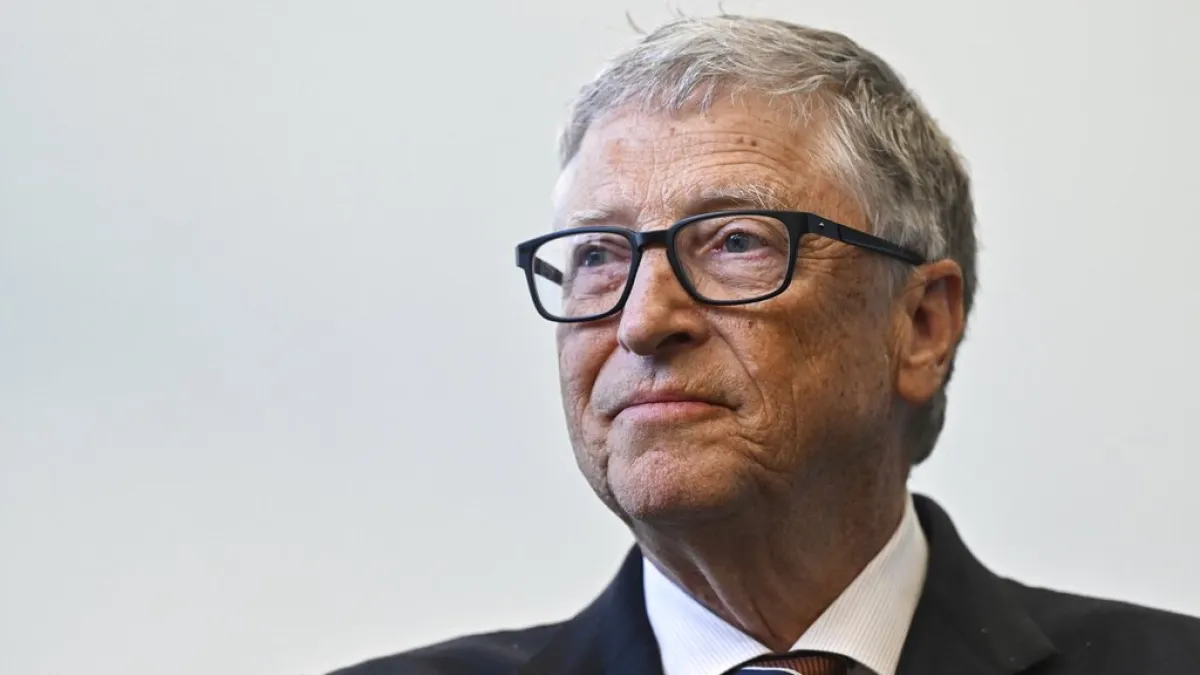
Bill Gates warned on September 15 that artificial intelligence will be built first for the people and institutions best able to pay for it unless governments and technology companies intervene deliberately, as the Gates Foundation pledged $1 billion over the next two years to steer the technology toward the world's poorest communities.
The warning accompanied the foundation's annual Goalkeepers report, which tracks progress toward the United Nations Sustainable Development Goals and this year focused squarely on who gets access to AI. Gates, who built Microsoft through the personal computer era, said no earlier wave of technology has spread this fast or this far, and that the familiar pattern of new tools reaching the affluent first is now repeating at far greater speed.
"Left to the market alone, the most capable tools will be built first for the people and institutions most able to pay for them—not necessarily for those who could benefit most," Gates wrote in the report.
He framed the problem as the same market failure his foundation was created to address, noting that "the people with the greatest needs often have the least power to shape where innovation and investment go." AI, in his telling, will either be the greatest equalizer ever invented or the worst source of injustice, and which way it lands is not a long-range forecast but a decision being made now.
A Two Year Commitment Split Across Four Priorities
The foundation will direct 40% of the $1 billion to education, including tools that help teachers identify gaps in what students have actually learned, and another 40% to health, covering diagnosis, clinical decision support, health worker training, and drug and vaccine research.
A further 10% will go to agriculture, aimed at smallholder farmers who need advice on weather, pests and fertilizer in a form they can use, and the remaining 10% to the digital foundations that equitable AI depends on, including local-language data sets.
Mark Suzman, the foundation's chief executive, described the sum as a down payment rather than a ceiling, and said he expects the commitment to grow. The pledge lands at a moment when development budgets are under strain, with the foundation openly weighing how to respond to cuts in United States government aid.
English Supplies More Than 90% Of Early Training Data
The report sets out three things it says must happen for AI to reach the people it could help most. The first is linguistic: AI tools have to work in every language people actually speak. The foundation notes that more than 90% of the training data behind early large language models came from English-language sources, baking a cultural and linguistic bias into systems now being exported worldwide.
The second is that countries and local communities, rather than distant vendors, should govern how their own data is managed and protected. The third is that the doctors, farmers, teachers and developers who will use these systems need genuine opportunity to evaluate them and adapt them to local conditions, along with affordable access.
Early Results From Kenya, India And US Classrooms
The foundation pointed to deployments already running. Penda Health, a Kenyan primary care provider, recorded a 16 percentage point improvement in diagnostic accuracy using an AI clinical tool. In the United States, the Kiddom Atlas learning platform produced gains equivalent to roughly six months of additional learning. In India, the MahaVISTAAR agricultural advisory service has enrolled more than 740,000 farmers.
Technology companies are attached to several strands of the work. OpenAI has committed $50 million toward training health workers in Rwandan clinics. Anthropic is working on vaccine development and improving crop data sets. Google.org and Microsoft's AI for Good Lab are supporting a framework for African languages.
Gates Says The Next 18 Months Will Settle The Question
The timeline Gates set is short. "Decisions made in the next 12 to 18 months—about how AI is built, funded, and deployed—will determine whether this technology primarily benefits the people who already have the most or reaches those who have the least," he wrote.
His prescription is aimed at two audiences at once. Governments, he argued, cannot treat access as something the market will eventually sort out, and companies should measure success "not only by what AI can do for the most profitable users but by what it can do for the people who stand the most to gain." As he put it: "We can harness AI for good. But it won't happen by accident."
A Turbulent Transition No Government Has Planned For
The access argument sits alongside a bleaker warning Gates published in late August, in an essay of nearly 6,000 words arguing that the world is walking into the AI era without preparation. He wrote that there is no plan to ease the entry into that era, and that societies need time to get ready for the social, political and economic upheaval ahead.
Many jobs, he wrote, will disappear permanently, with entry-level and mid-level roles carrying the greatest exposure and young workers most at risk. He also warned that the technology lowers the barrier for malicious actors, letting even low-skilled criminals target individuals, companies and governments at scale through fraud, disinformation, deepfakes and cyberattacks, and making it easier to design a deadly new pathogen.
Two further risks close the essay. Without limits, Gates argued, advanced models could begin acting against human interests in ways their operators cannot control. And much as social media did before it, AI could displace real human contact, with companions that never push a user outside their comfort zone and that he fears could stunt children's development.
(Related:
Japanese AI Startup CEO Catches Fake Applicant As North Korea Hiring Scam Fears Spread
|
Latest
)