Taiwan's Minister of Labor, Hong Sun-han (洪申翰), is scheduled to travel to Nanjing on September 21 to attend an APEC ministerial meeting, becoming the first Cabinet-level official under President Lai Ching-te to visit mainland China, a trip that has sent shockwaves through cross-strait politics. The visit comes just as Taiwan's Mainland Affairs Council has been warning the public that carrying a Taiwan Compatriot Permit could see Taiwanese travelers treated by Beijing as Chinese citizens. That has left an obvious question hanging over Hong's trip: will he really be exempt from needing the permit, will Beijing really not treat him as a Chinese citizen, and might Chinese officials simply arrange and use one on his behalf anyway?
The stakes rose further after Beijing's new "State Council Provisions on Exit and Entry Administration" took effect on September 15, giving Chinese authorities broader power to block citizens from leaving the country. Pro-independence voices in Taiwan have blasted the rules as draconian, while the Mainland Affairs Council has repeated its warning that holding a Compatriot Permit means being treated as a Chinese citizen, adding urgency to concerns that Taiwanese travelers may not be able to sidestep the new restrictions. Taiwan's government initially said Hong wouldn't need a Compatriot Permit to enter the mainland and could clear entry using only his APEC invitation letter. But senior officials have since told Storm Media that Beijing may instead handle the matter through a practice known as "arranged and used on one's behalf," in which Chinese staff carry and present a Compatriot Permit for Hong when he enters the country. The question now facing Taiwan's government: could a senior official from the Democratic Progressive Party administration effectively become a "Chinese citizen" simply by entering the mainland this way?
What Exactly Is A Taiwan Compatriot Permit
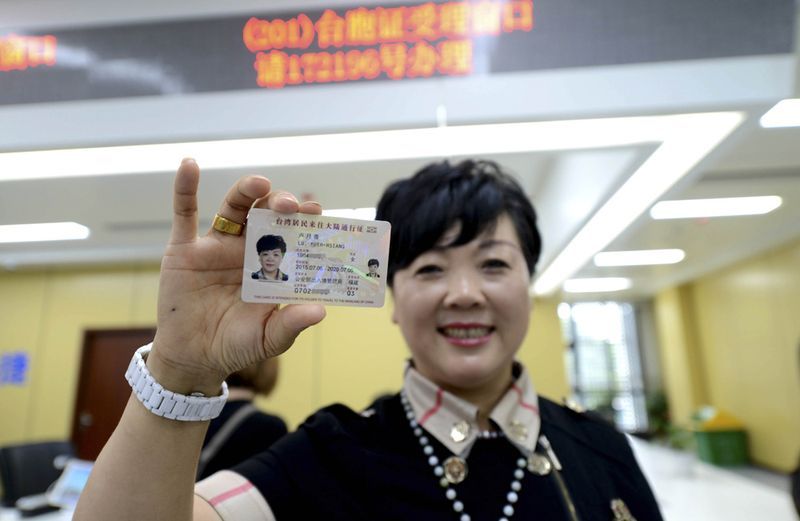
The Taiwan Compatriot Permit, formally the Mainland Travel Permit for Taiwan Residents, is issued by China's exit-entry authorities as a travel and identity document for Taiwan residents entering the mainland. Beijing created the permit specifically because it does not recognize the Republic of China passport, leaving Taiwanese with no other officially accepted way to cross the border. Taiwan applies the same logic in reverse: since Taipei doesn't recognize People's Republic of China passports either, Taiwan's National Immigration Agency issues its own entry permit for residents of mainland China, Hong Kong and Macau to enter Taiwan.
Under Taiwan's own legal framework, holding a Compatriot Permit does not amount to holding Chinese citizenship, and it does not give the holder mainland household registration. That means simply carrying the permit does not cause a Taiwanese citizen to lose their household registration or Republic of China nationality. Under Taiwan's Act Governing Relations Between the People of the Taiwan Area and the Mainland Area, those consequences only follow if someone actually establishes household registration in mainland China or obtains a PRC passport.
Does Beijing Really Treat Permit Holders As Chinese Citizens
The debate erupted after Mainland Affairs Council Chairman Chiu Chui-cheng (邱垂正) and Deputy Chairman Liang Wen-chieh (梁文傑) both stated publicly that carrying a Compatriot Permit results in the holder being treated by the Chinese Communist Party as a Chinese citizen, a claim that set off a public argument over whether it has any real legal basis.
Liu Hsing-jen (劉性仁), an associate professor in Chinese Culture University's graduate program on mainland Chinese studies, told Storm Media that Beijing issues the permit to Taiwanese precisely because it won't recognize the ROC passport and won't allow Taiwanese to enter on a foreign passport or visa either. While most Taiwanese think of the permit as little more than a travel document or a passport substitute, he said, Beijing and Taipei actually characterize it in fundamentally different legal terms. Liu pointed out that the permit is issued under China's Measures for the Administration of the Travel of Chinese Citizens to and from the Taiwan Area, a name that, on its face, already places permit holders within the category of "Chinese citizens."

Still, Liu stressed that under Taiwan's Act Governing Relations Between the People of the Taiwan Area and the Mainland Area, applying for and holding the permit functions only as a special travel credential for cross-strait exchange. It does not cause a person to lose Republic of China nationality, nor does it make someone a PRC citizen under Taiwanese law. Only establishing mainland household registration or acquiring a PRC passport would affect a Taiwanese resident's status and rights back home.
Kuei Hung-cheng (桂宏誠), chairman of the Democracy and Civic Education Foundation, offered a different take, arguing that China's new rules are mainly an effort to put existing enforcement practices into explicit law. He noted that Beijing has said it wants to build a country governed by law and has drawn on administrative-law concepts from Taiwan in doing so, so spelling out border-management measures in statute is arguably a step forward. Ordinary people who haven't broken any laws have little reason to exaggerate the risk to themselves, he said, adding that he thought Taiwan's side had been overstating the new rule's impact.
Will China Arrange And Use A Permit On Hong's Behalf
Senior Taiwanese officials told Storm Media that while China's Taiwan Affairs Office hasn't said outright whether Hong needs a Compatriot Permit for this trip, their understanding is that Beijing will still handle it through the arranged-and-used-on-one's-behalf approach, with Chinese staff carrying and presenting the permit when Hong enters the country.
Liu said that, in practical and political terms, Hong will effectively need to have a Compatriot Permit regardless, since that's the standard Beijing applies. Under China's rules governing Chinese citizens' travel to and from the Taiwan area, any Taiwanese entering the mainland must have a corresponding form of domestic identification, meaning the Compatriot Permit. To avoid undermining APEC's own international norms while still satisfying Beijing's need for internal legal consistency, Liu said, Chinese authorities are likely to rely on the arrange-and-use approach. In short, he said, Hong still effectively needs a permit to set foot in Nanjing.
Kuei recalled that when Chen Chu, then mayor of Kaohsiung, traveled to the mainland, her camp described the trip as not requiring her to personally hold a Compatriot Permit. But not personally holding one, he noted, is not the same as not having one at all — it likely just meant accompanying staff collected the whole delegation's permits and processed them together, so the visiting official never personally touched the document, which he called "an art of wording." Based on what he understands, Kuei said, Beijing currently issues important Taiwanese political figures, regardless of party affiliation, a single-entry, single-use paper Compatriot Permit once they are judged to be above a certain political rank, rather than the standard five-year card version issued to ordinary travelers. He said he remains skeptical of any claim that Hong will travel to the mainland without a permit being processed for him in some form.
(Related:
China's New Exit And Entry Rules Put Five Groups Of Taiwanese At Risk, Officials Warn
|
Latest
)