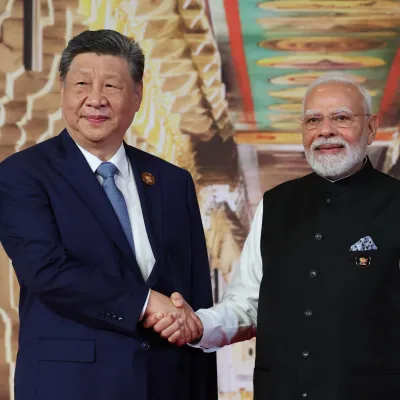
When Japanese Prime Minister Sanae Takaichi said late last year that a "Taiwan contingency" would be a matter of national concern for Japan, Beijing responded with furious diplomatic protests and urged Chinese citizens to "exercise restraint" before traveling to Japan. Nine months later, Japanese data tell a very different story than the one Chinese state media have been pushing: Japan's tourism industry is not just surviving the boycott, it just posted a record July for inbound foreign visitors, while China's own travel industry appears to be absorbing much of the damage instead.
Japan's Tourism Numbers Defy China's Warnings
According to the Japanese outlet Diamond Online, Japanese think tanks initially projected the boycott could cost the country roughly ¥1.79 trillion in a single year. About nine months on, the outlet reports, it would be fair to say Japan has come through almost unscathed.
Chinese state media have nonetheless repeatedly claimed Japan's economy cannot function without Chinese visitors. One widely cited report claimed Japan's services-trade balance flipped to a ¥10.3 billion deficit in May because of the drop in Chinese arrivals. But the underlying figures tell a different story: foreign visitor spending in Japan actually rose 2.5% year over year in the first quarter of 2026, to ¥2.3378 trillion, and rose again, by 0.2%, to ¥2.5096 trillion in the second quarter.
Total inbound visitor numbers from January through July were down 1.7% year over year, at just under 24.53 million, a decline the report attributes only partly to fewer Chinese arrivals, citing instability around Iran and reduced flight capacity as additional factors. July alone set a new record for the month, up 0.1% from a year earlier, evidence the outlet says points to a market still in solid recovery.
China's Own Travel Agencies And Airlines Are Feeling The Pinch
The report argues the boycott is inflicting real costs back home in China. Chinese travelers booking trips to Japan typically go through Chinese travel agencies and online platforms, which earn roughly a 1% commission on hotel bookings. With the number of Chinese visitors in the second quarter down 52.5% year over year, or roughly 971,000 fewer travelers, Diamond Online estimates Chinese agencies lost about ¥1.32 billion in commissions in that quarter alone, a figure that could reach ¥5.28 billion if the pattern holds for a full year.
Chinese airlines, which had commanded a large share of routes between China and Japan, cut capacity sharply after the boycott began: flights fell from 9,813 in November to 7,432 in December, a 24.3% drop, while available seats fell 23.2%, from 1.85 million to 1.42 million. Assuming an average fare of ¥50,000 and an 80% load factor, the report calculates Chinese carriers may have forfeited as much as ¥17.2 billion in ticket revenue in a single month, or roughly ¥206 billion annualized.
Additional losses are likely piling up from UnionPay and Alipay transaction fees, Chinese-run restaurants and informal taxi services that cater to Chinese tourists in Japan, and remittances sent home, all of which shrink along with visitor numbers, the report notes.
China has also introduced new exit and entry rules that broaden the government's ability to bar people working in "advanced industries" from leaving the country if authorities flag them as a risk, extending restrictions once aimed mainly at Communist Party members and civil servants to employees of private companies as well. Since 2024, teachers, bank employees and other staff at public institutions and state-owned enterprises have increasingly been asked to hand in their passports. China's outbound travel in the second quarter came in about 3% below earlier projections, at roughly 179 million trips, and the report expects that figure to fall further as exit controls tighten again starting September 15.
In Okinawa, Taiwanese And Korean Visitors Fill The Gap
Okinawa, long a favorite destination for mainland Chinese tourists, had been expected to lose around 200,000 Chinese visitors and roughly ¥9.2 billion in tourism spending. On the ground in Naha's Kokusai-dori shopping street and the Makishi public market, however, Diamond Online found Chinese-language signage was overwhelmingly written in the traditional characters used in Taiwan and Hong Kong rather than the simplified characters used on the mainland. Shop staff told the outlet that while mainland Chinese customers had indeed thinned out, Taiwanese and Hong Kong visitors, already a large share of their business, had picked up the slack, keeping sales steady.
Local diving operators described a similar shift: mainland Chinese customers typically requested Mandarin-speaking instructors, but bookings from Western and South Korean divers, who are comfortable working with Japanese-speaking instructors, have increased instead.
Taiwan and South Korea are now Okinawa's top two sources of foreign visitors, with growing numbers from Thailand and Singapore as well, and the prefecture's tourism revenue topped ¥1 trillion for the first time in 2025. The pattern, the report concludes, is that the falloff in Chinese arrivals has largely been absorbed by other markets, while China's own travel agencies, airlines and outbound tourists are the ones actually paying the price for Beijing's boycott.
Taiwan Contingency: Full Timeline
From Prime Minister Sanae Takaichi's November 2025 remarks in parliament to the latest developments, our timeline tracks every key turn in the Japan-China standoff and is updated regularly.
(Related:
Japan’s Intelligence Overhaul: Why Takaichi’s New Agency is a Game Changer for Taiwan
|
Latest
)