Taiwan's Vice President Hsiao Bi-khim's (蕭美琴) appearance at a European forum on the small Italian island of Ventotene drew a sharp protest from Beijing, but the pushback from Brussels and Rome was just as pointed: both the European Union and Italian lawmakers made clear they had no intention of backing away from engagement with Taiwan.
China Calls Hsiao A Taiwan Independence Politician
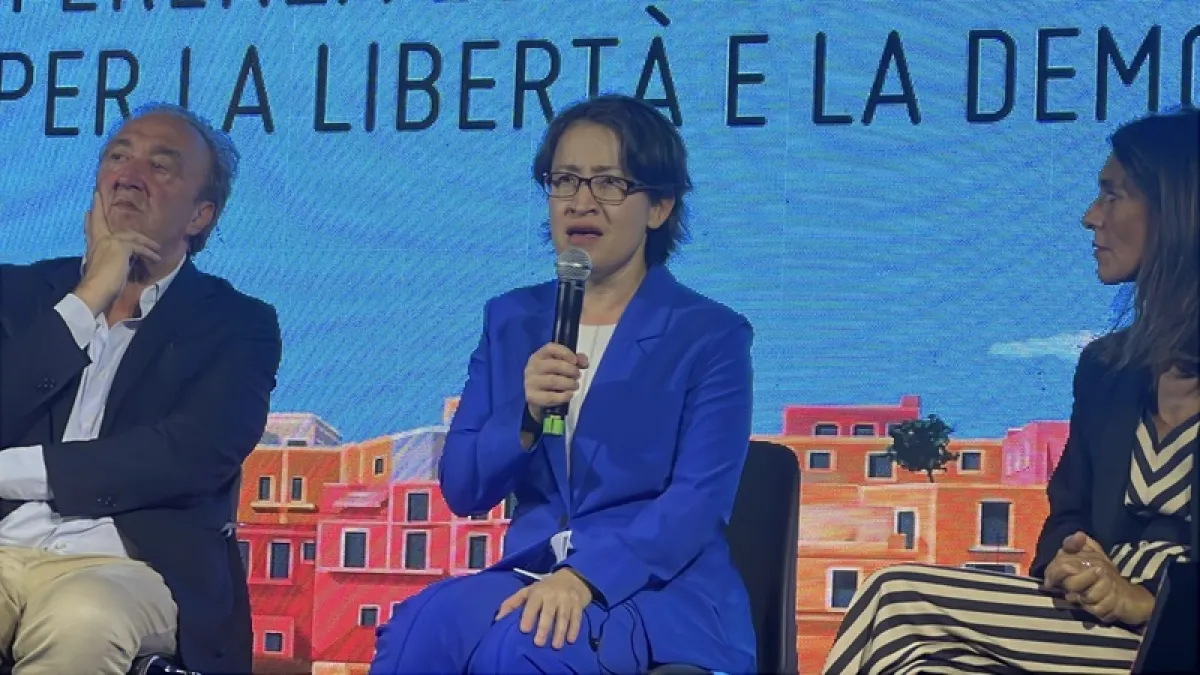
Hsiao's appearance at the second Ventotene European Forum on Freedom and Democracy, alongside Foreign Minister Lin Chia-lung, came at the invitation of European Parliament Vice President Pina Picierno, who launched the forum, with the event hosted by the European Parliament's Italy office and co-organized with the European Commission's Italy representation. It followed Hsiao's trip to Brussels last November for the Inter-Parliamentary Alliance on China's annual summit at the European Parliament.
Chinese Foreign Ministry spokesperson Mao Ning responded sharply at a regular press briefing, accusing what she called Democratic Progressive Party authorities and "individual politicians" of "racking their brains to ride on any momentum they can find" while using democracy and freedom as cover to seek independence with foreign backing, calling the behavior "contemptible" and "ultimately futile." Mao said China had lodged formal protests with both Italy and the EU over the visit of what she termed a "Taiwan independence politician," reiterating that the one-China principle forms the political foundation of China's relations with Italy and the EU and urging all sides to uphold it in practice.
The EU And Italy Push Back On Beijing
The response from Europe undercut Beijing's message. A European Union spokesperson, while declining to comment on the specifics of the trip or Hsiao's meetings with European Parliament members, said the EU and its member states remain willing to engage with Taiwan in ways that serve the bloc's interests, within the bounds of its one-China policy, according to Taiwan's Central News Agency. Engin Eroglu, who chairs the European Parliament's delegation for relations with China, said engagement between Europe and Taiwan has increased markedly in recent years and that high-level exchanges have become institutionalized to a meaningful degree. Several senior Italian lawmakers also issued statements backing Taiwan and criticizing Beijing's objection as absurd.
Hsiao Draws A Direct Line Between Ventotene And Taiwan
Speaking in English at the forum on the evening of September 11, local time, Hsiao thanked Picierno for the invitation and for including Taiwan in the discussion, noting that she and the Taiwanese delegation had traveled 27 hours from Taipei by air, land and sea, through rough weather, to be there, and that the visit carried real significance.
She drew a parallel between Ventotene's history and Taiwan's own. The island, she noted, once held anti-fascist prisoners during Europe's darkest years, and it was there that they drafted the Ventotene Manifesto, a founding text on using integration and cooperation to build peace and Europe's future. Taiwan, she said, had gone through its own difficult path to democracy, this year marking 30 years since its first direct presidential election, achieved only after 37 years of martial law and a long colonial period. Like those who fought for freedom on Ventotene, she said, Taiwan has had its own freedom fighters who struggled under difficult conditions.
Why She Says Taiwan Won't Be The Next Ukraine
Hsiao argued that Europe and the Indo-Pacific now face a shared new reality. Russia's invasion of Ukraine, she said, has upended long-held assumptions about peace, while economic interdependence has brought new vulnerabilities alongside its opportunities. Taiwan, she added, faces rising military and gray-zone pressure of its own and must defend itself while strengthening its economy, defense capabilities and whole-of-society resilience.
Asked about pressure from China, Hsiao said restrictions aimed at shrinking Taiwan's international space have persisted for years, and that she herself has been targeted and sanctioned, but none of that will stop Taiwan from engaging with the world. Taiwanese people, she said, have the right to make friends, talk with them, and work alongside like-minded partners on shared challenges, and precisely because Taiwan's environment is difficult, it treasures every opportunity to have a voice on the international stage and will not give up seeking one.
On the comparisons frequently drawn between Ukraine and Taiwan, Hsiao said Ukraine's experience serves as a painful reminder that Taiwan must do more to ensure it never becomes the next Ukraine. War, she said, is not an option Taiwan is choosing, which is why the government has focused on several policy pillars: strengthening self-defense, reinforcing its economic standing, expanding international partnerships, and maintaining a cross-strait posture that neither provokes Beijing nor bends to it, all aimed at making sure peace continues to prevail.
Small Islands, She Says, Still Deserve A Voice
Hsiao also brought a lighter note to the speech, describing the many cats she had seen around Ventotene and recalling her own self-given nickname, "War Cat." Cats, she said, are usually soft, warm and endearing, yet remarkably resilient, able to survive in difficult environments and tight spaces, balance competing pressures like walking a tightrope along a wall, and leap many times their own height despite their small size. Taiwan, she said, believes the same is true of itself: small, but capable of wielding influence well beyond what its size would suggest.
On Taiwan's exclusion from international organizations, Hsiao thanked the European Parliament and others for repeatedly voicing public support for Taiwan's meaningful participation in bodies such as the World Health Organization, arguing that Taiwan has much to contribute and that its exclusion carries real costs, pointing to consequences during the COVID-19 pandemic when Taiwan's input was sidelined. Cooperation across borders on issues from transnational crime to aviation safety requires everyone at the table, she said, and Taiwan is both willing and able to contribute. "The road ahead will remain very difficult," she said, "but that won't stop Taiwan's people from remaining generous, extending a helping hand, and continuing to be a force for good in the world."
(Related:
Inside Hsiao Bi-khim's Secretive Flight: Why Taiwan's VP Avoided Chinese Airspace on Italy Trip
|
Latest
)