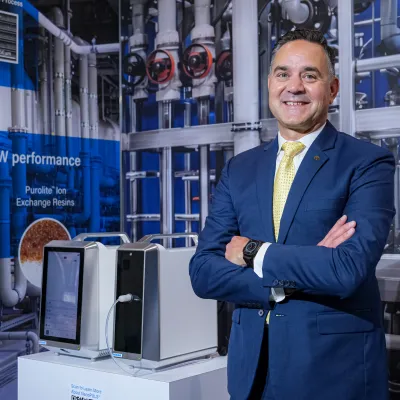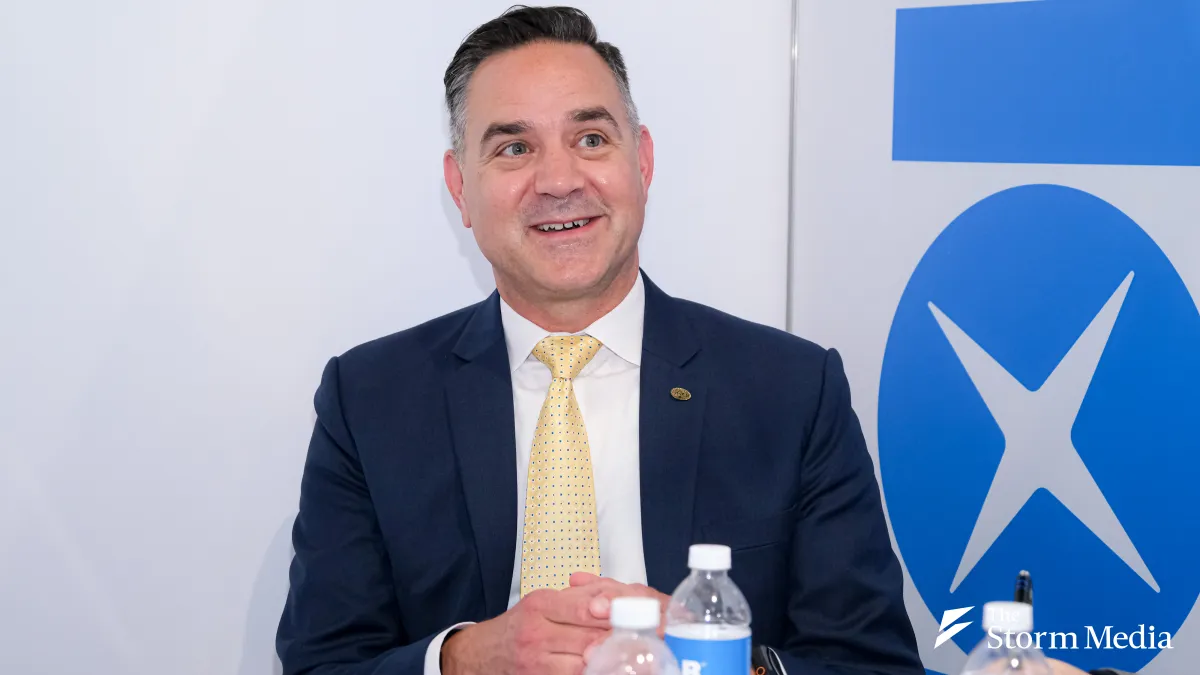
As Taiwan's chipmakers race to build new factories across the United States, Japan and Europe, water management company Ecolab wants to be at every one of them. In an exclusive interview with Storm Media at SEMICON Taiwan 2026, Josh Magnuson — Executive Vice President and General Manager of Ecolab's Global High Tech sector — explained why water chemistry, ultra-pure systems and liquid cooling may be the hidden variables that determine whether those overseas fabs succeed.
Taiwan's semiconductor expansion is exporting more than machines and engineers. It is also exporting the water standards, process chemistry and facility management protocols that quietly underpin chip yields. Magnuson said that when chipmakers move into new markets, they cannot simply replicate equipment and process parameters. The source water in Arizona, Kumamoto or Dresden is nothing like what flows into a Hsinchu fab, and the regulatory environment, climate and infrastructure differ just as sharply.
"The raw water quality, climate, regulations and infrastructure are all different in each location," he said. "Overseas fabs cannot just copy machine settings and process parameters — they have to rethink ultra-pure water, cooling water, reclaimed water and wastewater systems from the ground up."
Ecolab's pitch is that it can carry the same technical standard to every location and calibrate it for local conditions — making it the consistent thread in a supply chain that is, by design, anything but consistent. "When Taiwan semiconductor companies go global, we want to provide consistent water quality, service and solutions at every production site," Magnuson said. "If the vision is Made with Taiwan, we want to add one more line: Made with Taiwan — and with Ecolab."
A $16 Billion Water Giant Riding the AI Chip Wave
Ecolab (NYSE: ECL) is not a household name in Taiwan, but its scale is considerable. The company generates roughly $16 billion in annual revenue, employs about 48,000 people and operates across 40 industries in 170 countries. Its legacy businesses span industrial water treatment, sanitation and infection prevention; its newer bet is that the AI era is rewriting the demand curve for everything it already does.
In the second quarter of 2026, Ecolab reported revenue of $4.415 billion, a 10 percent increase year on year. The Global High Tech segment outpaced the rest of the company by a wide margin, posting 29 percent organic revenue growth as demand from microelectronics manufacturers and data center operators accelerated simultaneously. The segment's annualized revenue has now reached approximately $1.5 billion, and Magnuson's target is to grow that figure to $4 billion by 2030 while pushing operating margins toward 25 percent.
Chairman, President and CEO Christophe Beck has publicly called the Global High Tech platform the company's single largest growth engine. That is a significant statement for a company of Ecolab's breadth. As recently as 2021, the high-tech business generated only about $150 million in revenue; it has since expanded roughly tenfold, carried by the twin tailwinds of AI-driven chip demand and the rising computational density of data centers.
Two Acquisitions Extend Coverage From Wafer Fabs to Data Centers
To close capability gaps as quickly as customer demand required, Ecolab moved through two significant acquisitions in under a year. In December 2025, it completed the purchase of Ovivo Electronics, adding semiconductor ultra-pure water treatment, water recycling and wastewater management to its portfolio. Six months later, in June 2026, it closed the acquisition of CoolIT, a specialist in direct liquid cooling and chip-level thermal management for data centers.
The strategic logic is straightforward: the same AI buildout filling wafer fabs with orders is also filling data centers with high-density GPU clusters that generate heat no conventional cooling system can safely handle. Ecolab now addresses both ends of that chain.
The growth signals from both deals are striking. CoolIT's revenue more than doubled year on year in the first half of 2026, even before the acquisition closed. Ovivo Electronics is projected to deliver mid-double-digit revenue growth — roughly 15 percent — in full-year 2026 relative to its pre-acquisition baseline. Magnuson acknowledged that integrating Ovivo pushed the group's adjusted gross margin down by 60 basis points in the second quarter, though organic gross margins held roughly flat once the acquisition effect was removed.
Combined with the existing capabilities of Nalco Water — covering cooling water, boiler water, chemical processing, digital monitoring and global on-site service — Ecolab now spans semiconductor process water, fab utility systems and data center cooling in a single portfolio. Globally, it has installed more than 280 ultra-pure water systems with a combined output capacity exceeding 51,000 cubic meters per hour, along with 85 water recovery systems and 88 effluent treatment systems. That installed base is what makes it credible when it tells a chipmaker opening a new fab overseas that it has done this before, nearby.
Co-Design Not Construction, With Nine in Ten Revenue Dollars From Ongoing Service
Despite that breadth, Magnuson was emphatic about what Ecolab is not. The company has no intention of becoming an engineering, procurement and construction contractor that builds entire water treatment plants on a turnkey basis.
"We do not intend to be an EPC, but we will participate in the design," he said. Ecolab co-designs water systems with chipmakers and helps data centers plan cooling infrastructure, then works alongside engineering partners to execute the physical construction. That positioning means Ecolab is not a direct competitor to Taiwan's cleanroom, facility engineering and mechanical-electrical contractors. In practice, both sides may find themselves collaborating on the same overseas build-outs.
The business model is built for recurring engagement rather than one-time transactions. Across Ecolab's industrial operations, approximately 90 percent of revenue comes from consumables and ongoing services; project-based sales account for roughly 10 percent. Once a new fab comes online, Ecolab stays involved through chemical treatment, system monitoring, anomaly resolution and on-site service — because water quality management does not end at commissioning. It must be continuously adjusted as process nodes evolve, capacity expands and the proportion of reclaimed water in the system shifts.
Tainan R&D Center Positioned to Travel With Taiwan Chipmakers
Earlier this year, Ecolab opened a research and development center at the Southern Taiwan Science Park. The facility focuses on water chemistry, water quality monitoring, purification and water management technology, with a mandate to localize solutions originally developed in the United States and elsewhere for Taiwan's specific water conditions, regulations, infrastructure and microelectronics process requirements.
Magnuson framed the center not only as a resource for local customers but as a potential export platform. If water recycling or intelligent monitoring solutions can be validated inside Taiwan's leading-edge fabs — among the most demanding production environments in the world — they carry a credibility that may be difficult to establish anywhere else. When chipmakers then expand overseas, the validated solutions can travel with the supply chain, adapted to local conditions at each new site.
He also stressed that effective water management in any region requires coordination beyond the factory gate. It depends on connecting governments, utilities and industrial users — understanding local supply, consumption and wastewater treatment systems — while simultaneously reducing on-site water use and increasing recirculation to ease pressure on shared regional resources.
25 Years From Research Lab to Global High Tech Leadership
Magnuson joined Ecolab in 2001, starting in research and development in St. Paul, Minnesota. Over a 25-year career, he moved through digital solutions, marketing, sales and general management roles, accumulating international experience across Latin America, Asia Pacific and Europe. Before his current role, he led the Global Downstream division at Nalco Water in Houston and managed Ecolab's Food and Beverage operations for Europe, based in Zurich. He holds a bachelor of science in biology from the University of Wisconsin-Stevens Point and an MBA from the University of St. Thomas in St. Paul, and is now based in Chicago.
That trajectory from bench scientist to global business leader has shaped how he thinks about Ecolab's purpose. Translating complex water chemistry, equipment specifications and digital monitoring into outcomes that customers can actually measure — yield rates, throughput, energy consumption, cost per wafer — is, in his view, the real work. Ecolab's goal is not to sell a fixed set of hardware but to deliver an integrated capability that produces consistent results across widely varying water conditions and industrial settings.
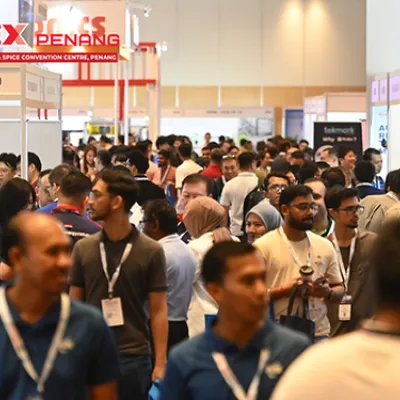
Magnuson has visited Taiwan multiple times over the years and lived in Singapore for two and a half years. He recalled his family's fondness for Din Tai Fung during their time in Asia — vivid enough that he still seeks out branches in Las Vegas and Seattle — and mentioned a particular appreciation for Taiwanese cucumber salad. This year's SEMICON Taiwan was his second consecutive appearance at the show, though Ecolab's booth footprint grew roughly eightfold from last year, a tangible measure of how much the company's investment in Taiwan's high-tech market has intensified.
"If the vision is Made with Taiwan," he said with a smile, "we want to add: Made with Taiwan — and with Ecolab."
Note: U.S. dollar figures converted to New Taiwan dollars at approximately NT$31.7 per dollar, the rate in effect on September 4, 2026.
(Related: Could China Catch Up To ASML? Dutch Journalist Warns DUV Chip Tools May Become Next Battleground | Latest )