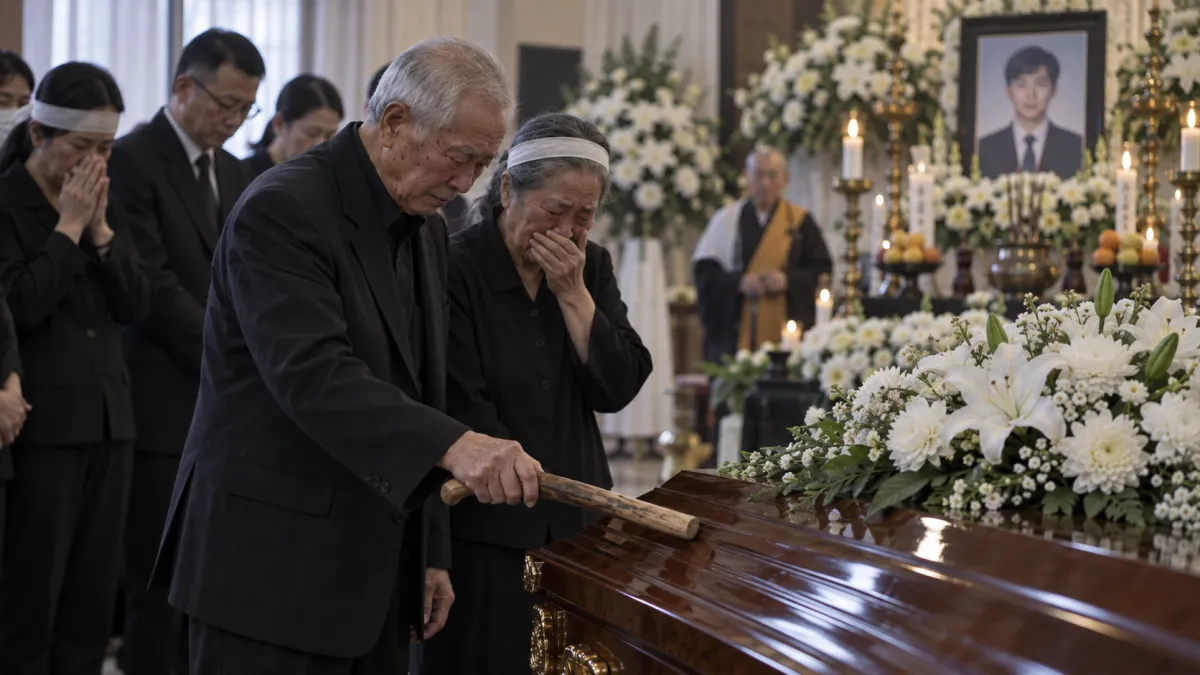
Losing a child is widely considered one of the heaviest griefs a parent can carry. Yet in parts of traditional Taiwanese funeral practice, if a deceased child's parents are still living, mourners may witness something that looks jarring to modern eyes just before the coffin leaves for burial: a parent picks up a wooden staff and strikes the coffin.
The gesture is not an act of resentment toward the child who died. It traces back to older ideas about filial duty, family hierarchy, and folk beliefs about what happens after death, and behind what looks like a rebuke is a sentence most parents could never bring themselves to say out loud.
The Custom Known In Taiwan As Knocking The Coffin
Traditional Taiwanese funeral records refer to this ritual as "gang guan," while today it is more commonly called "striking the coffin" or "knocking the coffin" in everyday and funeral-industry usage. According to research compiled by Taiwanese folklorist Hsu Fu-chuan in his study of traditional Taiwanese mourning rites, when a deceased person's parents are still alive, custom in some regions calls for them to strike the front of the coffin three times with a wooden staff as it is being moved, while in other areas the gesture takes place as the coffin departs for the funeral procession.
The symbolism is direct: it rebukes the child for dying before the parents and failing to continue caring for them in old age, a shorthand sometimes described as holding the deceased responsible for leaving filial duties unfinished. Illness, accidents and death are rarely within anyone's control, so why would early death get tied to a lack of filial piety at all? The answer lies in how traditional family roles were once understood.
Why Losing A Child Early Was Once Linked To Filial Duty
Traditional Han Chinese society placed enormous weight on the proper order of generations. In the expected course of a life, aging parents are cared for by their children, and when parents eventually pass away, it falls to the next generation to handle the funeral, mourning and ancestral rites. Under that framework, it is the child who is supposed to stand before the parents' coffin and see them off.
When a child dies first, that order is inverted entirely. Records of local funeral terminology compiled by the Huxi Township Office in Penghu County include a specific term for this situation, "reversed mourning," describing cases where a son dies without leaving behind a grandchild, or with only a young grandchild, and his still-living parents must take on mourning duties for him instead of the other way around. This is the formal version of what is more commonly described in Taiwan as "the white-haired burying the black-haired," a phrase for parents burying their own children.
The "lack of filial piety" implied in the ritual is not a claim that the deceased genuinely mistreated their parents while alive. It refers instead to the fact that they left before completing the life responsibilities traditional society expected of them, namely caring for aging parents and eventually seeing them off. On the surface, a parent striking the coffin seems to be asking: how could you leave before your parents did? That question is precisely what makes the moment so difficult to watch. The parents standing before the coffin were supposed to be the ones being cared for into old age and eventually mourned by their child. Instead, they are the ones sending their child away.
A Folk Belief That Turns Punishment Into Protection
There is another, more folk-religious layer to this custom. According to accounts passed down in traditional funeral practice, it was once believed that a person who dies before their still-living parents would face questioning in the afterlife over their unfinished duty to care for them. By striking the coffin beforehand, parents were seen as having already delivered that reckoning themselves, in the world of the living, so their child would not have to answer for it again after death.
Under that interpretation, each strike of the staff against the coffin carries two meanings at once, both a rebuke and a form of protection extended into the afterlife.
What The Gesture Still Means Today
People in earlier generations did not necessarily have the language modern society uses to talk about grief and loss, but many funeral rituals exist precisely to turn feelings that are hard to put into words into an action that can be seen and completed. Knocking the coffin is one of them.
The practice is no longer performed at every funeral in Taiwan today, but the relationship behind it is still what makes the gesture resonate. A parent standing before a coffin with a wooden staff can look, at first glance, like someone punishing a person who can no longer answer back. Within the traditional ethics and beliefs that shaped the custom, though, what those few strikes against the coffin were really saying was probably never "you were not filial." It was closer to a much simpler, much harder question: how could you possibly have gone before me.
(Related:
Why Do Public Toilet Seats Have a Gap? The Surprising Engineering Logic Behind It
|
Latest
)