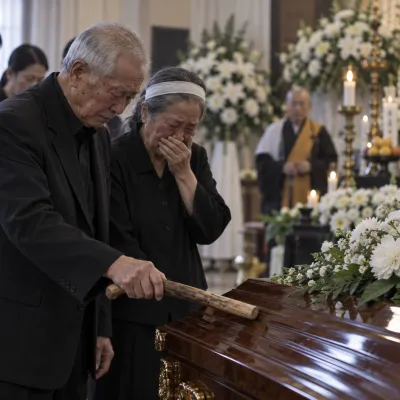
Mao Zedong (毛澤東) died in Beijing on September 9, 1976. Fifty years later, China has still not fully stepped out from under the political shadow he left behind, and the Chinese Communist Party marked this particular anniversary in a way that says as much through restraint as through ceremony. Mao's name has not vanished, and the party has not walked back his place in history. But the commemorations themselves were kept deliberately modest.
That does not mean Beijing ignored the date. The party newspaper People's Daily ran tribute content on the day itself, calling Mao "a great patriot and national hero of modern China," while state broadcaster CCTV reaffirmed his historical role in the revolution and the founding of the People's Republic. The Chairman Mao Memorial Hall in Beijing extended its visiting hours, and long lines of visitors formed to pay their respects.
In Shaoshan, Hunan, Mao's hometown, crowds had already begun gathering at the square around his bronze statue from September 8 onward, laying flowers and singing revolutionary songs in an atmosphere thick with nostalgia.
Why China Marks Mao's Birthday But Not His Death
The party's official verdict on Mao has not shifted since a landmark 1981 resolution on party history settled the question: his achievements outweigh his mistakes. That framing has since been built into the physical fabric of the state, from his portrait over Tiananmen Gate to his face on the currency to Mao Zedong Thought written into the party constitution.
China's current leadership has doubled down on that logic with what officials call the "two no-negations": the post-reform era cannot be used to negate the pre-reform era, and the pre-reform era cannot be used to negate the post-reform era. Mao remains one of the party's core sources of legitimacy, which is precisely why challenging his legacy is treated as a challenge to the party's own foundation.

A Legacy The Party Cannot Afford To Question
Birthdays and death anniversaries do very different political work. A birthday lends itself to celebrating the founding of an enterprise, in this case the party and the state Mao helped build. A death anniversary, by contrast, is far more likely to summon memories of the Cultural Revolution, the Great Leap Forward famine, and the political purges that followed, catastrophes the party's own history has labeled serious errors for which Mao bore primary responsibility.
Evoking those memories at scale in an official setting carries real risk of spinning out of the party's control. So the system has largely chosen not to hold formal events on the anniversary of his death at all.
How Young Chinese Turned Mourning Into Protest
Against a backdrop of a slowing economy, tough job prospects for young graduates and a widening gap between rich and poor, the equality and anti-bureaucracy sentiment Mao has come to symbolize now functions as something of a political pressure valve. Young Chinese may not genuinely long for a return to the Cultural Revolution, but paying tribute to the "people's leader" gives them a socially acceptable outlet for frustration with the present.

A Rule Written In 1996 Still Shapes The Memory
The pattern is not improvised. A 1996 joint notice from the General Offices of the Communist Party Central Committee and the State Council, governing how to mark the birthdays of deceased party and state leaders, explicitly states that no commemorative activities are to be held on the anniversaries of their deaths. Memorial events are reserved for birthdays only, and even those are graded strictly by rank and contribution.
Mao sits at the top of that hierarchy. Major state-organized commemorations are held on round-number anniversaries of his birth, such as every tenth, fiftieth or hundredth year, and always fall on December 26, his actual birthday. His death anniversary, by design, is treated very differently.
Fifty Years Later, Selective Memory Is The Real Legacy
Half a century on, China bears little resemblance to the closed, impoverished and hyper-politicized country Mao left behind in 1976. A market economy, digital surveillance systems, integration into global supply chains and a sizable middle class have all reshaped the country. Yet the party's insistence on absolute control over power, ideological unity, and vigilance against what it calls historical nihilism have never really broken from the political genetics Mao established.
Keeping death-anniversary commemorations low key is not an effort to distance the party from Mao. It is closer to a precise, calibrated use of him. Birthdays can be celebrated grandly, death anniversaries pass in near silence, and ordinary citizens can queue to lay flowers but never organize anything resembling a movement around it. The arrangement preserves Mao's symbolic value as a great man while heading off any public reckoning with the harm done in his name.
Fifty years on, Mao's embalmed body still lies in its crystal coffin, and his portrait still looks out over Tiananmen Square. But what China's political system has truly taken the most care to preserve is not a body. It is a set of rules about who gets to decide how history is written.
(Related:
Beijing Watch | US-Based Chinese Artist Sentenced to Three Years for Satirical Mao Sculptures
|
Latest
)