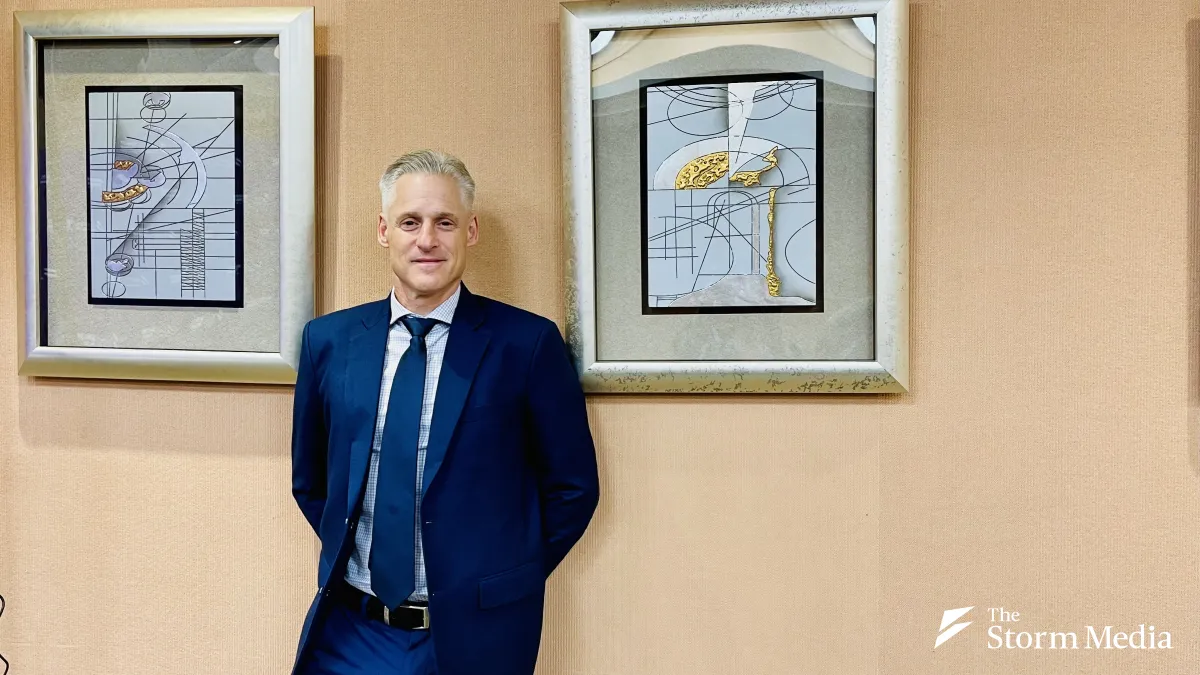
Israel built its global reputation as the "Startup Nation." Now the country wants to become something bigger: a "Full Stack Nation." In an exclusive interview with Storm Media, Ariel Sobelman, head of advanced computing at Israel's National AI Bureau, laid out that ambition directly. "We want to develop all five layers of AI, from energy and chips to infrastructure, models and applications, moving from an innovation nation to a full stack nation," Sobelman said. "Israel's national AI strategy puts lived AI first, AI that actually improves people's lives. And we welcome TSMC to invest in Israel."
Israel's National AI Bureau is a young institution, established roughly six months ago and reporting directly to the Prime Minister's Office. Prime Minister Benjamin Netanyahu appointed retired general Erez Askal to lead the bureau last October, and the government launched its formal "National AI Program" this past August to accelerate the country's push to become an AI power. "The world has changed, and the AI ecosystem is searching for a new balance," Sobelman said. "Israel is moving from a startup nation to a full stack nation, and our vision is lived AI."
An Israeli Official Making The Case Directly To Taiwan
Sobelman has deep ties to Taiwan, dating back more than two decades to his first visit. Over the years he has returned repeatedly for Computex and Semicon Taiwan, and once cycled the entire island. This year marked his first trip to Taiwan since joining the National AI Bureau, attending Semicon Taiwan and the accompanying Chip Chain Summit to engage directly with partners across the AI ecosystem and expand bilateral ties. In the interview, he laid out Israel's AI strategy in detail and explicitly welcomed TSMC to build a fab in Israel.
Within the bureau, Sobelman oversees semiconductors, quantum computing and Israel's role in the "Pax Silica" supply chain alliance. He brings 25 years in the semiconductor industry, having held senior roles at M-Systems, SanDisk and Valens, and previously conducted research on geopolitics, AI and technology infrastructure at Tel Aviv University's Institute for National Security Studies. He is also a Technology & Engineering Emmy Award winner and, outside of work, an endurance athlete who has completed 11 Ironman triathlons.
"Taiwan has a complete semiconductor supply chain and excels at hardware manufacturing, while Israel excels at software development and applications," Sobelman said. "Taiwan and Israel are both members of the Pax Silica alliance, and there's a great deal of room to cooperate on AI." He added that AI today is everywhere but still hasn't fully crossed over from the screen into daily life: "There are plenty of AI games and toys, but real life hasn't yet truly met AI-driven computing. We believe the real AI revolution happens when real life meets physical AI."
Why Sobelman Calls AI The New Synthetic Oil
Sobelman frames Israel's position using an energy analogy familiar to the wider Middle East. "Oil is a natural resource, and countries that have it are mostly just lucky," he said. "Israel doesn't have oil. But in the AI era, AI is like a manufactured, synthetic oil. That's not about luck, it's a completely different set of circumstances, and Israel has enormous advantages when it comes to developing AI."

Sobelman borrowed a framework popularized by Nvidia founder and CEO Jensen Huang, who has described AI as a five-layer cake running from energy, chips and infrastructure at the base up to models and applications at the top. Israel, he said, intends to build out all five layers as it makes the leap from startup nation to full stack nation. "Digital sovereignty is a major geopolitical consideration today," he said. "We're not aiming for full self-sufficiency, that's simply not possible. We think of it more like an Olympic minimum standard. Israel wants to build sovereign AI, deploying sovereign AI infrastructure at home to secure our digital sovereignty. Our vision is lived AI, applications that genuinely improve people's lives."
He argued that solving real-world problems is where Israel has always been strongest, whether in academia, technology or defense. "We're good at identifying the real problem, because life is full of challenges, and we're good at solving them," he said. "We connect algorithms with theory, science and everyday life, linking algorithms to missiles, drugs to specific diseases, and algorithms to education to help people learn more effectively."
Crowdsourcing The Nation's Everyday Problems
Askal, the bureau's director, reports Israel's AI strategy directly to Netanyahu, and with that approval secured, the bureau launched a public call asking ordinary citizens to submit the real-life problems they wanted AI to solve. "We ran a very large public campaign through social media, asking people to tell us the problems they run into in daily life, traffic jams, bottlenecks getting medical care, elementary schoolers struggling with math, these are the concrete problems people actually deal with," Sobelman said.
The bureau received thousands of submissions and distilled them into 50 to 100 problem areas across different sectors. On traffic, for instance, the specific pain point is severe congestion every morning between eight and nine. "We bring the relevant stakeholders together to work through it, using AI to tackle traffic congestion in ways that concretely improve people's daily lives," he said. On healthcare, he pointed to radiology bottlenecks, where patients often wait a long time after an X-ray for a specialist to read the results. Introducing AI-assisted reading, followed by a doctor's final diagnosis, he said, could dramatically shorten that wait and ease hospital congestion.
To act on these findings, Israel has set up a National AI Institute that pulls together experts across fields into working groups focused on research and problem-solving, alongside a network of "AI life labs" designed to produce concrete fixes for problems citizens raised, improving quality of life at home with solutions the government hopes to eventually share with allies. While other AI powers race to build data centers and ever-larger models, Sobelman said, Israel's national strategy is built around applying AI to healthcare, education, agriculture, manufacturing and government efficiency. He drew a parallel to water: more than half of Israel's land is desert, and the country's inventions in water management, from drip irrigation to desalination, have already spread worldwide. He expects Israel's AI solutions to eventually follow the same path.
Asked about the philosophical questions AI raises, Sobelman pointed to a Jewish tradition of debating what separates humans from other beings, tracing back to the Book of Ecclesiastes. "As robots and humanoid machines move into more parts of daily life, humanity faces a similar ethical question: what actually separates us from machines," he said. "Judaism has been debating questions like this for 3,000 years. It's a place where we can contribute."
Building Rather Than Renting AI Infrastructure
Israel's national AI strategy rests on two pillars: applying AI to everyday life, and building the infrastructure to manufacture AI itself. "If you depend entirely on someone else's models, it's like living in someone else's attic, you're a tenant who could be evicted at any time," Sobelman said. "Israel has decided to build its own AI infrastructure and manufacture and produce AI. Our strategy is to work with other partners across the global ecosystem to make sure the right infrastructure exists inside Israel."
Rather than trying to outspend far larger AI powers, Sobelman said Israel is competing on the strength of what it can offer. "Israel is a small country, we can't compete dollar for dollar with everyone else, so we compete on value," he said. "We offer unique incentives, welcoming players across the AI ecosystem to build data centers in Israel, with the Israeli government itself as a customer. We provide unique national data, including nationwide health and education data, to help hyperscalers accelerate model development."
He described Israel's national health records, which trace a person's history from prenatal checkups through birth, childhood and eventually death, as an unusually complete dataset for a democracy, made richer by a population drawn from Jewish communities across the world. That diversity, he said, gives life-sciences researchers and drug developers a valuable resource, one that already proved useful during the COVID-19 pandemic in helping vaccine makers. Decades of standardized academic testing data add another layer, he said, one Israel is putting to commercial use not primarily to generate revenue but to unlock its distinct value. Many multinational tech firms already run research centers in Israel specifically to tap that talent pool, and Sobelman said the bureau is in talks with several hyperscalers, offering national datasets and a compute-purchasing budget as incentives for them to build AI infrastructure in the country.

A Target Of 100,000 GPUs Within Five Years
Facing intense geopolitical pressure, Israel is determined to build sovereign AI capability and eventually manufacture advanced chips of its own. National AI Bureau director Erez Askal told Bloomberg in a separate interview that Israel is actively lobbying TSMC, Samsung and Intel to manufacture 2-nanometer or more advanced chips domestically, while also pushing a data center cluster initiative aiming to bring 100,000 GPUs online within five years.
Multinational tech giants including Nvidia, Apple, Intel, Google, Meta and Microsoft already operate research and development centers in Israel, with Nvidia alone employing more than 6,000 people locally. "We welcome TSMC to build a fab in Israel, and we'd love to see Nvidia design its next-generation AI chips here, that would be a three-way win," Sobelman said, adding that the 100,000-GPU cluster target is already underway and could realistically be reached within four years.
Sobelman argued that human capital, not hardware, is ultimately what will determine whether Israel's full stack ambitions succeed. Israel's first prime minister, David Ben-Gurion, once said human capital is the foundation of everything, and Sobelman said the bureau is partnering with industry and universities on doctoral programs for people working at the cutting edge of science and technology, letting them pursue advanced degrees while continuing to work on the world's most advanced technology, an arrangement he called a win-win.
Powering It All Means Betting On New Energy
Turning Israel into a full stack AI nation comes with real obstacles. Building AI infrastructure and compute capacity at scale requires enormous amounts of electricity, and Sobelman said the government is actively developing new energy sources, including geothermal, wind and solar, to meet that demand. As a member of the Pax Silica alliance, Israel is also seeking a bigger role as a contributor to the broader AI supply chain and looking for more opportunities to partner with fellow members, calling the alliance a trustworthy ecosystem that matters greatly to Israel's strategy. Beyond power and geopolitics, he said, the biggest challenge is simpler to state and harder to solve: pulling every part of the strategy together so AI actually changes people's lives. "Our strategy is to bring all the stakeholders together to work out solutions. We believe that's what will actually accelerate AI development and get real problems solved," he said.
Ben-Gurion once said Israel's future lies in its desert, and more than half of the country's territory is exactly that, land with abundant, largely untapped solar potential. "With AI, compute and infrastructure, the opportunity is really here," Sobelman said. "We can realize the dream of turning desert into oasis, and change the world in the process."
Why Sobelman Calls Taiwan Israel's North Star
Sobelman sees Taiwan and Israel as natural complements: Taiwan leads the world in semiconductor manufacturing, while Israel is a pioneer in software development and applications. "Geopolitics is shifting fast today, and being excellent in just one area isn't enough anymore. Participants across the AI supply chain need to work together to keep up," he said, adding that he hopes Israel and Taiwan's AI ecosystems can partner more closely. "Israel is strong in semiconductor design, we're the world's second-largest hub for it after Silicon Valley. A lot of Israeli tech workers and engineers deeply admire TSMC's ability to manufacture the world's most advanced chips. They see Taiwan as a kind of North Star, and they want to find ways to work together."
"I hope Taiwan's tech leaders can see the scale of this opportunity," he said. "What we're hoping for is a bottom-up, grassroots partnership between our two ecosystems."
Weighing AI's Risks Against Its Benefits
Asked about AI's future, Sobelman pushed back gently on some of the field's darker predictions, including Nobel physics laureate Geoffrey Hinton's warning that AI will eventually control the world and that humanity does not know how to keep it in check. "Utopian and dystopian are two ends of the same spectrum," Sobelman said. "I believe AI's future can have a very positive impact on humanity, and at the National AI Bureau, I'm working hard to make sure our contribution is a positive one."
He did not dismiss the risks outright. "Entering the AI era, we have to develop AI responsibly and ethically, use it in a healthy and inclusive way, and share these advantages with our allies, so that AI's risks and dangers stay under control and its benefits outweigh them," he said. He acknowledged that, as with any technology, some people will misuse AI, pointing to cybercrime as an example. "Bad actors will use AI to launch cyberattacks, but we can build AI tools to defend against exactly that. Cybersecurity is one of the things Israel does best, and we can apply that expertise to keeping AI itself safe."