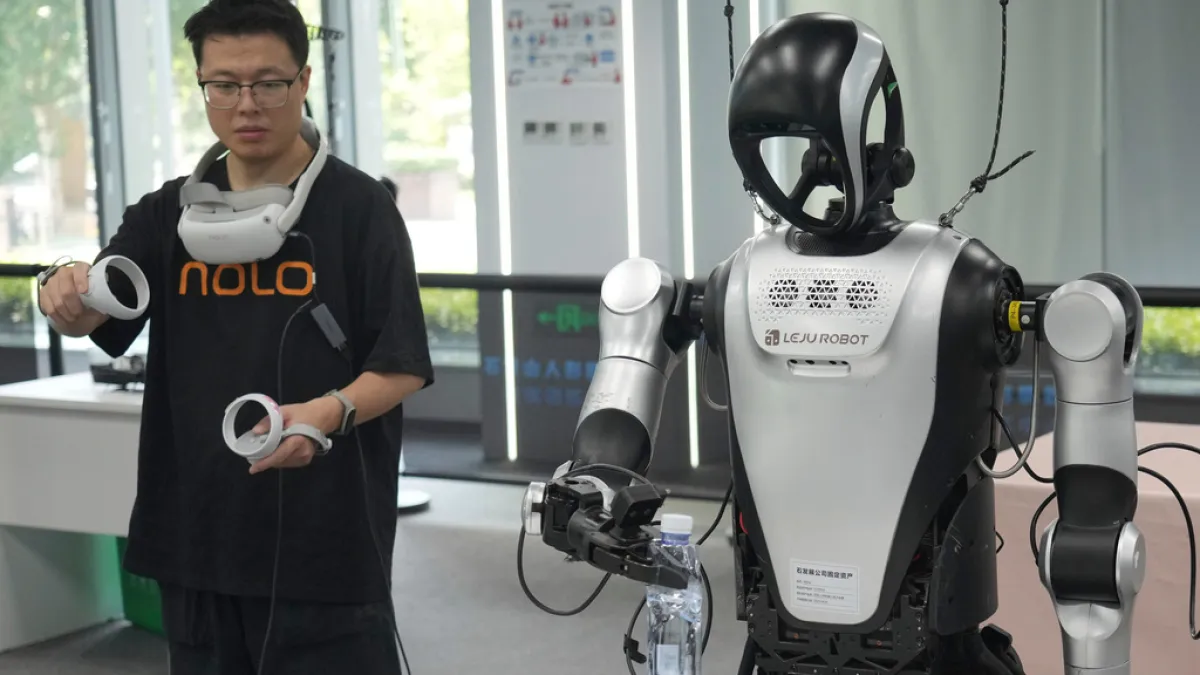
While humanoid robots have mostly made headlines for racing, boxing and dancing on stages around the world, China's military appears to be asking a very different question: can these machines be sent into combat? Chinese military institutions have spent the past two years testing humanoid robots against real battlefield requirements and pursuing equipment and training technology to support them, with interest in military applications rising sharply since 2024. That testing has focused on perception, manipulation and training data, and this past June the People's Liberation Army budgeted roughly US$300,000 for a "humanoid robot data collection and annotation system" to gather camera, radar and motion data, including information on which terrain a robot can actually cross.
From Buying Robots To Building Them In House
For years, the PLA's approach to the technology leaned on outside procurement, posting tenders on military-wide bidding platforms for Chinese civilian firms or state-owned enterprises to develop the systems. That has started to change. Following repeated anti-corruption crackdowns inside the military, the PLA has increasingly moved toward developing humanoid robots itself rather than buying finished products from contractors.
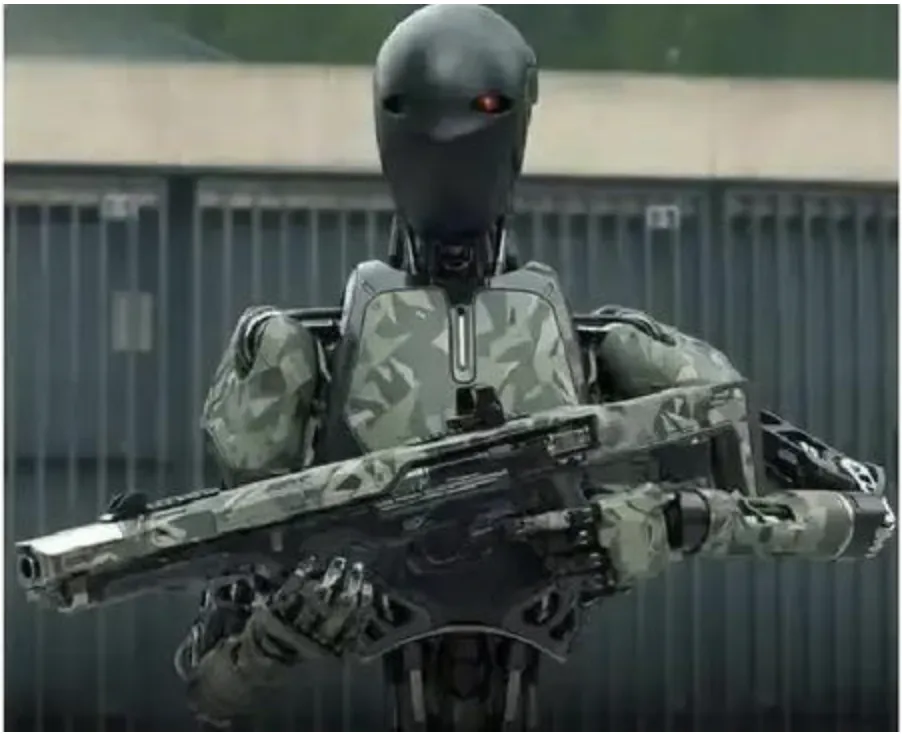
Researchers at the National University of Defense Technology's Xi'an training base outlined one vision for that future last August in a paper describing humanoid robots taking part in urban combat: six "combat robots," a mix of humanoid units, robot dogs and unmanned vehicles, assigned to two assault teams working alongside ground troops to clear an enemy-held building floor by floor and room by room.
This year, on the PLA's August 1 founding anniversary, CCTV's flagship evening news broadcast rarely aired a few seconds of footage showing the military testing humanoid robot soldiers. Days later, after Beijing hosted the World Humanoid Robot Games from August 22 to 26, the PLA's own newspaper published a commentary calling for accelerating "smart equipment" so that robots developed in laboratories could become genuine "fighters" capable of winning battles.
The core bottleneck for humanoid robots is that so-called embodied intelligence requires enormous amounts of real-world data to train. A machine has to do more than recognize what an object is; it needs to know how to approach it, grip it, climb over an obstacle, or judge whether a given surface can even be crossed. Camera data lets the machine "see," radar data lets it "sense" its surroundings, and motion data teaches it how to move. Combined with an AI model, what the military is really building is not a single robot but an entire training infrastructure aimed at battlefield conditions.

Why Humanoid Design Makes Sense For Combat
Stairs, doorknobs, windows, narrow corridors, vehicle cockpits and underground tunnels are all spaces built for humans. The theoretical advantage of a humanoid robot is that it can use environments and tools already designed for people, without a military having to redesign the battlefield itself. If a future conflict in the Taiwan Strait were to unfold in a heavily urbanized battlespace, buildings, underground facilities, ports, airports and industrial sites could all become contested ground, terrain that often poses natural limits for wheeled or tracked unmanned vehicles. A humanoid robot, by contrast, could use its legs to climb over obstacles and its hands to open doors, scale structures or carry equipment.
Humanoid robots still face serious constraints on endurance, reliability, balance, environmental perception and autonomous decision making, and Reuters has reported there is no evidence China has formally deployed armed humanoid robots to PLA combat units. What robots are most likely to take over first isn't necessarily the infantry's job, but the missions considered too dangerous or too low-value to risk a soldier's life on: searching enemy buildings, crossing exposed terrain, conducting reconnaissance, hauling ammunition and supplies, disposing of explosives, or operating in contaminated or otherwise high-risk environments. That mirrors a pattern already visible in the Russia-Ukraine war, where battlefields have shifted away from manned platforms toward heavy reliance on unmanned systems, drones for reconnaissance, targeting and strikes, unmanned vehicles for transport and casualty evacuation, and artificial intelligence increasingly built into navigation, identification and decision-making.
From Remote Control To Eventual Autonomy
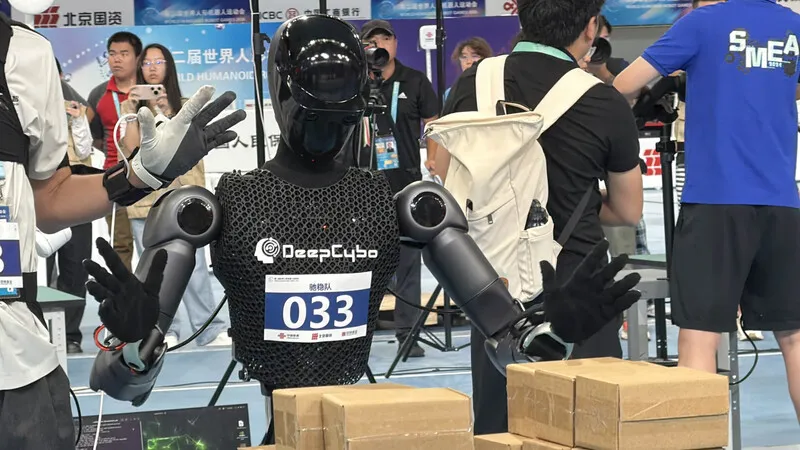
China North Industries Group has shown off a humanoid robot called Fuxi that it describes as capable of sentry duty, all-weather reconnaissance, smart patrols and dangerous missions, paired with a teleoperation system that lets a human operator control it remotely. Letting a machine make fully autonomous decisions raises a tangle of problems around AI reliability, communications, misjudgment and the laws of war. Keeping a human operator in the loop from a safe distance sidesteps some of that: the robot itself only has to handle movement, sensing and execution, which lowers the technical bar considerably.
That approach has its own vulnerability. In a high-intensity conflict, satellites, navigation systems, radios and data links are all likely targets for electronic warfare. A robot that depends on a stable communications link to function loses much of its battlefield value the moment that link is jammed or severed.
Based on what is publicly known, China still appears to be some distance away from fielding humanoid robots at scale in its armed forces. In AI and robotics, the most time-consuming part of the process is rarely building the first working prototype; it's accumulating enough data, building out training pipelines, validating the technology across different battlefield scenarios, and finally folding it into the military's existing systems.