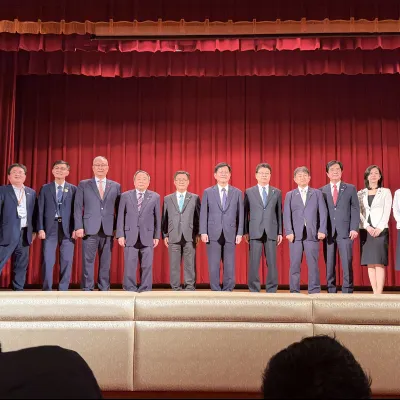
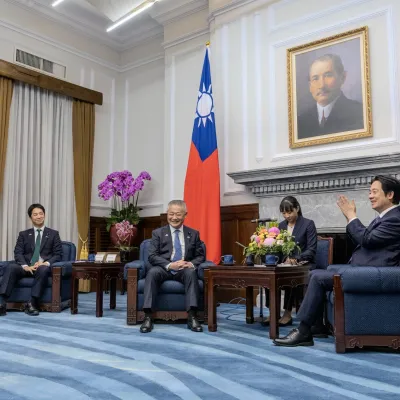
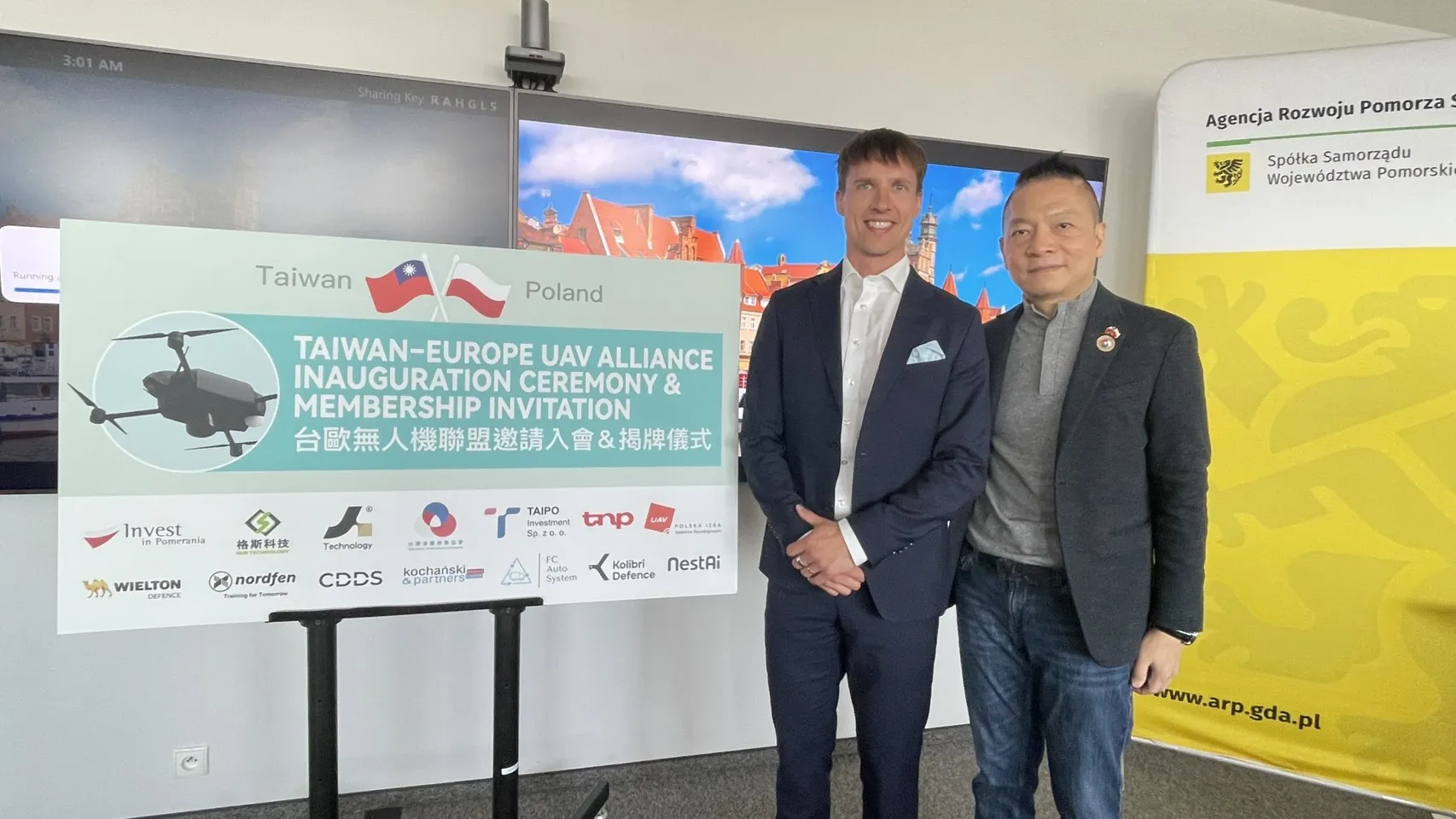
Taiwan Chiayi County Magistrate Weng Chang-liang led a Taiwanese business delegation to Poland and signed a memorandum of understanding with Invest in Pomerania on September 7, with the agency's director Katarzyna Matuszak, before witnessing the formal inauguration of the Taiwan-Europe UAV Alliance at an industry matchmaking event in Gdańsk the following day.
The alliance was organized by the Taiwan-Poland Chamber of Commerce(TAIPO) and brought together Taiwanese drone manufacturers, academics, and county officials for meetings with Polish investors and potential partners in Warsaw and Gdańsk.
Companies in the delegation included Thunder Tiger Group, AerosoarX Technology, Taiwan Swarm Innovation, and Taiwan UAV. Scholars from National Chung Cheng University and the Smart Machinery and Intelligent Manufacturing Research Center at National Formosa University also participated.
TAIPO: The Thread That Keeps The Relationship From Fraying
In an exclusive interview with Storm Media after the alliance's inauguration, Weng described the MOU as broadly scoped, covering not only drones but also agricultural products and niche industries. "Including agricultural products and various niche areas: there are possibilities for cooperation across all of them," he said.
He singled out TAIPO's role as the linchpin of the relationship: "Through this kind of interaction and TAIPO's presence, for the future prosperity of Chiayi and Poland, we look at opportunities ahead, whether in agriculture, tourism, industry, or drone development."
In his view, the chamber's long-term presence in Taiwan is what ensures the bilateral relationship "will not be severed."

NT$6.859 Billion Park To Unite Taiwan's Scattered Drone Industry
Taiwan's drone industry is currently dispersed across the island: more than 150 companies, including supply chain firms, operate in the north, around 50 in central Taiwan, and about 30 in the south, with the supply chain still expanding. The Chiayi hub is designed to pull that fragmented ecosystem into a single gravitational center.
Weng disclosed that Chiayi is preparing to break ground next month on the Minxiong Aerospace and Drone Industrial Park, a 50-hectare development led by the National Chung-Shan Institute of Science and Technology, with groundbreaking originally held during former President Tsai Ing-wen's term.
The park is divided into eastern and western zones. The eastern section, focused on military-grade drone research and development, completed nearly three years of construction and officially opened this month. The western commercial zone, with a total development budget of NT$6.859 billion, is set for imminent groundbreaking, with tenant recruitment expected to begin in 2028.
More than 20 domestic and foreign firms have already expressed interest in setting up operations there, in a campus that will include a low-speed wind tunnel, an AI computing center, and a smart power grid.
Weng was candid that companies joining the park would not necessarily shutter their existing facilities. "A firm that moves to Chiayi from Taoyuan won't close its Taoyuan operation, same goes for those in Taichung," he said, drawing a parallel with Taiwan's semiconductor sector, which thrives through distributed nodes rather than concentration in one place.
"It won't only be Chiayi in the future: Chiayi will be the center, but all of Taiwan will develop together."
The county also hosts the Asia Drone AI Innovation and Application Research Center, where more than 60 government, academic, and research institutions have set up operations and delegations from 36 countries have visited.

TAIPO Chair Predicts Real Deals In 2026 And 2027
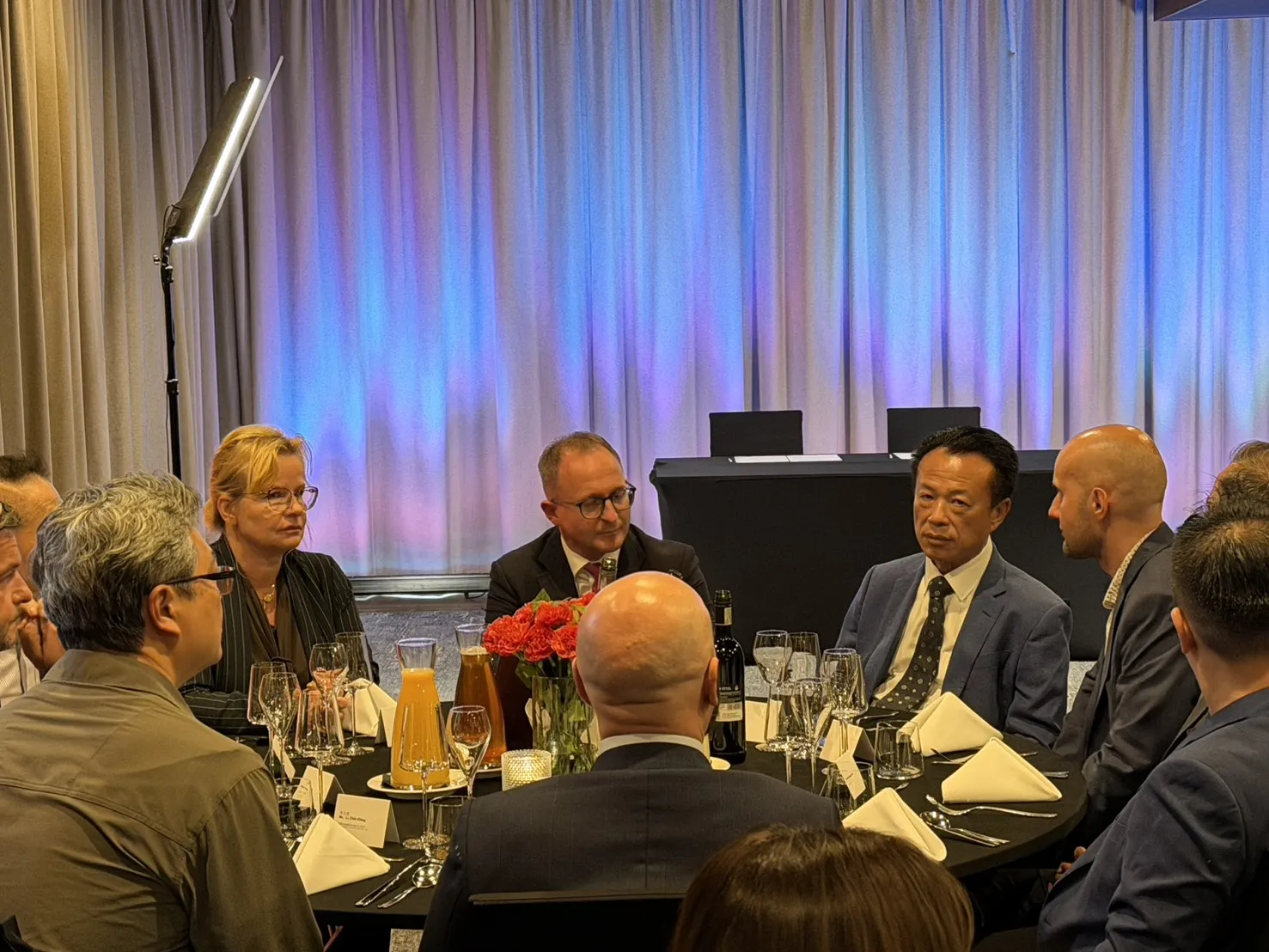
TAIPO Chairman Chao Chung-chieh, the primary architect of the alliance's inauguration, spoke to local Polish media on September 8 about the chamber's strategy, with Gdańsk identified as the priority focus for the current push.
"The most important thing is that both sides must build mutual trust and mutual understanding," he said, framing TAIPO's role as a "facilitator," one that creates the conditions for Taiwanese companies to form genuine connections with Polish investors rather than acting as a dealmaker itself.
Chao was candid about the limitations of government-driven commercial models in Taiwan, arguing that G2B (government-to-business) frameworks are difficult to sustain and that B2B cooperation, built incrementally, is the more reliable route.
After multiple TAIPO-organized events, he said confidence has grown on both sides. "Both sides can work together. I believe that in 2026 and 2027, we will see real results."
Defense Cooperation Already Underway At Component Level
When asked whether the MOU touched on defense procurement, Weng was direct: "Defense procurement cannot be handled at the county level, but defense cooperation between Poland and Taiwan has essentially already begun."
He noted that collaboration on drone components is already underway and will only deepen. The driver, he said, is geopolitics. "The countries surrounding Russia all need drones, and they need them in very large quantities, including the Baltic states, and many parts of the Middle East, where instability is severe."
He framed surging global demand as a strategic opening Taiwan cannot afford to miss: expanding the drone market through world demand is "a very important path forward."
At the same time, he drew a firm line on jurisdiction: "Anything involving defense naturally falls under the central government's purview: it is not a matter for local government."
From Alliance To Orders: Chiayi's Gateway Ambition
Running parallel to the Taiwan-Europe UAV Alliance is a new Taiwan-Poland AI Robotics Alliance, extending the cooperation framework into broader robotics and automation. Together, the two initiatives signal an ambition that reaches well beyond drone hardware.
Weng's answers in Poland sketched a dual positioning for Chiayi: a physical manufacturing base on one hand, and a lever for local diplomacy on the other, using the MOU and TAIPO to connect Chiayi's drone strengths to the Polish and broader Central and Eastern European market.
Yet one question he did not answer directly was when concrete orders between Chiayi and Pomerania would materialize. The path from MOU to industrial reality is long, particularly where cross-border government procurement and regulatory certification are involved.
Chiayi is already Taiwan's national drone hub. Whether it becomes the country's true gateway into the European defense and commercial drone market, moving from "base" to "anchor," is the test that the next two years will have to answer.
Original Article in Chinese