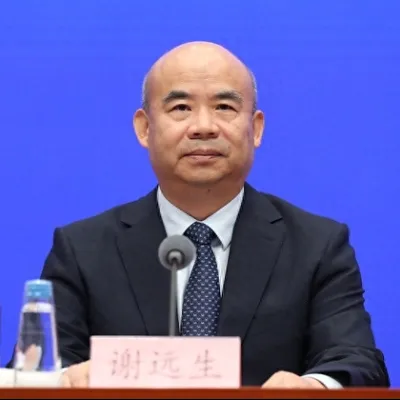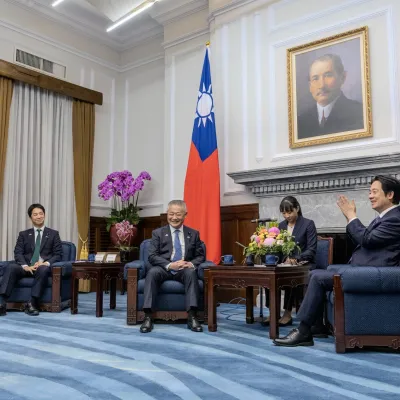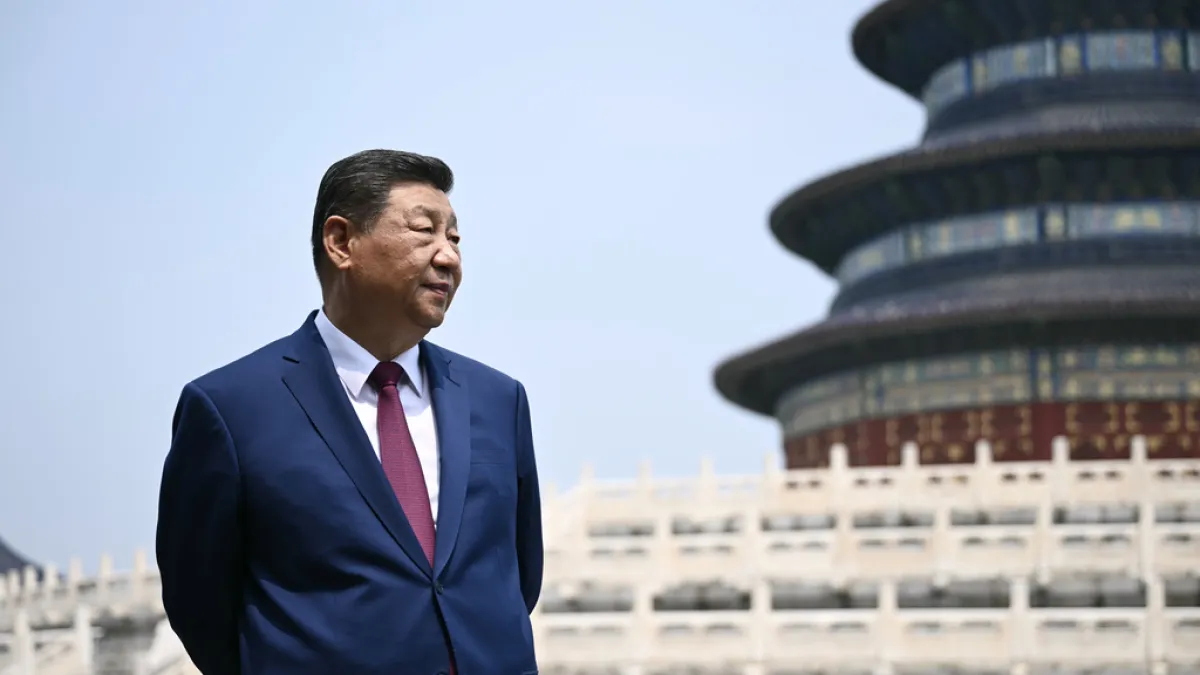
China's People's Political Consultative Daily, the official newspaper of the Chinese People's Political Consultative Conference, recently ran an essay by Xu Xiaoquan, a researcher at the Chinese Academy of Social Sciences' Institute of Taiwan Studies, titled "From Governance To Unification: Shaping The Overall Trend Of National Reunification In The New Era." Taken as a whole, the essay lays out three things Beijing is doing to bring about cross-strait unification, consolidating a one-China framework within the international community, punishing Taiwan independence activity through law, and stepping up law enforcement patrols in the waters east of Taiwan to assert sovereignty, converting sovereignty claims into concrete acts of jurisdiction under a framework the essay calls "governance leading to unification."
The People's Political Consultative Daily serves as the official mouthpiece of China's top political advisory body, while the Chinese Academy of Social Sciences functions as the country's top academic institution for philosophy and social sciences and a central think tank and ideological hub. Zhu Weidong, director of the academy's Institute of Taiwan Studies, previously floated a related concept known as "unification without unifying," which drew significant attention across the strait.
The new essay from the institute argues that as the mainland continues pushing forward the process of national reunification, its Taiwan policy has entered a new phase of proactively shaping the situation, shifting from an older approach of "unify first, govern later" toward "governing while unifying," continuously building toward what it calls the new normal of "governance leading to unification." Cross-strait relations, the essay argues, have now entered the historical stage closest to full national reunification since the Taiwan question first emerged, with the trend of governance serving as the core vehicle for translating sovereignty claims into jurisdiction that can actually be exercised on the ground.
According to the essay, Beijing plans to achieve cross-strait unification through three specific actions.
Consolidating A One China Framework Internationally
The essay argues that the United States has repeatedly stirred up the notion that "Taiwan's status is undetermined," using measures such as pro-Taiwan legislation, arms sales to Taiwan, and helping Taiwan expand its international space to challenge the authority of United Nations General Assembly Resolution 2758, heightening the risk of what it calls the "internationalization of the Taiwan question."
The essay also accuses Taiwan's ruling Democratic Progressive Party administration of actively cooperating with what it describes as a U.S.-led Western strategy to contain China, pushing what it calls the fallacious narrative of Taiwan independence and deliberately manufacturing a historical narrative sympathetic to Japan that denies the historical fact of Taiwan's restoration to China, in an effort to sever the legal basis for Taiwan belonging to China at its root.
To counter the risk of the Taiwan question becoming internationalized, the essay says, the mainland is proactively shaping and consolidating a one-China framework grounded in international law, embedding the one-China principle into the broader framework of upholding international order. In 2025, the mainland used the 80th anniversary of Taiwan's restoration as an opportunity to systematically lay out for the international community the historical context and legal basis behind Taiwan's return to China after World War II. At the same time, when signing bilateral agreements or issuing joint statements with other countries, the mainland has, where appropriate, incorporated language opposing Taiwan independence and supporting unification, pushing more countries to explicitly support what it frames as the Chinese people's cause of opposing Taiwan independence and completing national unification, continuously consolidating a one-China framework within the international community.
Punishing Taiwan Independence Through Law
The essay states that mainland China continues to build out a complete legal framework for "punishing Taiwan independence according to law," anchored in the constitution as its foundation, the Anti-Secession Law as its core, the criminal law and national security law as its pillars, targeted judicial guidance as its instrument, and disciplinary blacklists as its tool, arguing that the crackdown on Taiwan independence forces has shifted from policy statements to concrete action.
The essay points to the Law on the Promotion of Ethnic Unity and Progress of the People's Republic of China, which formally took effect on July 1 this year, as providing a solid legal basis that further rounds out this legal framework for punishing Taiwan independence.
Normalizing Patrols In The Waters East Of Taiwan
The essay says that this year, Fujian's coast guard has stepped up routine law enforcement patrols near the waters around Kinmen, organizing vessel formations to strengthen control over relevant waters. China's Ministry of Transport has carried out special maritime traffic law enforcement operations in the waters east of Taiwan, boosting its capacity for patrols and traffic control there. China Coast Guard formations have conducted routine law enforcement patrols in waters east of Taiwan, which the essay characterizes as lawful, while the research vessel Blue Sea 201 has carried out fishery resource surveys in the same waters, which the essay frames as a practical step to lawfully defend maritime rights and improve the coastal governance system.
The essay argues that "cracking down on Taiwan independence separatist forces according to law" and "concrete actions asserting sovereignty and regulating maritime governance" together mark the mainland's actual governance over Taiwan-related affairs becoming increasingly routine and institutionalized, representing an improvement in its substantive governing capacity over Taiwan. It repeats that cross-strait relations have now entered the historical stage closest to full national reunification since the Taiwan question first emerged, with the trend of governance serving as the core vehicle for turning sovereignty claims into jurisdiction that can be exercised on the ground.
The essay emphasizes that the "governance leading to unification" strategy shows that the Chinese Communist Party's overall approach to resolving the Taiwan question in the new era is not about replacing one measure with another, but about iterating and layering on top of previous Taiwan policy, reflecting a clear pattern of adapting and optimizing over time.