After lawmakers stripped every unmanned systems line item out of Taiwan's NT$1.25 trillion special defense budget, the Executive Yuan came back with a separate NT$210 billion drone budget of its own, while opposition parties pushed their own competing versions. The version that ultimately passed was the Kuomintang's NT$240 billion proposal. Jedidiah P. Royal, a former Principal Deputy Assistant Secretary of Defense for Indo-Pacific Security Affairs at the U.S. Department of War, said the outcome amounts to a single, not a home run, and voiced regret over the time and opportunity Taiwan has already lost.
Royal Says Two Clocks Are Ticking Over The Taiwan Strait
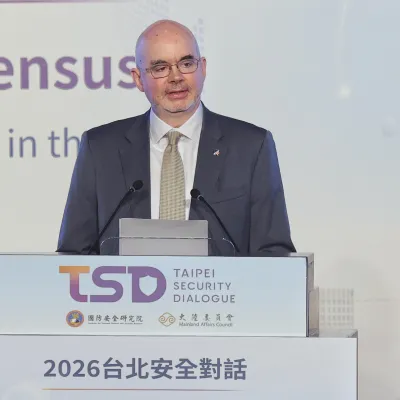
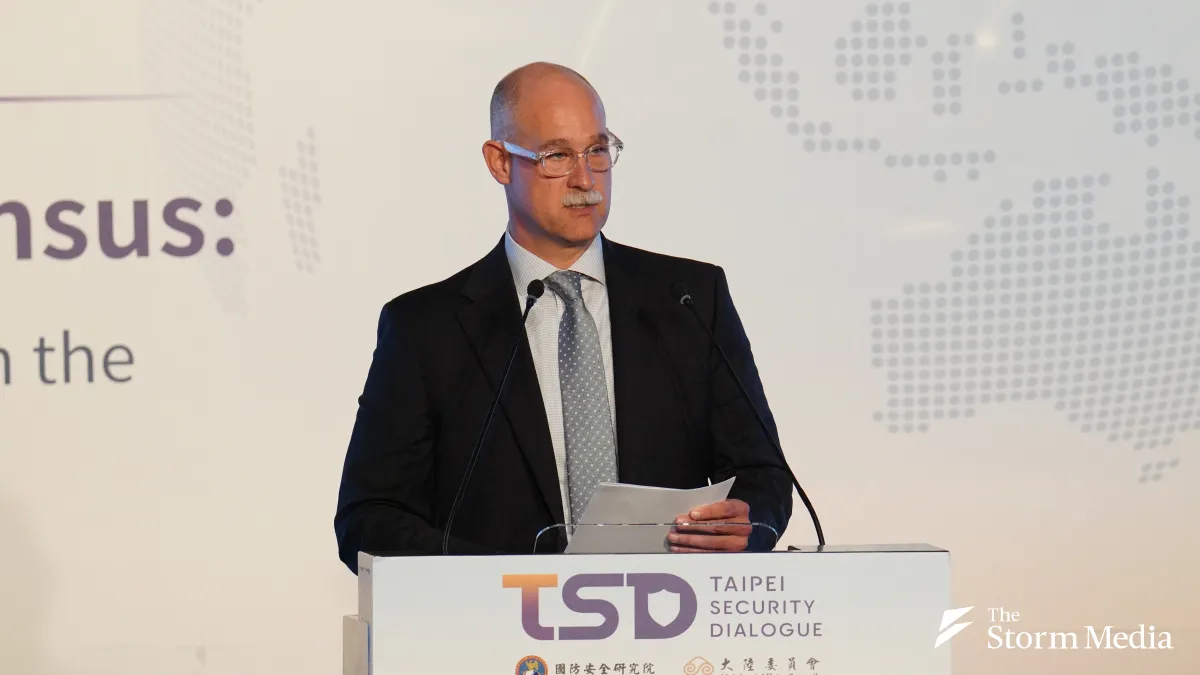
Royal delivered the keynote address at the 2026 Taipei Security Dialogue, hosted by the Institute for National Defense and Security Research (INDSR) on September 9. He said the region is being shaped by two clocks running at once. The first, he said, is the "threat clock," a fixture of discussion among China watchers worldwide. "We have all heard Xi Jinping himself speak to intentions and timelines tied to 2027, 2035 and 2049," Royal said, adding that the world has already seen, and continues to see, those directives translated into action by the People's Liberation Army, from threatening flights around Taiwan and live-fire drills to incursions inside Taiwan's 24-nautical-mile contiguous zone and rhetoric designed to intimidate and coerce.
Royal said that while Xi's stated intentions and the military activity tied to those dates do not mean conflict is inevitable, nor do they necessarily bind Beijing's future decisions, he is confident China has set a clear policy trajectory, one its national instruments of power are relentlessly executing in pursuit of strategic advantage over its neighbors, its peers, and the international system as it currently operates.
"In the final four years of my 25-year government career, I was responsible for defense policy across the Indo-Pacific, so I take Chairman Xi very seriously, and I take that threat clock very seriously. It is ticking," Royal said. "But it is not the only one. There is a second clock ticking as well, the delivery clock."
Royal Says The Second Clock Can Still Be Accelerated
Royal explained that as the threat clock counts down toward greater danger, the delivery clock moves in the opposite direction, toward deterrence and stability. As the threat clock burns through available time, he said, the delivery clock can buy that time back, pushing off the worst-case scenario and lowering overall risk.
"The second clock is one we have the power to accelerate. We can bend time toward our shared interests, but only if we stay focused and act with everything we have. We have the chance to do this, but it will take more than what we have put in so far," he said.
Royal said he does not believe Taiwan and its partners are fully on the right track yet, and that more work remains, particularly in a few critical areas. Chief among them, he said, is that Taiwan must put forward a budget and a plan sufficient to rapidly scale up domestic drone production. "Twelve months ago, when I was still at the Pentagon, I assumed this would already be finished, and that progress would be far beyond where it stands today," he said.
Royal Calls The New Drone Budget A Single Not A Home Run
Royal said the recently announced NT$240 billion drone budget is certainly welcome, but for many observers who share his view, it still falls short of what had originally been expected. "This budget announcement is a single, not a home run," he said. The biggest opportunity for future deterrence, he added, will hinge on whether reliable, networked and rapidly responsive unmanned systems can be fielded within the command and control layers that sit behind the front lines.
Even though unmanned systems alone cannot deliver deterrence or defense on their own, Royal cautioned that Taiwan's current inventory of conventional manned and regular weapon systems, including those already scheduled for delivery, will over time fall short of future requirements. That is because the People's Liberation Army continues to pour resources into increasingly advanced and intelligent technology, steadily expanding its arsenal's reach, speed and lethality.
Royal Regrets Lost Time As Taiwan's Domestic Drone Industry Waits
Royal said that watching the domestic politics behind this debate unfold, he feels regret over the time and opportunity already lost. Taiwan, he said, is fully capable of becoming a major supplier of high-quality drones, with products spanning multiple domains of warfare, all built on a supply chain free of Chinese components. He said he believes Taiwan is moving in that direction, but that failing to quickly reach consensus on a strong budget and execution plan has already weakened that opportunity and given other countries more room to advance competing programs of their own.
Royal said he strongly encourages Taiwan's legislature to act, pushing for a larger-scale domestic drone defense program while broadly raising the overall defense budget and directing more spending toward the key systems that matter most. In practical terms, he said, that spending is what buys time.