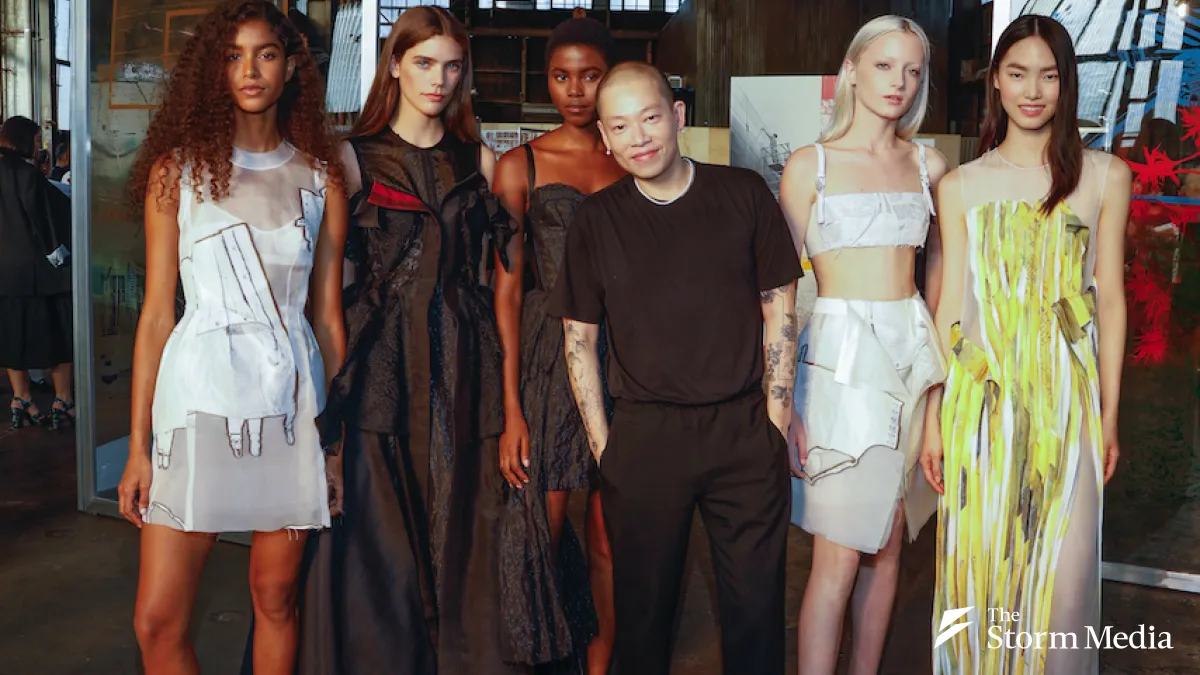
For nearly two decades, Jason Wu's name has been synonymous with precision. Clean lines, considered proportions, garments finished to an exacting standard — this was the vocabulary that built one of Taiwan's most internationally recognized fashion brands. But for a new collection created in collaboration with the Robert Rauschenberg Foundation, Wu set aside the sketchbook and stood at the mannequin with his hands.
"Put a little, look a little," he says, describing the method. "Put a little more, then look again. Come back tomorrow and look one more time." For a designer accustomed to the controlled choreography of a fully developed pattern, it was something close to relearning.
Rauschenberg's Archive Changes His Eye
Robert Rauschenberg — the postwar American artist who dismantled the boundaries between painting, sculpture, photography, and everyday objects — had been on Wu's radar for more than a decade. His "Combines" series, where canvas became a field for newspaper, fabric, metal scraps, and photographs, proposed that no material held a fixed rank, and that accident was not something to be erased but listened to.
When the Rauschenberg Foundation approached Wu about a collaboration, he entered the artist's archive and spent time moving through hundreds of pages of work. He stopped at the textile experiments of the early-to-mid 1970s — particularly the "Hoarfrost" series from 1974 to 1976 and the 1974 "Airport Suite." The attraction, he says, was immediate: "It was very instinctual. Like love at first sight. The frequency matched."
Analysis was present, of course — years of professional experience don't disappear. But design, Wu says, still needs to begin somewhere sensory: "Design still has to be made from feeling."
Precision Makes Room for Raw Edges
The tension between Wu's methods and Rauschenberg's was real, and productive. Where Wu has historically sought control — measured, refined, tightly resolved — Rauschenberg's practice honored collision, the unresolved, the marks that materials leave on each other. To let those two approaches actually meet, Wu had to allow things into his garments that had rarely appeared there before.
Raw edges stayed raw. Fabrics of wildly different weights and textures were layered into the same piece. Some works were built from as many as 10 to 20 distinct materials. "There had to be collision," Wu says.
More fundamentally, the making process itself changed. Rather than following a sketch through pattern to construction, many pieces were developed directly on the mannequin — cloth placed, studied, removed, added to. Returning to the studio the next morning, he would reassess everything the previous day had left behind.
"Is it finished enough?" The question ran through the entire project. Without a fixed endpoint defined by technical completion, Wu had to develop a different kind of judgment — when to add, when to stop, when to leave the edge unstitched. "Should the raw edge be trimmed? Should the collage go further? Does what worked yesterday still work today?" The Rauschenberg Foundation gave him unusual latitude; the foundation did not see the finished pieces until they were presented. Every decision came back to him.
For a designer who had spent years building a recognizable standard, this kind of deliberate uncertainty brought a new kind of energy. Loosening precision, it turned out, was not a loss of identity but an extension of it.
The Exhibition That Brought Work Home
The collection was shown at TAO ART in Taipei — and for Wu, the gallery context changed how the work could be encountered. On the runway, a look passes in seconds; what registers first is silhouette, proportion, and atmosphere. In a gallery, a viewer can step close enough to see how fabrics were joined, how edges were left, how different surfaces overlap, and then step back to watch the garments and Rauschenberg's works act on each other across the room.
"The perspective is very different," Wu says. He describes the relationship between the two bodies of work in that space as two people sitting across from each other — Rauschenberg on one side, the garments on the other.
For Wu, bringing the work to Taipei also carried a more personal weight. His career has been built largely through the American and European fashion systems; many people in Taiwan know his name and his story, but few have stood in front of his work. "A lot of young people might know my name, know my story — but they haven't seen my work."
This time, he wanted the work to be seen. Especially by family. His children know what "Jason Wu" means; they've watched him draw, seen him handle garments at home. But standing in a room of completed pieces is something different. His parents — older now and less able to travel easily to New York or Paris — could encounter this work close to home for the first time. "Work that used to be scattered across New York, Paris, and other cities," he says, "has come back to Taipei, and in doing so, come closer to my family."
Looking Back at Asia After Two Decades Away
Wu describes his next twenty years with a single word: evolution. "The world has changed, so my work has to change too." Style requires a recognizable identity — but identity sustained only by familiar silhouettes eventually becomes self-repetition. As a designer moves through different phases of life, the way they see women, beauty, craft, and culture shifts. The work has to follow.
He is also looking back at where he came from. "When I was young, I always looked outward," he says. Paris, New York, London — for a generation of Asian creatives entering Western fashion in the early 2000s, these were the centers of gravity. Entry required adoption into those systems, not an assertion of origin.
Now, approaching the midpoint of his career, his gaze has turned. "I'm particularly interested in my own culture, in Chinese things — and I'm afraid these things might disappear." He wants his children to look carefully at Taiwan, South Korea, and other Asian cities, and to understand their own relationship to these cultures.
The shift is being met by the world in kind. Korean pop culture, music, film, and fashion have reshaped global markets; Asian faces appear with increasing frequency in international campaigns and editorial. Wu has watched this change from inside the American fashion industry for nearly twenty years — from the era of being seen, to the beginning of active cultural output. Having spent his youth looking outward, he is now looking back with a clearer sense of where he began.
His interests now extend into film, performing arts, art history, fashion history, architecture, and space. "The boundaries," he says, "are slowly opening."
At the center of it all, though, is the simplest image: a designer with a mature brand, a clear aesthetic, and international recognition, standing in front of a mannequin, placing a piece of cloth, stepping back, looking, adding a little more — then coming back the next day and starting again.
Twenty years ago, Wu entered this industry because he loved making clothes. Twenty years later, that is what he returned to — the fabric, his hands, and the reason he became a designer in the first place. "For me," he says, "this was pretty exhilarating." (Related: 1% Profile | Takahide Komatsu Paints Butterflies Against Time | Latest )