Taiwanese entertainer Wuxiong (五熊) has been fined and released by Japanese authorities after prosecutors in Nara indicted her for pouring liquid on a 1,200 year old national treasure at Yakushiji Temple, closing out a case that began in April with a bizarre confession and weeks of online detective work linking her to the crime.
A Fine And A Public Apology Close Out The Case
Japan's public broadcaster NHK and Kyodo News reported on September 3 that the Nara District Public Prosecutors Office had indicted Wuxiong, whose legal name is Tsai Yi-chen (蔡宜臻), through summary proceedings for violating the Cultural Properties Protection Act. The Nara Summary Court issued its judgment the same day, ordering a fine of 500,000 yen, roughly NT$100,000. She paid the fine and was released shortly after. Wuxiong confirmed the outcome herself, posting matching statements in Chinese and Japanese on social media in which she apologized to Japan and to Yakushiji Temple, acknowledged she had no excuse for what she called her own ignorance, and promised "I will not do this again."
A Bizarre Ritual Explains The April Incident
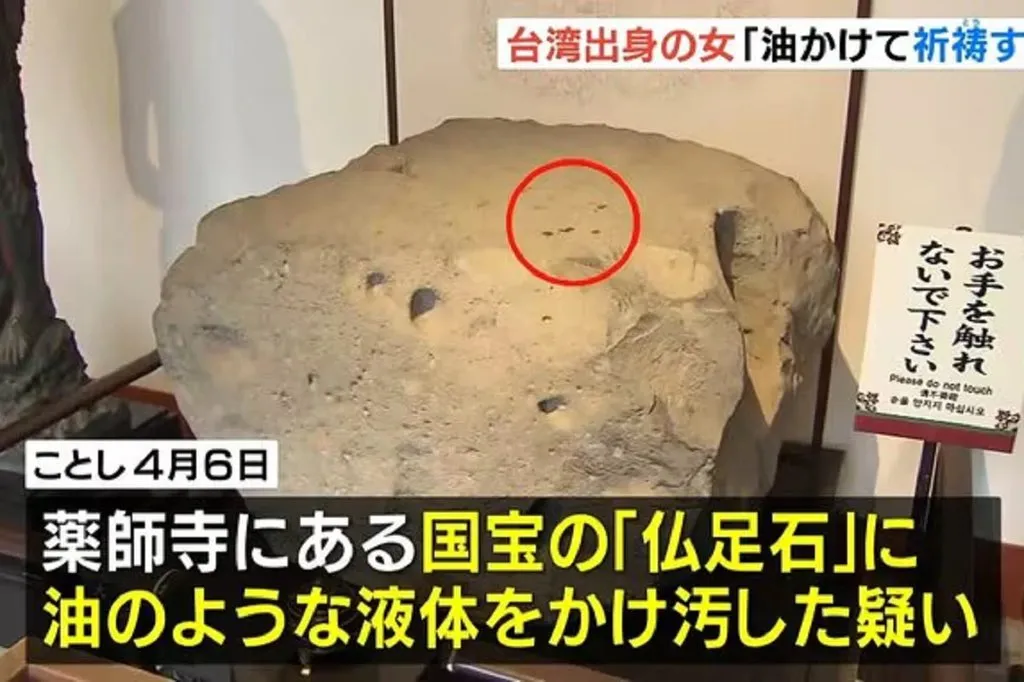
The case traces back to April 6, when a woman entered the lecture hall at Yakushiji Temple in Nara and poured a liquid later found to contain glycerin onto the temple's Buddha Footprint Stone, a carved stone bearing the imprint of Buddha's feet that is more than 1,200 years old and among the oldest of its kind in Japan. Temple staff noticed stains that would not clean off and alerted police, who traced the glycerin residue and eventually identified a suspect, though the case stalled for months. It broke open on August 22, when the woman flew back into Japan and was arrested by Nara prefectural police at Kansai International Airport. According to investigators, she admitted to the act and explained that she has a habit of "pouring oil in prayer" over things that move her emotionally, saying she believed she had done the same to the stone. She also told police she had done something similar at other sites during past trips to Japan, prompting authorities to review whether other cultural properties had been damaged in the same way.
How Internet Sleuths Connected The Dots To A TV Personality
Japanese outlets did not name the suspect as a celebrity, but the details they did release, a 39 year old Taiwanese woman working in what she described as the "hosting" industry, named Tsai Yi-chen, arrested after a trip to Japan earlier in the year, closely matched the public profile of Wuxiong, whose legal name is also Tsai Yi-chen and who has hosted variety, travel and cooking programs in Taiwan since being discovered on a talent show. Taiwanese social media users noted that Wuxiong had posted about a trip to Japan in April, the same month the incident occurred, and the overlapping details quickly drew her name into the story. Neither Japanese police nor Japanese media formally confirmed that the suspect was the celebrity, and Wuxiong did not immediately confirm or deny it, though her management agency issued a statement on August 24 saying only that "the matter is currently under investigation by the relevant authorities in Japan" and that it could not reach her directly, an indirect acknowledgment that fueled further speculation at the time.
A Backstory Of Faith And A Falling Out
The suspect's account of "pouring oil in prayer" also revived attention on Wuxiong's own Christian faith, which she has spoken about publicly for years, including thanking God on stage after winning a Golden Bell Award in 2015. Some Christian traditions do involve anointing with oil as a form of blessing or prayer, but that practice has no established connection to damaging public cultural property, and commentators in Taiwan were careful to note that a shared religious background does not amount to evidence in the case. Separately, a livestreamer who said she had once served alongside Wuxiong and her husband at a church came forward publicly to describe a falling out over disagreements about religious practices within their former group, saying she was "not at all surprised" by the news. Those claims are one-sided and have not been addressed by Wuxiong or her husband, and remain a separate matter from the criminal case itself.

What Japan's Cultural Property Law Says About The Penalty
Because the Buddha Footprint Stone is a designated national treasure, the case carried far more legal weight than an ordinary vandalism complaint. Japan's Cultural Properties Protection Act allows for penalties of up to five years imprisonment or a fine of up to 1 million yen for damaging, abandoning or concealing important cultural property. In the end, prosecutors pursued the lesser route of summary indictment, resulting in the 500,000 yen fine rather than a prison sentence, a resolution that reflects factors such as the extent of the damage, whether it can be repaired and the degree of intent involved. In her apology, Wuxiong wrote that she had cooperated fully with Japanese investigators and had come to understand that regardless of her original intentions, she should have taken more care to learn about the culture, history and laws of the country she was visiting, especially around a site of such historical and cultural significance.
(Related:
Fire Guts A Historic Hall At Taipei's Zhinan Temple, A Landmark Older Than Modern Taiwan
|
Latest
)