The semiconductor equipment industry is on course for a historic surge, with SEMI projecting the global wafer fab equipment market will reach $220 billion by 2028 — a $20 billion upgrade from a forecast made just months ago and nearly double 2025 levels.
SEMI previewed its September market outlook on August 31, on the eve of SEMICON Taiwan 2026, revising its 2028 Wafer Fab Equipment (WFE) estimate upward from $200 billion to $220 billion. The driver is not the smartphone or PC recovery that typically fuels industry upturns, but a structural surge in AI infrastructure spending.
2nm and 3nm Expansion, HBM Investment Drive Upward Revision
SEMI Senior Director of Industry Research Clark Tseng cited three factors behind the upgrade: leading chipmakers are expanding 2-nanometer and 3-nanometer capacity faster than expected; AI accelerators are pushing high-bandwidth memory (HBM) demand to record levels, lifting DRAM investment along with it; and growing AI inference workloads are driving enterprise SSD and high-layer NAND Flash demand.
The WFE market stood at $117 billion in 2025. A rise to $220 billion by 2028 would nearly double it in three years.
Tseng noted that the macro backdrop remains weak: global GDP growth in 2026 is projected at 2.2%, PC and smartphone shipments are still under pressure, and rising memory prices are squeezing consumer electronics margins. The chip industry's sharp divergence from these conditions shows how completely AI has decoupled advanced semiconductor investment from traditional cyclical patterns.
AI Chips Demand More Testing and Costlier Packaging
The revisions reach beyond the fab floor. SEMI now puts the 2028 global test equipment market at $23.5 billion, up from a prior estimate of $20.8 billion, and assembly and packaging equipment at $10 billion, up from $8.6 billion.
Tseng explained that high-end AI chips require more test points and longer test times than conventional devices. HBM stacks — integrating logic dies with multiple memory layers — demand more rigorous functional, performance, and reliability verification. As chiplet, 2.5D IC, and 3D IC architectures become the norm, packaging has evolved from a final production step into a core system design discipline governing bandwidth, power consumption, and thermal management.
Taiwan's major outsourced semiconductor assembly and test firms have already raised capital expenditure guidance, with probe card makers, packaging equipment suppliers, and wet process vendors all reporting stronger orders. Tseng's broader point: not only are volumes rising, but the testing and packaging value embedded in each AI chip is increasing — making back-end processes an indispensable part of mass production.
SEMI projects the global semiconductor materials market will grow from roughly $83 billion in 2026 to $92 billion in 2027, delivering back-to-back double-digit growth — historically rare in a sector known for cyclical swings. Taiwan alone is expected to account for $28 billion of that 2027 total, or about 30% of global demand, the largest share of any single market for both front-end wafer fabrication and back-end packaging materials.
Tseng cautioned that capturing this growth is not automatic. Advanced process nodes demand higher purity, greater stability, and tighter batch consistency. Advanced packaging is adding demand for substrates, specialty chemicals, and encapsulants. Whether Taiwan suppliers can clear customer qualification hurdles and sustain quality at scale will determine how much of the expansion converts into higher-margin business.
"AI-related demand has pushed the global semiconductor market onto a higher growth trajectory, but this is not broad-based growth," Tseng said. "Current expansion is concentrated in high-end computing, HBM, and data center applications. Taiwan's advantage lies not in any single technology or platform, but in the depth and integration of its advanced process, advanced packaging, equipment components, and materials ecosystem."
SEMICON Taiwan 2026 Opens With Record Exhibitor Count
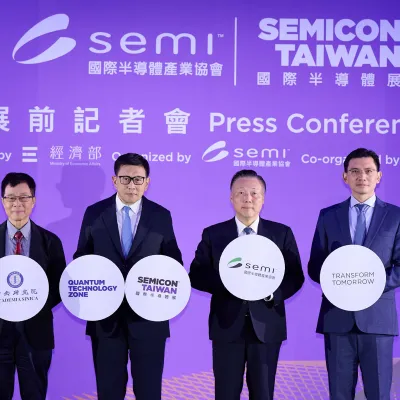
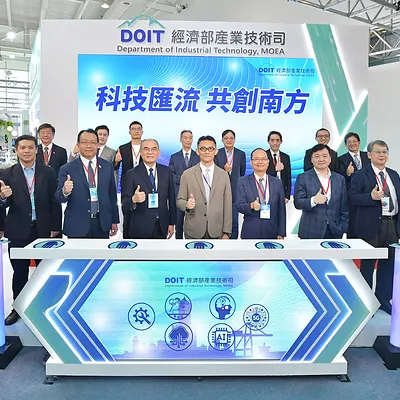
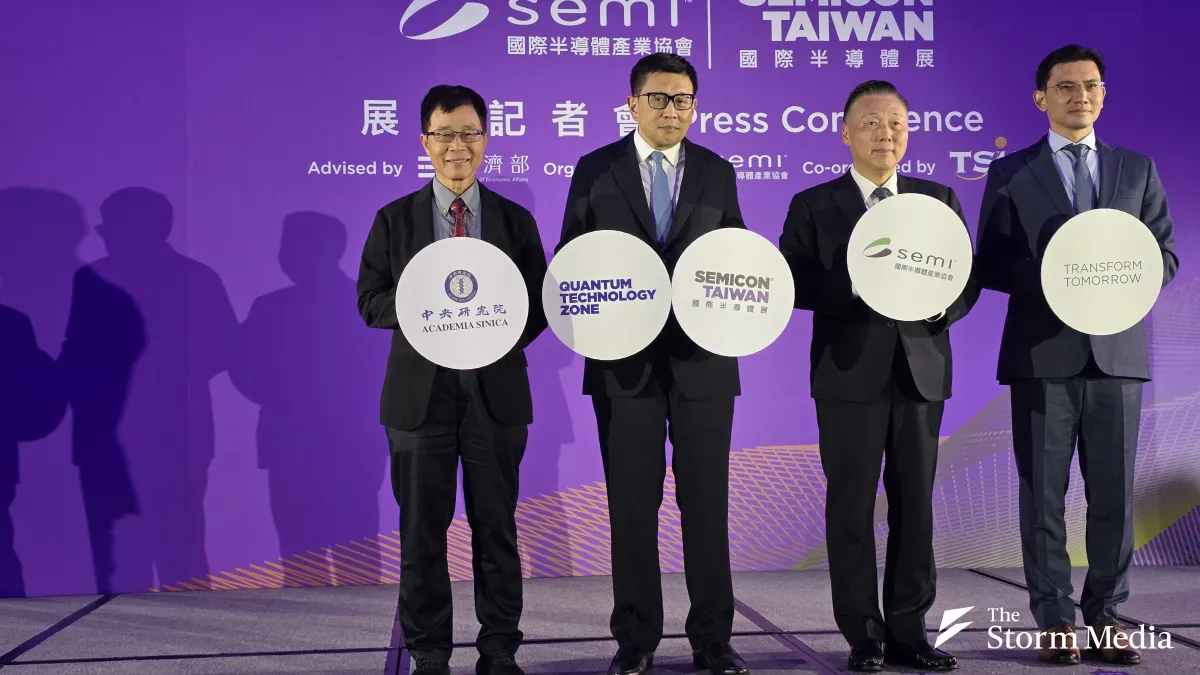
SEMICON Taiwan 2026, which kicked off with the August 31 press conference, is being held at Nangang Exhibition Center's Hall 1 and Hall 2 under the theme "Transform Tomorrow." The event is expected to draw more than 100,000 participants from 65 countries, with over 1,300 companies filling more than 4,300 booths across 18 national pavilions.
SEMI Global Chief Marketing Officer and Taiwan President Terry Tsao said the exhibition is designed to present a complete AI end-to-end supply chain — from cloud service providers and IC design through wafer foundry, memory, packaging and testing, to equipment, materials, server systems, and power management.
The program spans 15 themes — from AI compute and silicon photonics to quantum technology and semiconductor cybersecurity — with more than 50 international forums and over 200 industry leaders on the schedule. New this year are dedicated zones for quantum technology, intelligent wafer manufacturing, and chiplet design. A first-ever closed-door SEMI Venture Day in the Chip Startup Zone will connect semiconductor startups with global investors, in partnership with U.S.-based incubator Silicon Catalyst.
Tsao said AI is redrawing the rules of semiconductor competition and pushing global supply chains toward deeper collaboration. "Taiwan's critical value lies in its ability to connect chip design, advanced processes, intelligent manufacturing, heterogeneous integration, and system applications into a complete ecosystem," he said, "and to capture the growth as AI investment spreads from chips into equipment, packaging, and materials."